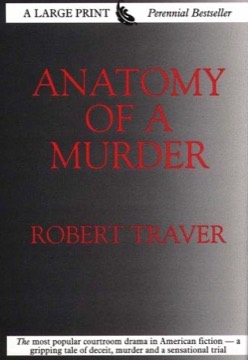
Anatomy of a Murder
Robert Traver's 1958 novel about a small-town Michigan lawyer defending an army lieutenant who shot the man he believed had raped his wife. Written by a serving state supreme court justice.
- First published
- 1958
- Publisher
- ImPress Mystery
- Pages
- 437
- Shelf
- Thriller
- Level
- Core
- ISBN-13
- 9780312912789
Record checked against
Only one source carried a publication date for this work, so the year is uncorroborated.
Catalogue note
- Reads as
- ReflectiveChanges how you see rather than what you do.
- Level
- Core / BuildingAssumes general familiarity with the subject.
- Approach
- Theoretical
- Written for
- Readers who mean to stop at one more chapter, Readers with some grounding
Saved in this browser only — no account, nothing sent anywhere. My library
Read this if
- You want to be kept up late, and made uneasy about who to believe.
- You want to think harder about what is actually right.
- You want a book that changes how you see things rather than what you do tomorrow.
- You know roughly how the subject works and want the fuller account.
The premise
Paul Biegler, a former county prosecutor now practising alone and fishing more than he works, is asked to defend Lieutenant Frederick Manion. Manion shot a bar owner dead in front of witnesses and does not deny it.
His wife says the man raped her. The question is not what happened but whether any available legal defence fits it, and the novel is honest that this is the actual work.
He admits the shooting. The entire case is about finding a defence that the facts will support.
Devmark’s reading — not a quotation from the book
Written from inside
Robert Traver was the pen name of John D. Voelker, a Michigan Supreme Court justice who had been a county prosecutor, and the novel is based on a case he defended.
The authority is total. Procedure, evidentiary rules, jury selection and the relationship between a judge and counsel are all rendered by someone who did the work for decades.
The defence
Biegler leads his client toward irresistible impulse without telling him what to say, in a scene that has been taught in law schools as an illustration of the ethical line.
The passage is the novel's most famous and most valuable: it shows exactly how a lawyer can shape testimony without suborning perjury, and it is uncomfortable precisely because nothing improper occurs.
Ambiguity maintained
The novel never establishes whether the rape occurred, whether the wife is truthful, or whether Manion was genuinely dissociated.
Traver refuses to resolve any of it. The reader finishes without knowing what happened, which is the position a jury is actually in and which almost no courtroom fiction reproduces.
Laura Manion
The wife is flirtatious, unreliable in her account, and treated by everyone around her as a problem to be managed.
The novel is unusually clear-eyed about how a rape complainant's behaviour is used against her, and about the fact that this happens regardless of whether she is telling the truth.
Small-town Michigan
The Upper Peninsula setting is rendered specifically: the iron towns, the fishing, the drinking, the relationships between people who have known each other for decades.
Voelker loved the region and wrote about it separately, and the sense of place is what distinguishes the novel from a procedural transcript.
Pace
It is long and deliberately unhurried, with extended passages on preparation, research and Biegler's fishing.
The leisure is the point. The novel is interested in a trial as months of work rather than as a few days of performance, and readers wanting only the courtroom will find a great deal of other material.
The trial
The courtroom sections occupy roughly the final half and are conducted at close to real time, with objections, sidebars and rulings included rather than summarised.
The fidelity is unusual and is the reason the book is still read: it is probably the most accurate depiction of an American criminal trial in popular fiction.
Frankness
The novel was notable in 1958 for using explicit clinical language about the alleged rape in court, which was necessary to the case and was controversial.
Traver's position is that a trial requires precise language, and the discomfort of the courtroom scenes is deliberate and defensible.
Prose
Conversational, wry and occasionally sentimental, with Biegler narrating in a voice that is self-deprecating about his own competence.
The style is warmer than the subject and is what makes the length bearable, and the legal explanations never condescend. Voelker also writes fishing better than he writes anything else, and the digressions into the Upper Peninsula rivers are plainly where his own attention went.
The film
Otto Preminger's 1959 adaptation with James Stewart is faithful and is considered among the best courtroom films made, with a score by Duke Ellington.
The film preserves the ambiguity, which is unusual for an adaptation and is the principal reason it works. It was also filmed in the actual Upper Peninsula locations with Voelker's involvement, and several minor roles were taken by people connected to the original case.
Who it is for
Readers who want the legal process taken entirely seriously, and who are prepared for a novel that is genuinely about procedure.
It is the best courtroom novel in this section by a considerable margin, and it is slower than anything else here. Readers who want Grisham's momentum should be warned that this is the opposite.
What to take away
- 01Finding a defence the facts supportGuilt is not in question; the work is identifying which available legal argument the evidence can be made to fit.
- 02The ethical line demonstratedBiegler leads his client toward a defence without telling him what to say, and nothing improper occurs, which is why it is uncomfortable.
- 03A jury's actual positionThe novel never establishes what happened, leaving the reader where a juror genuinely stands.
- 04Written by a practitionerA state supreme court justice who had been a prosecutor supplies procedural authority that research cannot reproduce.
- 05A trial as months of workPreparation, research and the tedium around the courtroom occupy as much space as the hearing itself.
- 06Behaviour used against a complainantThe novel is clear that how the wife conducts herself is weighed regardless of whether her account is true.