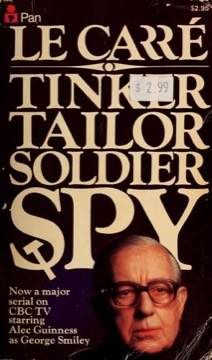
Tinker Tailor Soldier Spy
John le Carré's 1974 novel in which a disgraced intelligence officer is brought back to find a Soviet mole at the top of British intelligence. The book that made espionage fiction a literature of paperwork.
- First published
- 1974
- Publisher
- Hodder & Stoughton General Division
- Pages
- 369
- Shelf
- Thriller
- Level
- Core
- ISBN-13
- 9780340733950
Record checked against
Catalogue note
- Reads as
- ReflectiveChanges how you see rather than what you do.
- Level
- Core / BuildingAssumes general familiarity with the subject.
- Approach
- Theoretical
- Written for
- Readers who mean to stop at one more chapter, Readers with some grounding
Saved in this browser only — no account, nothing sent anywhere. My library
Read this if
- You want to be kept up late, and made uneasy about who to believe.
- You want to understand how power is taken, kept and lost.
- You want a book that changes how you see things rather than what you do tomorrow.
- You know roughly how the subject works and want the fuller account.
The premise
George Smiley has been forced out of the Circus, Britain's intelligence service, after an operation in Czechoslovakia went catastrophically wrong. He is retired, unhappily married, and largely forgotten.
He is then quietly asked to investigate a claim that one of the four men now running the service is a Soviet agent of long standing. He cannot use the Circus to do it, because the Circus is the thing under suspicion.
The detective cannot use the police, because the police are the case.
Devmark’s reading — not a quotation from the book
How the investigation actually works
Almost nothing in the book is surveillance or confrontation. Smiley reads. He requisitions old files, interviews people who have been dismissed or sidelined, and reconstructs from expense claims and duty rosters who was where on which night.
The method is archival. What he is really doing is auditing an institution against its own paper trail, and the tension comes from watching a record that has been curated by someone with an interest in how it reads.
Why it is told in flashback
The present-day thread is thin on purpose: a man in rented rooms, going through boxes. Nearly everything that matters has already happened, and reaches the reader as testimony from people recalling it years later.
That structure does the book's central work. Every account is shaped by what the teller wanted to believe at the time, and the reader is put in Smiley's position of weighing memories rather than facts.
The Circus as an institution
Le Carré's intelligence service is a bureaucracy with the politics of a university department. Careers, sections and budgets are contested; operations get approved because a faction needs a win rather than because they are sound.
This was the genuinely new thing. Before it, fictional espionage was individual heroics against foreign enemies. Here the most dangerous pressures on an officer come from two floors up in his own building.
The enemy abroad is a problem. The enemy in the next office is a career.
Devmark’s reading — not a quotation from the book
Smiley as a character
Smiley is short, overweight, mild, and married to a woman who is openly unfaithful. He is described repeatedly in terms of what he is not: not imposing, not quick, not charming.
What he has instead is patience and an unusually exact memory for what people said. The novel treats his humiliation at home as inseparable from his professional insight — he is good at this partly because he is used to seeing clearly and doing nothing.
The vocabulary
Le Carré supplies a complete working jargon: the Circus, lamplighters, scalphunters, honey traps, a mole. Some of it he invented; some he adapted; the effect is of overhearing a trade that does not explain itself.
The words are never glossed. A reader assembles their meaning from use, which is a small version of what Smiley is doing with the files and is part of why the book rewards a second reading.
Betrayal as the subject
The mole hunt is the plot. The subject is what it does to people to have been close to someone who was lying to them for decades — not the strategic damage, which is handled briskly, but the private damage.
Almost every relationship in the novel is a version of the same question. Marriages, friendships and loyalties to the service are all tested by the gap between what someone professed and what they did.
The Cold War as it is actually depicted
There is very little ideology. Nobody makes a case for communism or against it at any length, and the contest is presented as two intelligence services that have been playing each other so long they have come to resemble one another.
Moral advantage is not claimed. Both sides run agents into danger, both abandon them, and the novel's coldest passages concern people who were expendable to whichever service employed them.
Two services that have studied each other until they share a professional culture.
Devmark’s reading — not a quotation from the book
What it borrowed from the real case
Le Carré had served in both MI5 and MI6, and his career was effectively ended by Kim Philby's exposure. The Cambridge ring's central facts — a long-embedded, upper-class, socially impeccable traitor — are the book's starting conditions.
It is not a roman-à-clef. The characters do not map onto real people, and the novel is more interested in the texture of a service absorbing that kind of blow than in reconstructing what happened.
The prose
The sentences are longer and more subordinated than thriller convention allows, and the book withholds scene-setting that a more commercial novel would front-load. Dialogue does most of the characterisation.
Le Carré also writes physical detail sparingly and precisely: a damp coat, a bad lunch, a room that is too cold. The accumulation is what makes the world feel administered rather than imagined.
Its influence
After this book, the credible register for spy fiction became institutional. The competent, tired, middle-aged professional working against his own organisation's incentives is now a stock figure across novels, film and television, and it is substantially le Carré's invention.
The influence runs past the genre. Its assumptions — that institutions protect themselves, that documents can be read against their authors — show up in political and crime fiction that has no espionage in it at all.
Where to start, and what it asks of you
It is the first of three linked novels and stands alone, though the two that follow gain from being read after it. It is not a difficult book, but it is an inattentive-reader-punishing one: names, dates and sections matter.
Readers who find the opening slow are usually being asked to hold more unexplained material than a thriller normally requires. That material is load-bearing, and the second half depends on having carried it.
What to take away
- 01Espionage as clerical workThe tradecraft that matters here is reading a file carefully enough to notice what is missing from it.
- 02An institution is a characterThe Circus has interests, factions and a survival instinct, and those shape outcomes more than any individual does.
- 03Testimony is not evidenceNearly everything reaches the reader as recollection, already shaped by what the teller needed to believe.
- 04Competence without glamourSmiley's advantages are patience, memory and a tolerance for humiliation — none of them cinematic.
- 05Betrayal is measured privatelyThe novel weighs a long deception by what it did to the people close to it, not by the intelligence lost.
- 06Withholding as structureThe jargon is never glossed and the backstory arrives out of order, so reading the book mirrors the investigation inside it.