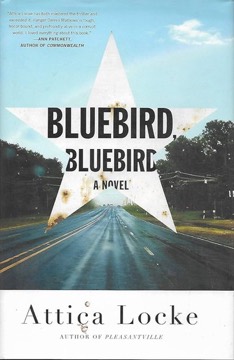
Bluebird, Bluebird
Attica Locke's 2017 novel about a Black Texas Ranger investigating two deaths in a small East Texas town, conducted while he is himself under suspension.
- First published
- 2017
- Publisher
- Polar Verlag
- Pages
- 320
- Shelf
- Thriller
- Level
- Core
- ISBN-13
- 9780316363266
Record checked against
Catalogue note
- Reads as
- ReflectiveChanges how you see rather than what you do.
- Level
- Core / BuildingAssumes general familiarity with the subject.
- Approach
- Theoretical
- Written for
- Readers who mean to stop at one more chapter, Readers with some grounding
Saved in this browser only — no account, nothing sent anywhere. My library
Read this if
- You want to be kept up late, and made uneasy about who to believe.
- You read for the writing as much as for the argument.
- You want a book that changes how you see things rather than what you do tomorrow.
- You know roughly how the subject works and want the fuller account.
The premise
Darren Mathews, one of very few Black Texas Rangers, is suspended pending a grand jury investigation into his involvement in a case that went badly.
A friend at the FBI asks him to look informally at two bodies pulled from a bayou in Lark, a town on Highway 59: a Black lawyer from Chicago and, days later, a local white woman.
Two bodies, days apart, in a town with a café on one side of the highway and an icehouse on the other.
Devmark’s reading — not a quotation from the book
Order of death
The sequence matters enormously: a Black man killed first and a white woman second produces a local narrative that a reversed order would not.
Locke builds the investigation around this, and the town's assumptions about who must have done what are the obstacle Darren is actually working against.
East Texas
The setting is specific: a highway town, an Aryan Brotherhood presence, a café run by a Black family, and land ownership stretching back generations.
Locke's rendering of the region's history — who owns what, and how they came to — is the novel's foundation, and the geography of the highway divides the town physically.
Darren
He is a lawyer by training, from a landowning Black family, drinking too much, and caught between two uncles with opposite views about what the law can do.
The competing inheritances — one uncle a Ranger, the other a defence attorney — structure his conflict, and the novel does not resolve which of them was right.
The Rangers
The institution's history, including its role in violence against Black and Mexican Texans, is present rather than elided, and Darren's position inside it is the book's central discomfort.
Locke neither condemns his choice nor endorses it, which is a difficult position to hold and is held consistently.
Geneva Sweet
The proprietor of the café is the novel's most substantial character: elderly, watchful, and holding a history of the town that nobody has asked her for.
Her sections are the strongest writing in the book, and her relationship to the land is the eventual key to the case.
Pace
It is short, tightly plotted and moves quickly, with the investigation conducted over a few days.
Locke's construction is disciplined and the book does not digress, which distinguishes it from a good deal of literary crime fiction. At under three hundred pages it is also among the shortest books in this section, and the compression is a deliberate contrast with the century of history it carries.
The blues
Music runs throughout, and the title is taken from a Lightnin' Hopkins song, with the tradition supplying both the town's history and the novel's emotional register.
The material is integrated rather than decorative, and several plot points depend on it. Locke also uses the music to establish which characters share a history, since who knows which songs is itself information about where they come from.
Contemporary politics
The novel is set shortly after the 2016 election and the atmosphere is explicit, with the Aryan Brotherhood presence treated as emboldened rather than as marginal.
Locke is direct about this and the book is plainly an intervention as well as a mystery. Locke has been explicit in interviews that she wrote it in response to the period, and the novel does not pretend to neutrality about what it depicts.
Prose
Controlled and unshowy, with close third-person narration and a strong sense of heat, dust and the physical experience of the place.
Locke writes atmosphere economically, and the descriptive passages are brief and precise rather than extended. The dialogue also carries the regional speech accurately without resorting to phonetic spelling, which is a technical problem most writers handle considerably worse.
The series
A sequel, Heaven, My Home, continues the case, and Locke has written further novels set in the same region.
The first stands alone and resolves its central question, though a subplot is carried forward deliberately. Locke's earlier novels, including Black Water Rising, are set in Houston and share the interest in land, oil and Black Texan history.
Who it is for
Readers who want crime fiction with a serious historical and political argument, delivered without sacrificing the investigation.
It won the Edgar for best novel and is among the strongest recent American crime novels. It requires no background and is short enough to read in two sittings.
What to take away
- 01Order of death as the engineA Black man killed first and a white woman second produces a local narrative that the reverse sequence would not.
- 02Land ownership as foundationWho owns what in East Texas, and how they came to, is the history the investigation eventually turns on.
- 03An institution not elidedThe Rangers' history of violence is present, and Darren's position inside it is neither condemned nor endorsed.
- 04Competing inheritancesTwo uncles with opposite views about what the law can achieve structure the protagonist's conflict, and neither is proved right.
- 05A witness nobody askedGeneva Sweet holds the town's history, and her sections are the book's best writing and its eventual key.
- 06Music integrated, not decorativeThe blues tradition supplies the town's history and several plot points rather than atmosphere.