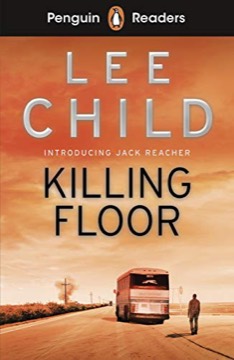
Killing Floor
Lee Child's 1997 debut, in which a drifting former military policeman is arrested for a murder in a small Georgia town he has only just walked into. The first Jack Reacher novel.
- First published
- 1997
- Publisher
- Albatros
- Pages
- 500
- Shelf
- Thriller
- Level
- Entry
- ISBN-13
- 9781561008063
Record checked against
Catalogue note
- Reads as
- ReflectiveChanges how you see rather than what you do.
- Level
- Accessible / FoundationalNo prior reading assumed.
- Approach
- Theoretical
- Written for
- Readers who mean to stop at one more chapter, Newcomers to the subject
Saved in this browser only — no account, nothing sent anywhere. My library
Read this if
- You want to be kept up late, and made uneasy about who to believe.
- You read for the writing as much as for the argument.
- You want a book that changes how you see things rather than what you do tomorrow.
- You are starting from scratch here and want a way in that assumes no prior reading.
The premise
Jack Reacher gets off a bus in Margrave, Georgia, on a whim, walks into a diner, and is arrested within the hour for a murder committed the previous night.
He has no address, no possessions beyond a folding toothbrush, and no way to account for himself, which is exactly the position the series is built to exploit.
No address, no luggage, no alibi — and the series depends on all three.
Devmark’s reading — not a quotation from the book
Reacher as a construction
He is enormous, trained by the military police, indifferent to comfort and entirely unattached: no home, no phone, no possessions, no obligations.
The design is deliberate. A protagonist with nothing to protect can be dropped anywhere and has no reason to walk away, which solves the series problem of why an ordinary person keeps encountering crime.
First person, and why it changed
This debut is narrated in the first person, and Child later moved the series to third for most subsequent books.
The first-person voice here is drier and more sardonic than the later narration, and many readers consider it the strongest version of the character's interiority.
The town
Margrave is unnaturally prosperous for its size — new paint, funded public works, an oversized police department — and Reacher notices the anomaly before he understands it.
Using economics as the first clue is a good instinct, and the eventual explanation for the town's money is the plot's spine.
Method
Reacher's investigative technique is observation and arithmetic: counting people, estimating distances, timing a walk, noticing what a detail implies about cost or logistics.
The novel takes real pleasure in this, and the deductive passages are better than the genre usually manages because they proceed from physical facts a reader can check rather than from intuition a reader must accept.
Violence
The fight scenes are described with clinical specificity — angles, weight, what a strike does to a joint — and Reacher is never in serious doubt of winning.
This is closer to competence fantasy than to suspense. The tension in the book comes from information, not from physical jeopardy.
Structure
Short chapters, a tight week-long timeline, and a steady escalation from a single murder to a conspiracy with national implications that the early chapters give no hint of.
Child's pacing is the series' commercial engine: every chapter ends with a reason to continue, and the exposition is always delivered in motion, inside a drive or a search rather than in a briefing.
The prose
Very short sentences. Frequent fragments. A deliberately flat affect that mirrors the character's own economy and refuses almost every opportunity for figurative language.
It is a mannered style that some readers find hypnotic and others find irritating, and it is entirely consistent across the series, which is part of why the books are so reliably consumable.
The personal stake
The murder victim turns out to be connected to Reacher, which gives the debut a motive the later books usually replace with coincidence or principle.
It is the only Reacher novel where the case is genuinely his business, and the emotional register is correspondingly different.
The one book in the series where he actually has a reason to stay.
Devmark’s reading — not a quotation from the book
What it established
The wandering competent stranger who arrives, corrects an injustice by force, and leaves is an old American shape — the Western drifter — and Child restated it for the airport thriller.
The series' enormous success rests on that recognisability plus the rigour of the procedural detail.
Series order
It is the first of a long sequence, and the books are largely independent; Child has said they can be read in any order, though the character's history accumulates.
This one is unusual for being both the first published and the most personally motivated, which makes it a natural starting point.
Who it is for
Readers who want propulsion, competence and a clean moral arrangement. The book is efficient and makes no claims beyond that.
Readers who want moral complication or a protagonist who can lose should look elsewhere on this shelf; Reacher is never seriously in doubt, and the novel has no interest in pretending otherwise. Its contract with the reader is competence delivered on schedule.
What to take away
- 01A protagonist with nothing to protectNo home, no possessions and no obligations solve the series problem of why one man keeps encountering crime.
- 02Economics as the first clueReacher notices that the town is too prosperous for its size before he understands anything else.
- 03Deduction from physical factThe reasoning proceeds from distances, weights and costs, which makes it more convincing than genre deduction usually is.
- 04Competence, not jeopardyFights are described clinically and never in doubt; the tension lives in information instead.
- 05The Western drifter, restatedA capable stranger arrives, corrects an injustice by force and leaves — an old American shape fitted to the airport thriller.
- 06The one personal caseThe victim is connected to Reacher, giving the debut a motive the later books replace with principle.