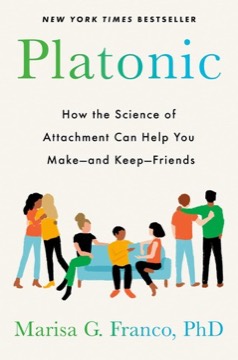
Platonic
How the Science of Attachment Can Help You Make—and Keep—Friends
Marisa Franco's research-based account of adult friendship: why it gets harder after education ends, and what attachment theory predicts about who makes friends easily.
- First published
- 2022
- Publisher
- G.P. Putnam's Sons
- Pages
- 336
- Shelf
- Love
- Level
- Entry
- ISBN-13
- 9780593331897
Record checked against
Only one source carried a publication date for this work, so the year is uncorroborated.
Catalogue note
- Reads as
- ReflectiveChanges how you see rather than what you do.
- Level
- Accessible / FoundationalNo prior reading assumed.
- Approach
- Theoretical
- Written for
- Anyone thinking about how people attach, Newcomers to the subject
- Ideas
Saved in this browser only — no account, nothing sent anywhere. My library
Read this if
- You want to understand why people attach to each other the way they do.
- You want a book that changes how you see things rather than what you do tomorrow.
- You are starting from scratch here and want a way in that assumes no prior reading.
The argument
Franco, a psychologist, applies attachment theory to friendship rather than romance. Secure, anxious and avoidant patterns shape platonic relationships as much as partnerships, and they explain much of what people experience as inexplicable difficulty making friends.
Her central practical claim is that friendship requires initiative that most adults have never had to exercise, because school and university supplied repeated unplanned contact.
Friendship used to be a by-product of institutions. After those end, it has to be an activity.
Devmark’s reading — not a quotation from the book
What the research says
The finding readers react to most is the liking gap: people consistently underestimate how much a new acquaintance liked them and enjoyed the conversation, which suppresses follow-up.
Also covered: the mere exposure effect and why repeated unplanned contact builds closeness, the role of vulnerability in accelerating it, and evidence on how long a friendship actually takes to form in hours of contact.
The practical part
Initiate explicitly rather than hoping. Assume you are liked, on the evidence of the liking gap. Build repetition deliberately — recurring activities beat occasional efforts. Express affection directly, which adults do far less than they did as children.
Franco is realistic that this feels effortful and slightly undignified, and argues the discomfort is the actual barrier rather than time.
The barrier is not time. It is that initiating feels undignified, and Franco says so plainly.
Devmark’s reading — not a quotation from the book
Where it sits
Better evidenced than most books in this category and more useful than the general loneliness literature, because it addresses formation rather than diagnosis.
It is also the rare relationship book that treats friendship as a primary relationship rather than as what remains after romance.
Franco writes from research rather than practice — she is an academic psychologist rather than a clinician — and the book is correspondingly stronger on findings than on what to do when a specific friendship fails.
Attachment applied to friends
Franco's contribution is to take adult attachment styles out of romance and apply them to friendship: the anxious friend who reads a slow reply as rejection, the avoidant one who cancels as closeness increases, and the secure one who assumes goodwill. The transfer is the book's organising idea.
Initiative
Her most repeated practical claim is that people systematically underestimate how much others want to hear from them and how positively an invitation will be received. The research she cites on this liking gap is reasonably solid, and the prescription follows directly: reach out first, and more often than feels warranted.
People want to hear from you considerably more than you believe they do. That is a finding, not encouragement.
Devmark’s reading — not a quotation from the book
Why it collapses after education
She is precise about the mechanism: school and university supply repeated unplanned contact with the same people, and adult life removes it. Friendship does not decay because adults care less but because the structure that generated it without effort has gone, and nothing replaces it automatically.
Vulnerability, carefully
The chapters on disclosure argue for going first, and for going slightly deeper than feels immediately comfortable, on the evidence that reciprocal openness is what converts an acquaintance into a friend. Franco carefully distinguishes this from unloading a crisis onto somebody who has not agreed to receive it, and that distinction matters enormously — a good deal of the surrounding popular literature fails to make it at all.
Anger and repair
An unusual and valuable section deals with conflict between friends, which is a subject most friendship writing avoids entirely: how to raise a grievance without framing it as an accusation, why quiet avoidance ends far more friendships than open argument ever does, and what repair actually looks like in a relationship with none of the structural glue that a marriage or a family provides.
The evidence and its limits
Franco is a psychologist and cites real literature throughout, but a good deal of it is correlational, several findings come from single studies, and the attachment framework is applied more confidently than the research supports. The practical advice is sound; the theoretical scaffolding is heavier than it needs to be.
What to take away
- 01Attachment applies to friendsSecure, anxious and avoidant patterns operate platonically.
- 02The liking gapPeople underestimate how much new acquaintances liked them.
- 03Repetition over effortRecurring unplanned contact does what occasional attempts cannot.
- 04Initiation feels undignifiedNamed as the real barrier rather than time.
- 05Friendship as primaryTreated as a central relationship, not a residual one.