Red, White & Royal Blue
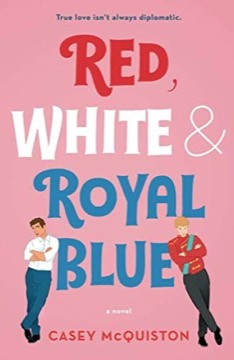
Casey McQuiston's romantic comedy about the son of the first woman US president and a British prince, who are required to fake a friendship after ruining a royal wedding cake.
- First published
- 2019
- Publisher
- SEGUINTE
- Pages
- 440
- Shelf
- Love
- Level
- Entry
- ISBN-13
- 9781663617651
Record checked against
Catalogue note
- Reads as
- ReflectiveChanges how you see rather than what you do.
- Level
- Accessible / FoundationalNo prior reading assumed.
- Approach
- Theoretical
- Written for
- Anyone thinking about how people attach, Newcomers to the subject
Saved in this browser only — no account, nothing sent anywhere. My library
Read this if
- You want to understand why people attach to each other the way they do.
- You read for the writing as much as for the argument.
- You want to understand how power is taken, kept and lost.
- You want a book that changes how you see things rather than what you do tomorrow.
- You are starting from scratch here and want a way in that assumes no prior reading.
The premise
Alex Claremont-Diaz is the president's son and a political operator in his own right. Prince Henry is third in line to the British throne and, in Alex's view, insufferable. A collision at a royal wedding creates a diplomatic incident.
The fix is a staged friendship for the cameras. The staging does what staging always does in this form.
A fake friendship arranged by two governments, which is a considerably higher-stakes version of the usual setup.
Devmark’s reading — not a quotation from the book
How it works
McQuiston writes the political machinery with real affection and real detail — the campaign, the polling, the Texas race that runs underneath — so the romance has a functioning world around it rather than a backdrop.
The correspondence between Alex and Henry, which quotes historical letters between men, is the book's best writing and carries most of the emotional development.
The emails are the novel's centre, and they are doing something more careful than the comedy suggests.
Devmark’s reading — not a quotation from the book
What it is about
The serious material is about being publicly closeted under institutional pressure, and Henry's position — a monarchy with no exit — is treated as a genuine constraint rather than a plot obstacle.
The book is deliberately optimistic about politics in a way that reads as either a comfort or a fantasy depending on the reader, and McQuiston has been open that this was the intention.
Its place
A significant commercial success for queer romance in the mainstream, and one of the books widely credited with moving the category from specialist shelves to front tables in general bookshops.
It is funny, fast and unembarrassed, and its optimism is a stated position rather than an oversight. McQuiston has been explicit that the book was written during a period when a hopeful political fantasy felt necessary, and that the wish-fulfilment is deliberate rather than naive.
The premise is a machine
Two young men who publicly loathe each other are forced by a diplomatic incident at a royal wedding into a programme of staged friendship, and the plot runs efficiently on that machinery: arranged photo opportunities, minders, itineraries and briefings. The enemies-to-lovers structure is executed cleanly and at pace, and the novel never once pretends to be doing anything other than that.
Emails
The relationship is conducted substantially in writing, with long messages quoting historical correspondence between men, and these sections are where the book is at its most sincere. The device also solves the problem of two characters on different continents needing to fall in love on the page.
They are on separate continents for most of it. The book happens in the correspondence.
Devmark’s reading — not a quotation from the book
The alternate politics
It is set in a United States with a woman president and a Texas Democratic coalition, published in 2019, and the wish-fulfilment is deliberate rather than naive. McQuiston has been clear that the book was written as a corrective fantasy for a specific political moment.
Coming out under scrutiny
The most serious material in the book concerns the sheer impossibility of a private life under that degree of scrutiny: permanent security details, a mother weighing her son's happiness against an election, a palace managing risk, and eventually a forced disclosure that removes any choice about timing or wording. The novel handles all of this with considerably more weight than its comic register would suggest.
Family and staff
The supporting cast — a sharp older sister, a chief of staff, a best friend with her own complicated romance, and the White House residence staff who have seen several families come and go — is unusually well drawn for the genre and given real interior life. A considerable amount of the book's warmth comes from these relationships rather than from the central couple.
What kind of book it is
It is comic, sexually explicit, unapologetically optimistic, and entirely uninterested in realism about either the British monarchy or the mechanics of American politics, both of which it treats as a stage set. Readers who want either of those things will be frustrated throughout. Readers who want a well-constructed romantic comedy with genuine emotional stakes underneath the farce are the intended audience, and it delivers.
What to take away
- 01Staged by two governmentsThe fake-relationship setup with diplomatic stakes attached.
- 02LettersThe correspondence, quoting historical letters between men, is the emotional core.
- 03Institutional closetingHenry's monarchy is written as a real constraint with no exit.
- 04Political machineryCampaign detail gives the romance a functioning world.
- 05Deliberate optimismThe hopefulness is an authorial choice, stated as such.