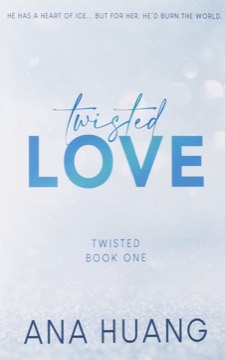
Twisted Love
Ana Huang's contemporary romance, first in the Twisted series: a woman is left in the care of her brother's cold, controlling best friend, and the arrangement does not stay professional.
- First published
- 2021
- Publisher
- Hugo Roman
- Pages
- 358
- Shelf
- Love
- Level
- Entry
- ISBN-13
- 9781735056678
Record checked against
Catalogue note
- Reads as
- ReflectiveChanges how you see rather than what you do.
- Level
- Accessible / FoundationalNo prior reading assumed.
- Approach
- Theoretical
- Written for
- Anyone thinking about how people attach, Newcomers to the subject
Saved in this browser only — no account, nothing sent anywhere. My library
Read this if
- You want to understand why people attach to each other the way they do.
- You read for the writing as much as for the argument.
- You want a book that changes how you see things rather than what you do tomorrow.
- You are starting from scratch here and want a way in that assumes no prior reading.
The premise
Ava Chen is a photography student with gaps in her memory and a recurring nightmare. When her brother travels for work he asks Alex Volkov — wealthy, precise and by reputation without feelings — to look after her.
Alex is running a long revenge plan of his own, and Ava is not part of it until she is.
The setup is the brother's-best-friend arrangement, run at a much colder temperature than usual.
Devmark’s reading — not a quotation from the book
What kind of book it is
This is contemporary romance in its most stylised register: a hero written as emotionally unavailable to an almost clinical degree, high wealth, and a plot that escalates into suspense.
It is explicit, and it deals with trauma and recovered memory as plot material. Readers should treat the content warnings as load-bearing rather than decorative.
It is stylised rather than realistic, and reads best if you take the mode on its own terms.
Devmark’s reading — not a quotation from the book
Why the series works
Huang's four Twisted books each take one couple from the same friendship group, so a reader accumulates a cast. That structure — familiar from the genre but executed tightly here — is much of the appeal.
The books were a substantial self-publishing success before wider release, driven almost entirely by reader recommendation rather than review.
Where it sits in this library
The library holds one volume rather than the series. Twisted Love is the entry point and the one that established the pattern; the later books assume it.
It is included as a representative of a form that sells enormously and is rarely described seriously — the character-archetype-driven contemporary romance, working exactly as designed.
One volume stands for the series here, because a catalogue is not a bookshelf and four would say nothing new.
Devmark’s reading — not a quotation from the book
The arrangement
The plot is set in motion by a brother asking his oldest friend to look after his sister while he travels, which places two people who have been avoiding each other into daily proximity with an explicit duty of care. It is the oldest device in the category and it is deployed efficiently.
The hero as a type
Alex is written to a specification the genre recognises immediately: wealthy, controlling, emotionally unavailable to a nearly clinical degree, and possessive in a way presented as devotion. Readers outside the category frequently mistake the stylisation for realism; it is closer to a fairy tale's grammar.
He is not written as a person to be assessed. He is written as a type the genre has agreed on.
Devmark’s reading — not a quotation from the book
Ava's memory
The heroine has documented, medically acknowledged gaps in her childhood memory and a recurring nightmare she cannot place, and the gradual recovery of what is missing from that period runs underneath the romance as a second and considerably darker plot. It supplies almost all of the book's suspense and virtually all of its serious content, and it is resolved in the final quarter.
The Twisted structure
Huang's four books each follow one couple from the same friendship group, so each novel resolves a romance while advancing the group. Readers accumulate a cast and later volumes assume knowledge of earlier ones, which is the pattern the category has borrowed from long-running series romance.
Content and the warnings
It is explicit, and it contains violence, references to childhood trauma, and a hero whose behaviour would be alarming outside the genre's conventions. The category has developed detailed content-note practice for exactly this reason, and readers should use it rather than rely on the cover.
Where it came from
It was self-published and reached scale through online reading communities before traditional publishers were involved, which is now the standard route for the category. Its commercial performance is a better guide to its cultural position than its critical reception, of which there is very little.
What to take away
- 01Brother's best friendA familiar setup executed at unusually low emotional temperature.
- 02Stylised, not realisticThe mode is deliberate and the book should be read on its terms.
- 03A shared castFour books rotating through one friendship group.
- 04Reader-driven successBuilt through recommendation rather than review coverage.
- 05One volume, not fourThe catalogue holds the entry point rather than the set.