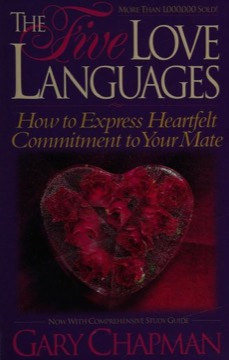
The Five Love Languages
Gary Chapman's proposal that people express and receive affection through five distinct modes, and that most relationship frustration comes from two people speaking different ones fluently at each other.
- First published
- 1992
- Publisher
- Northfield
- Pages
- 204
- Shelf
- Love
- Level
- Entry
- ISBN-13
- 9780786274598
Record checked against
Catalogue note
- Reads as
- PracticalWritten to be applied, not only understood.
- Level
- Accessible / FoundationalNo prior reading assumed.
- Approach
- Practical
- Written for
- Anyone thinking about how people attach, Newcomers to the subject
Saved in this browser only — no account, nothing sent anywhere. My library
Read this if
- You want to understand why people attach to each other the way they do.
- You want to be understood the first time.
- You want something to apply, not only something to think about.
- You are starting from scratch here and want a way in that assumes no prior reading.
The idea
Five languages: words of affirmation, quality time, receiving gifts, acts of service, and physical touch. Chapman's claim, from decades of pastoral counselling, is that each person has a primary one and tends to express love in the language they wish to receive.
The prescription follows directly: identify your partner's language and act in it rather than in yours.
Most people give love in the language they want to receive it, which is the whole misunderstanding.
Devmark’s reading — not a quotation from the book
Why it spread
The framework is simple, immediately actionable, and gives couples a shared vocabulary for a conversation that is otherwise hard to start. That combination explains sales in the tens of millions.
Its practical effect — prompting deliberate attention to what a specific partner actually values — is probably real regardless of whether the categories are correct.
The evidence
There is little empirical support for five discrete languages. Studies testing the typology generally fail to find clean categories, and the evidence that matching partners' languages improves outcomes is weak.
What is supported is the underlying idea that deliberate, partner-specific positive attention matters — which is Gottman's turning-toward finding arriving by another route.
The five categories do not survive testing. The habit they produce probably helps anyway.
Devmark’s reading — not a quotation from the book
What to know
Chapman is a Baptist pastor and the book's framing is Christian and heteronormative in its original edition, with a traditional view of marriage roles in places.
Read it as a conversational device rather than a psychological finding. The question it prompts is more valuable than the taxonomy it proposes.
The five
Words of affirmation, quality time, receiving gifts, acts of service and physical touch. Chapman's claim is that each person has one primary channel through which affection actually registers as affection, and that couples routinely express love fluently and generously in a language their partner does not read — so the effort is made, is real, and arrives as nothing. The resulting resentment on both sides is the pattern the book is written to break.
The love tank
His governing metaphor is a reservoir that depletes and must be refilled, and that an empty one produces the complaints and withdrawal most couples present with. It is a crude model and its crudeness is why it travels — people can apply it without instruction.
The complaint is rarely the problem. It is usually the sound an empty tank makes.
Devmark’s reading — not a quotation from the book
Where it came from
Chapman is a Baptist pastor who developed the framework from decades of congregational marriage counselling, and the book's origin is anecdotal rather than experimental. The Christian framing is present but light in the main text, and it is much more explicit in the surrounding series.
Its real usefulness
The evidence for five discrete categories is weak, but the underlying instruction — ask your partner what actually makes them feel cared for, and believe the answer even if it is not what works for you — is sound regardless of whether the taxonomy is. That is the transferable part.
What the research finds
Studies testing the model have generally failed to confirm five distinct types, and have found that matching partners' languages predicts satisfaction less well than simply doing more of all five. The finding is consistent enough that the categories are better used as a prompt list than as a diagnosis.
The franchise
It has produced editions for children, teenagers, singles, workplaces and the military, along with quizzes and apps. The expansion has diluted the original, and the concept's presence in ordinary conversation now far exceeds anything the evidence supports — which is worth separating from the modest, useful core.
What to take away
- 01Five modesAffirmation, time, gifts, service, touch.
- 02You give what you wantThe core misunderstanding the book identifies.
- 03Weak as a typologyStudies do not find five discrete categories.
- 04Useful as a promptThe conversation it starts is the real contribution.
- 05Religious framingWritten by a pastor, with a traditional view of marriage.