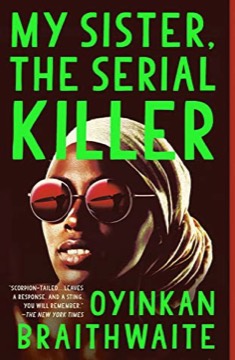
My Sister, the Serial Killer
Oyinkan Braithwaite's 2018 debut about a Lagos nurse who repeatedly helps her younger sister dispose of the boyfriends she has killed.
- First published
- 2018
- Publisher
- Knopf Doubleday Publishing Group
- Pages
- 238
- Shelf
- Thriller
- Level
- Entry
- ISBN-13
- 9781786495983
Record checked against
Catalogue note
- Reads as
- ReflectiveChanges how you see rather than what you do.
- Level
- Accessible / FoundationalNo prior reading assumed.
- Approach
- Theoretical
- Written for
- Readers who mean to stop at one more chapter, Newcomers to the subject
Saved in this browser only — no account, nothing sent anywhere. My library
Read this if
- You want to be kept up late, and made uneasy about who to believe.
- You read for the writing as much as for the argument.
- You want a life told honestly, at full length.
- You want a book that changes how you see things rather than what you do tomorrow.
- You are starting from scratch here and want a way in that assumes no prior reading.
The premise
Korede is a nurse, orderly, plain and reliable. Her sister Ayoola is beautiful, careless, and has now killed three boyfriends, each time telephoning Korede to help with the cleaning.
The arrangement holds until Ayoola begins seeing the doctor Korede is in love with. Braithwaite establishes the arrangement in the first chapter without any exposition at all, and the reader understands the entire situation within three pages.
Three dead boyfriends, and her sister calls her every time to help with the bleach.
Devmark’s reading — not a quotation from the book
Brevity
It is very short, told in chapters that are frequently under two pages, and can be read in a couple of hours.
The compression is the book's defining quality. Nothing is developed beyond what the situation requires, and the economy produces a sharpness a longer version would lose.
Comedy
It is genuinely funny, largely through Korede's exasperated practicality about the logistics of disposal and her resentment of her sister's ease.
The humour never softens the material and is not used as relief; it is simply the register in which Korede experiences her own life.
Obligation
The novel's actual subject is what a sibling relationship compels, and Korede's compliance is treated as neither weakness nor loyalty.
Their shared history with a violent father is disclosed gradually and supplies the explanation without excusing anything. Braithwaite also refuses to let Korede off by making Ayoola sympathetic, and the sister remains genuinely careless about the people she kills.
Beauty
Ayoola's appearance functions as an operating asset: it secures forgiveness, attention and the benefit of the doubt in every situation the novel depicts.
Braithwaite is precise about the practical advantages it confers and about Korede's accurate resentment of them. The novel also notes that Korede's own competence is consistently less visible than Ayoola's appearance, including to people who depend on it professionally.
Lagos
The city is present in specifics — traffic, hospital conditions, domestic staff, social media, the particular textures of middle-class Nigerian life.
The setting is unremarked rather than explained, which is the correct decision and means the novel never pauses to orient a foreign reader. The domestic staff in particular are drawn specifically, and the household's dependence on people whose discretion is assumed is used for the plot.
The husband and father
The sisters' father is disclosed across the book as a violent and corrupt man whose death was not straightforward.
The material is delivered in short fragments and is the novel's darkest content, and it reframes Ayoola without converting her into a victim. Braithwaite delivers it in fragments across the whole novel rather than in a single flashback, which keeps it from operating as an explanation the reader can settle into.
Korede's position
She narrates and is complicit throughout, and the novel is uninterested in resolving her into either accomplice or casualty.
Her confessions to a comatose patient are the book's best device, letting her speak without consequence and letting the reader hear what she cannot say aloud.
Genre
It is marketed as a thriller and is closer to a domestic comedy with corpses in it, with no investigation and very little jeopardy.
Readers expecting suspense will find the police almost entirely absent, which is deliberate and is part of the book's point about who gets investigated.
Prose
Clipped, present-tense and extremely controlled, with short sentences and almost no description.
Braithwaite's economy is consistent and the voice never slips, which is a considerable achievement across a whole novel however short. The chapter titles are also single words, which reinforces the compression and gives the book a formal consistency it maintains throughout.
Its reception
It won the Los Angeles Times Book Prize and was longlisted for the Booker, and it brought Braithwaite substantial international attention.
Its success also contributed to a wider English-language readership for contemporary Nigerian fiction. It was also widely read as satire of a particular kind of family dynamic, and Braithwaite has discussed the sibling material as the book's actual origin.
Who it is for
Readers who want something short, funny and genuinely unsettling, and who do not require a crime novel to contain an investigation.
It is among the most immediately enjoyable books in this section and is over before it outstays anything. Readers wanting plot machinery should look elsewhere.
What to take away
- 01Economy as the defining qualityChapters under two pages and nothing developed past what the situation needs, which a longer version would dilute.
- 02Comedy as the narrator's registerThe humour is how Korede experiences her own life rather than relief supplied to the reader.
- 03Compliance neither excused nor condemnedThe sisters' history with a violent father explains Korede's behaviour without making it acceptable.
- 04Beauty as an operating assetAyoola's appearance reliably secures forgiveness and the benefit of the doubt, and the novel is precise about the advantage.
- 05A confessor who cannot respondKorede's monologues to a comatose patient let her speak without consequence, which is the book's best device.
- 06The police almost entirely absentThere is no investigation, which is deliberate and is part of the point about who is pursued and who is not.