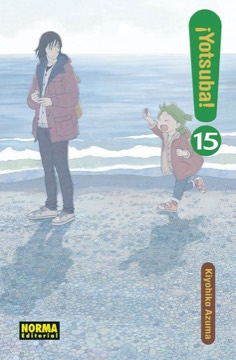
Yotsuba&!
Kiyohiko Azuma's series, begun in 2003, about a five-year-old girl encountering ordinary things for the first time. Comedy with no conflict at all.
- First published
- 2003
- Publisher
- Norma
- Pages
- 240
- Shelf
- Anime
- Level
- Entry
- ISBN-13
- 9784049135978
Record checked against
Catalogue note
- Reads as
- ReflectiveChanges how you see rather than what you do.
- Level
- Accessible / FoundationalNo prior reading assumed.
- Approach
- Theoretical
- Written for
- Readers of comics, and anyone curious how the form works, Newcomers to the subject
Saved in this browser only — no account, nothing sent anywhere. My library
Read this if
- You read for the writing as much as for the argument.
- You want a life told honestly, at full length.
- You want a book that changes how you see things rather than what you do tomorrow.
- You are starting from scratch here and want a way in that assumes no prior reading.
What it is
Yotsuba Koiwai is five, green-haired, adopted, and entirely without fear. She moves to a new town with her father and encounters, one chapter at a time, air conditioning, cicadas, a bicycle, a farm, a festival, a thunderstorm and global warming.
There is no plot. Each chapter is an encounter with something ordinary.
A five-year-old meets an escalator, a cicada and a rainstorm, one chapter at a time.
Devmark’s reading — not a quotation from the book
The absence of conflict
Nothing bad happens. Nobody is in danger, no one is cruel, and the stakes never exceed a lost toy or a missed promise.
The series demonstrates that a long-running comic can sustain interest entirely on observation and affection, which is a genuinely difficult thing to do and is almost never attempted.
Comic timing
Azuma's timing is exceptional, and the humour depends almost entirely on panel rhythm: a held reaction, a silent beat, a cut to a face.
The jokes are frequently unquotable because they exist in the spacing rather than in the dialogue, which is a comics-specific skill demonstrated here about as well as it can be.
Yotsuba herself
She is loud, literal, easily delighted and occasionally alarming, and the series never makes her precocious or knowing.
She is written as an actual five-year-old: bad at understanding, confident anyway, and genuinely difficult to manage. The refusal to make her cute in a calculated way is what makes her funny.
The adults
Her father, his friends and the family next door are all competent, kind and recognisably adult, and the series takes their lives seriously in the background.
Koiwai's position as a single adoptive father is handled without comment or drama, and the surrounding adults are allowed their own concerns.
The drawing
Clean, precise and extremely detailed in backgrounds — real Japanese suburbia, drawn from reference, with careful attention to light and to objects.
The realism of the setting against the simplicity of the figures is deliberate: an ordinary world rendered accurately is what makes a child's astonishment at it legible.
Episodic form
Chapters are self-contained and roughly chronological, following the seasons across what amounts to a single year stretched over many volumes.
The structure means it can be read in any quantity and put down indefinitely, and the series makes no demands on a reader's memory at all.
Sentiment
It is warm without being sentimental, and the series never asks the reader to find a moment touching.
The affection is in the attention rather than in any statement, and the restraint is why the occasional genuinely moving chapter lands as hard as it does.
Pace of publication
Azuma works slowly and volumes appear at long and irregular intervals, with multi-year gaps.
The series is ongoing after two decades and has covered roughly one year of its character's life, which is either charming or frustrating depending on the reader. Azuma draws the backgrounds himself from photographic reference, which accounts for a substantial part of the delay and for a substantial part of the quality.
Azumanga Daioh
His earlier series, a four-panel high-school comedy, established his approach and is considerably more conventional in form.
Readers who like the timing here will find it there in a more compressed format, though Yotsuba is generally considered the better work. The four-panel format forces a joke every four panels, which is a different discipline from the long chapters here and produces a noticeably faster read.
Its standing
It is widely regarded as one of the best comedy manga produced, and it has an unusually broad readership across ages.
It is also frequently recommended as a first manga, since it requires nothing and its pleasures are immediately available. It has also won awards outside Japan and is one of the few manga regularly stocked by general bookshops rather than by specialist retailers.
Who it is for
Anyone. It is the most genuinely all-ages work in this section, funny for adults without being aimed over children's heads, and it needs no familiarity with the medium.
Readers who require narrative progression will not find any, and that is the only real caveat. It is also the series in this section most likely to be enjoyed by someone who has never read a comic, which is worth something on its own.
What to take away
- 01A long comic without conflictNothing bad happens across twenty years of publication, which is extremely difficult to sustain and almost never attempted.
- 02Jokes that live in the spacingThe humour depends on panel rhythm and held beats rather than on dialogue, which is a comics-specific skill.
- 03An actual five-year-oldYotsuba is literal, badly informed, confident and difficult, rather than precocious or calculatedly cute.
- 04Accurate world, simple figuresDetailed suburban backgrounds against simplified characters are what make a child's astonishment legible.
- 05Affection through attentionThe warmth is in what the series chooses to look at, never in anything it asks the reader to feel.
- 06Two decades, one yearSlow irregular publication means the series has covered roughly a year of its character's life since 2003.