xxxHolic
CLAMP's series, begun in 2003, about a student who can see spirits and the shop owner who will remove the ability for a price. Supernatural stories about what things cost.
- First published
- 2003
- Publisher
- Kodansha
- Pages
- 176
- Shelf
- Anime
- Level
- Core
- ISBN-13
- 9788498143843
Record checked against
Catalogue note
- Reads as
- ReflectiveChanges how you see rather than what you do.
- Level
- Core / BuildingAssumes general familiarity with the subject.
- Approach
- Theoretical
- Written for
- Readers of comics, and anyone curious how the form works, Readers with some grounding
Saved in this browser only — no account, nothing sent anywhere. My library
Read this if
- You read for the writing as much as for the argument.
- You care why some things are obvious to use and others are not.
- You want to examine an assumption you have never examined.
- You want a book that changes how you see things rather than what you do tomorrow.
- You know roughly how the subject works and want the fuller account.
What it is
Kimihiro Watanuki is tormented by spirits he can see and nobody else can. He stumbles into a shop run by Yūko Ichihara, who grants wishes at a price exactly equivalent to their value, and agrees to work for her in exchange for removing his ability.
The series proceeds largely as a sequence of supernatural cases, with a long narrative accumulating underneath.
Every wish has a price equal to what it is worth, and the shop does not negotiate.
Devmark’s reading — not a quotation from the book
The price principle
The rule governing the shop — that payment must be exactly equivalent, never more and never less — is the series' organising idea and is applied with complete consistency.
It produces genuine moral problems. Several clients pay in ways that are technically fair and personally catastrophic, and Yūko refuses to protect anyone from a bargain they chose.
Yūko
The shop's owner is manipulative, indulgent, evasive about herself and one of CLAMP's strongest creations.
She functions as a teacher who refuses to explain, and the series' emotional weight comes from Watanuki's slow understanding of what she has been doing for him. She is also genuinely funny, and a substantial part of the early volumes consists of her drinking, demanding elaborate meals and refusing to answer questions.
Folklore
The cases draw on Japanese folk belief — specific yōkai, ritual practices, the significance of names and of promises — and the research is substantial.
The series is a reasonably good informal introduction to the material, and it treats the beliefs as coherent systems rather than as monster-of-the-week material.
The art
The most stylised of CLAMP's work: extremely elongated figures, dense patterning, smoke and fabric used as compositional elements, and pages that abandon panels entirely.
It is beautiful and frequently hard to read, and the density is a genuine obstacle for some readers. CLAMP have said they treated the series as a place to experiment formally, and the layouts become progressively less conventional as it proceeds.
Crossover material
The series is entangled with CLAMP's Tsubasa: Reservoir Chronicle, and several significant developments occur in the other work.
This is a real problem for readers who only want this book. The overlap is substantial in the middle volumes and the series does not stand as independently as it initially appears.
Structure
Nineteen volumes, beginning as episodic supernatural cases and becoming progressively more continuous and more concerned with Watanuki's own situation.
The shift is gradual and the later volumes are considerably darker and stranger than the opening. The early cases are largely self-contained and can be read in any order, while the later volumes require sequence and considerably more attention.
Consequence
The series is consistently interested in the fact that choices bind: a promise made cannot be unmade, and a thing given away is gone.
This gives a supernatural anthology an unusual moral seriousness, and it is what distinguishes the book from a monster-of-the-week format. Several clients return many volumes later carrying the effects of a bargain the reader has largely forgotten, which is a quiet piece of long-form construction.
Watanuki
He begins as a comic figure — irritable, loud, an excellent cook — and the series gradually reveals how thoroughly alone he is.
His arc toward accepting what Yūko has arranged for him is the series' real narrative, and it is considerably sadder than the early volumes suggest.
Food and domesticity
Cooking, sake, seasonal dishes and the running of a household occupy a surprising amount of the book, and function as the counterweight to the supernatural material.
The domestic texture is what makes the shop feel inhabited rather than merely atmospheric. Watanuki's cooking is also how he expresses affection, since he is incapable of saying anything directly, and the meals track his relationships precisely.
Adaptations
Two animated seasons and a set of original video animations exist, with the later material diverging from the manga considerably.
The manga is the complete version, and the crossover entanglement makes adaptations of it particularly difficult to follow. The animated version also removes most of the crossover material, which makes it more self-contained and correspondingly less coherent in its final act.
Who it is for
Readers who want supernatural fiction with a consistent internal ethics, and who can tolerate dense, decorative pages and a plot that reaches into another series.
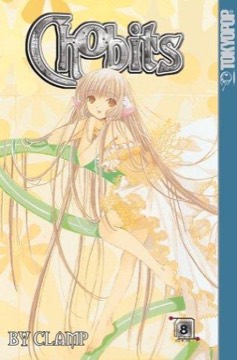
It is among CLAMP's strongest work and among their least self-contained, and both of those matter to the recommendation. Readers who want a single complete CLAMP work with no external dependencies would be better served by Chobits, which asks considerably less of them.
What to take away
- 01Exact equivalence as a rulePayment must match a wish's value precisely, never more or less, applied with total consistency and no mercy.
- 02A teacher who will not explainYūko arranges Watanuki's education by refusing to tell him what she is doing, and the reveal carries the emotional weight.
- 03Choices that bindA promise cannot be unmade and a thing given is gone, which gives a supernatural anthology real moral seriousness.
- 04Folklore as coherent systemYōkai, ritual and the significance of names are treated as an internally consistent body of belief rather than as monsters.
- 05Beautiful and hard to readThe elongated figures and dense patterning are among CLAMP's finest work and a genuine obstacle for some readers.
- 06Not self-containedSignificant developments occur in a companion series, which is a real problem for readers who want only this book.