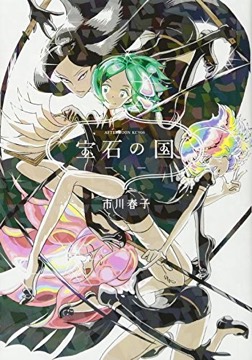
Land of the Lustrous
Haruko Ichikawa's series, begun in 2012, about immortal gem-bodied beings who are hunted for their material. Science fiction with an unusual formal approach.
- First published
- 2012
- Publisher
- Kodansha Comics
- Pages
- 192
- Shelf
- Anime
- Level
- Core
- ISBN-13
- 9781682337288
Record checked against
Catalogue note
- Reads as
- ReflectiveChanges how you see rather than what you do.
- Level
- Core / BuildingAssumes general familiarity with the subject.
- Approach
- Theoretical
- Written for
- Readers of comics, and anyone curious how the form works, Readers with some grounding
Saved in this browser only — no account, nothing sent anywhere. My library
Read this if
- You read for the writing as much as for the argument.
- You want to examine an assumption you have never examined.
- You care why some things are obvious to use and others are not.
- You want a book that changes how you see things rather than what you do tomorrow.
- You know roughly how the subject works and want the fuller account.
What it is
In the far future, twenty-eight beings made of crystalline mineral live on a strip of land, assigned duties according to their hardness. They are attacked periodically by the Lunarians, who harvest them for ornament.
Phosphophyllite, the youngest and most fragile, is given the task of compiling a natural history because nothing more useful can be found for them.
Immortal, breakable, and harvested for decoration by something they cannot understand.
Devmark’s reading — not a quotation from the book
Bodies that shatter
The gems can be broken and reassembled, and lost fragments take memory and personality with them, so injury is a form of partial death that the survivor continues past.
The mechanic is the series' central idea. Identity here is physical and divisible, and the question of how much of someone can be lost before they are someone else is asked repeatedly and answered badly.
Phos
The protagonist changes continually across the series as parts are replaced with other materials, acquiring abilities and losing the person who wanted them.
The arc is genuinely disturbing. Each improvement is a subtraction, and the series tracks the accumulating loss with precision while everyone around them fails to notice.
The art
Ichikawa's drawing is spare, luminous and unusually architectural, with enormous white space and figures whose hair is rendered as mineral rather than as hair.
It is among the most visually distinctive series in this section, and the apparent simplicity conceals extremely careful composition. Ichikawa works largely digitally, and the flat clean surfaces suit mineral bodies in a way conventional hatching would not.
Religion and the Lunarians
The attackers arrive in formations resembling religious iconography, and the eventual explanation of what they want connects to Buddhist ideas about attachment and release.
The theology is worked through seriously rather than used as decoration, and the series' final movement depends on taking it at face value.
Sensei
The gems' teacher is a monk-like figure who trains and repairs them and declines to explain anything about their origins or his own.
His withholding is the series' central mystery and its most painful relationship, since his care for them is real and is also a form of management.
Tone
The early volumes are largely comic, with a light school-adjacent register, and the series becomes progressively bleaker until the comedy is entirely gone.
The transition is gradual and unmarked, and readers frequently notice only retrospectively that the book they are reading is not the one they started.
Immortality
The gems cannot die and can be destroyed, which is a distinction the series explores at length: a shattered gem is gone as a person while continuing to exist as material.
It is one of the more original treatments of deathlessness in fiction, and it avoids the usual complaint that immortality is simply tedious.
Difficulty
The cast is large, the characters are visually similar, and significant information is withheld for many volumes.
Readers frequently report needing to consult a reference to keep the gems distinct, and the series does very little to help with this. The gems are also distinguished partly by hardness values that the series expects the reader to remember, which is a genuine demand on attention.
The ending
The conclusion is bleak, strange and thematically consistent, resolving the theological material and offering the protagonist something that is not comfort.
It is among the more uncompromising endings in this section and is likely to divide readers sharply. Ichikawa has said very little about it publicly, and the final volume has generated a substantial amount of interpretive argument among readers.
The adaptation
A 2017 computer-animated series covers the early volumes and is visually successful, with the gem bodies suiting the technique unusually well.
It is incomplete and stops well before the material becomes fully bleak, which gives a misleading impression of what the series is. It was also produced before the manga concluded, so it could not have adapted the later material even had it wanted to.
Who it is for
Readers who want formally ambitious science fiction and can tolerate a work that becomes steadily more distressing.
It is complete at twelve volumes. Readers who begin it expecting the light tone of the opening should be warned that the series has no intention of maintaining it.
What to take away
- 01Identity as divisible materialLost fragments take memory and personality with them, so injury is a partial death the survivor continues past.
- 02Every improvement a subtractionPhos acquires abilities by replacing parts, losing the person who wanted them, and everyone around fails to notice.
- 03Destroyed without dyingThe gems cannot die and can be shattered, which avoids the usual complaint that immortality is merely tedious.
- 04Theology taken at face valueBuddhist ideas about attachment and release are worked through seriously, and the ending depends on them.
- 05Care that is also managementSensei's affection for the gems is genuine and inseparable from his refusal to tell them anything.
- 06A tone that shifts unannouncedThe comic opening gives way to bleakness so gradually that readers notice only in retrospect.