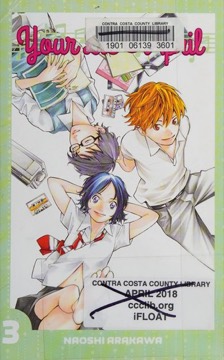
Your Lie in April
Naoshi Arakawa's series, begun in 2011, about a former child piano prodigy who can no longer hear his own playing, and the violinist who forces him back to the instrument.
- First published
- 2016
- Publisher
- Vertical, Incorporated
- Pages
- 189
- Shelf
- Anime
- Level
- Entry
- ISBN-13
- 9781945054266
Record checked against
Only one source carried a publication date for this work, so the year is uncorroborated.
Catalogue note
- Reads as
- ReflectiveChanges how you see rather than what you do.
- Level
- Accessible / FoundationalNo prior reading assumed.
- Approach
- Theoretical
- Written for
- Readers of comics, and anyone curious how the form works, Newcomers to the subject
Saved in this browser only — no account, nothing sent anywhere. My library
Read this if
- You read for the writing as much as for the argument.
- You want a book that changes how you see things rather than what you do tomorrow.
- You are starting from scratch here and want a way in that assumes no prior reading.
What it is
Kōsei Arima was a celebrated child pianist whose mother drilled him to mechanical precision and died when he was eleven. Since then he has been unable to hear the notes he plays.
At fourteen he meets Kaori Miyazono, a violinist whose playing is wildly unorthodox, and she pushes him back toward performance.
He can still play perfectly. He simply cannot hear any of it.
Devmark’s reading — not a quotation from the book
Music as description
The series attempts something difficult: conveying performance in a silent medium, using visual metaphor, colour, water imagery and the audience's reaction rather than notation.
It largely succeeds, and the concert sequences are the best drawing in the book. Arakawa also stages performances as arguments between players, so a duet becomes legible as a disagreement even to a reader who cannot read music.
Abuse and grief
Kōsei's mother was seriously ill and genuinely cruel, and the series is careful that his feelings about her are unresolved: he loved her, she hurt him, and both remain true.
The refusal to simplify this is the work's strongest material, and his eventual accommodation is not forgiveness so much as understanding.
Kaori
She is loud, impulsive, and deliberately performs a version of herself that the narrative later examines.
The character has been criticised as a device for the protagonist's development, and the criticism has force, though the series does more with her interiority in its final volumes than that reading allows.
Competition
The competitive structure of classical performance — juries, placements, the difference between technical accuracy and interpretation — supplies the plot's mechanics.
The series argues consistently that correctness is not the point, which is both its thesis and, in its treatment of actual performance practice, somewhat simplified.
Sentiment
It is extremely emotionally direct, with monologues, tears and declarations, and it makes no attempt at restraint.
Readers divide sharply on this. The series is sincere rather than manipulative in intent, but its methods are unsubtle and it presses hard on every available feeling. It is also relentless: there is no chapter in the final third that does not reach for an emotional peak, and the cumulative effect is exhausting by design.
The art
Clean and expressive, with an exceptional sense of movement in the performance sequences and heavy use of light, petals and water as emotional notation.
The imagery is repetitive by design, building a visual vocabulary that the final volumes then use as shorthand. The performance pages in particular abandon panel structure entirely, spreading a single passage of music across a full spread with figures floating in it.
Comedy
The comic material — slapstick violence between the four central friends — is the weakest element and sits awkwardly against the serious content.
It is a genre convention that the series follows without needing to, and many readers find it actively harmful to the tone.
The ending
The conclusion is heavily signposted from early on and lands hard regardless, with a final device that reframes the title.
It is the series' most discussed element, and its effect depends almost entirely on how a reader has responded to the preceding sentiment. Arakawa also withholds one piece of information until the last possible moment, and whether that constitutes craft or manipulation is the main critical disagreement about the book.
Length
Eleven volumes, complete, which is short enough to read quickly and long enough for the central relationships to develop properly.
The pacing is well judged, with the concert sequences given the space they need and the surrounding material kept brisk. Eleven volumes also makes it one of the shorter complete works in this section, which matters for readers deciding where to start.
Adaptations
A twenty-two-episode animated series adapts it closely and adds actual music, which resolves the medium's central problem and is the version many people prefer.
A live-action film also exists. The manga remains worth reading for the visual invention in the performance sequences, which the animation handles differently rather than better.
Who it is for
Readers who want emotionally direct fiction about grief, performance and recovery, and who do not object to being pressed on.
It is a good entry point to the medium for readers who like music and character drama, and it is entirely self-contained. Readers who dislike sentimentality should avoid it entirely.
What to take away
- 01Sound drawn, not writtenPerformance is conveyed through colour, water imagery and audience reaction rather than through notation.
- 02Love and harm both trueKōsei's feelings about his mother are left unresolved, and his eventual position is understanding rather than forgiveness.
- 03Correctness rejected as the goalThe competitive frame exists so the series can argue that technical accuracy is not what performance is for.
- 04A visual vocabulary built then usedRepeated imagery is deliberate, establishing shorthand the final volumes rely on.
- 05Sincerity without subtletyThe series presses hard on every available feeling, which is intent rather than manipulation and still divides readers.
- 06A convention it did not needThe slapstick comedy is a genre obligation that sits badly against the material and damages the tone.