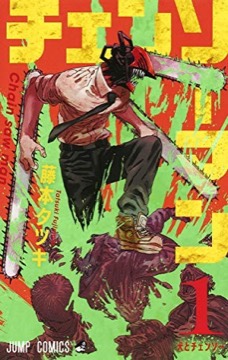
Chainsaw Man
Tatsuki Fujimoto's series, begun in 2018, about an indebted teenager who merges with a chainsaw devil and is recruited as a government devil hunter.
- First published
- 2018
- Publisher
- Shueisha
- Pages
- 191
- Shelf
- Anime
- Level
- Core
- ISBN-13
- 9784088817804
Record checked against
Catalogue note
- Reads as
- ReflectiveChanges how you see rather than what you do.
- Level
- Core / BuildingAssumes general familiarity with the subject.
- Approach
- Theoretical
- Written for
- Readers of comics, and anyone curious how the form works, Readers with some grounding
Saved in this browser only — no account, nothing sent anywhere. My library
Read this if
- You read for the writing as much as for the argument.
- You want to be kept up late, and made uneasy about who to believe.
- You want a book that changes how you see things rather than what you do tomorrow.
- You know roughly how the subject works and want the fuller account.
What it is
Denji lives in extreme poverty, working off his dead father's debt to the yakuza by hunting devils with a chainsaw-dog creature called Pochita. When he is betrayed and killed, Pochita merges with him and he becomes something else.
He is recruited into a public safety division and spends the series pursuing appetites that are almost entirely mundane.
His ambition is bread with jam and someone to touch him. Everything else is incidental.
Devmark’s reading — not a quotation from the book
A protagonist without ambition
Denji does not want to save the world, protect anyone or become strong. He wants food, sleep and physical affection, and states this plainly and repeatedly.
The refusal of heroic motivation is the series' central joke and its central argument: a person raised in deprivation has small, concrete wants, and treating those as beneath a narrative is itself a class judgement.
Devils and their logic
Devils derive power from what humans fear, so the Gun Devil is enormously strong and the Tomato Devil is not, and named fears produce named creatures.
The system is simple and produces genuinely inventive antagonists, including several whose power comes from abstractions that are difficult to fight.
Tone
It moves without warning between crude comedy, extreme gore, genuine pathos and abrupt anticlimax, frequently inside a single chapter.
The instability is deliberate and is the main thing that determines whether a reader connects with it. Fujimoto consistently undercuts his own dramatic peaks. Readers who need a stable register will find it exhausting; readers who enjoy being wrong-footed will find very little else like it.
Fujimoto's influences
The series borrows openly from horror and action cinema, and several arcs are structured around specific films, with panel compositions that quote them directly.
He is an unusually cinephile manga author, and the reference density is part of the texture rather than decoration. He has also written short works that are almost entirely free of genre, and the range is wider than the chainsaws suggest.
Violence
It is extreme, frequent and largely without dignity: characters are dismembered mid-sentence, and deaths are rarely given the weight the genre usually supplies.
The refusal to ennoble death is consistent with everything else in the series, and it makes the few moments that are treated seriously land harder.
Makima
Denji's handler is calm, controlling and deliberately opaque, and the relationship between them is the series' spine.
It is written as exploitation rather than romance, and the series is clear about that while also letting Denji remain unable to see it, which is the most uncomfortable thing in the book.
The art
Loose, urgent and frequently rough, with a strong sense of movement and an obvious impatience with detail that does not serve the moment.
Fujimoto's page compositions are inventive and his action is legible in a way his linework suggests it should not be. The style is a choice rather than a limitation.
Structure
The first part runs to eleven volumes and reaches a genuine conclusion; a second part has since continued with a different protagonist and a slower, more domestic register.
Readers can stop at the end of part one with complete satisfaction, which is rare in this section.
What it is actually about
Underneath the chainsaws it is about poverty, exploitation, and the way people with nothing are recruited by institutions that find their lack of options useful.
Denji's employers are not villains in the ordinary sense; they are simply making rational use of someone who cannot refuse.
The adaptation
A 2022 animated series adapted the early volumes with a deliberately cinematic style, and a film covering a later arc followed.
The adaptation is more restrained than the manga and loses some of the tonal whiplash, which is arguably the source's defining feature. The second part's quieter register may suit adaptation better, though it had not been adapted at the time of writing.
Who it is for
Readers who want something formally unpredictable and are not attached to tonal consistency or to characters surviving.
It is short, complete in its first part, and unlike almost anything else in this section. Readers who find crude humour beside graphic violence intolerable should choose something else.
What to take away
- 01Small wants taken seriouslyDenji's ambitions are food, sleep and affection, and the series treats dismissing those as itself a class judgement.
- 02Power indexed to fearDevils draw strength from what humans dread, so the antagonists are ranked by cultural anxiety rather than by physique.
- 03Deliberate tonal instabilityComedy, gore, pathos and anticlimax sit in single chapters, and Fujimoto consistently undercuts his own peaks.
- 04Death without dignityCharacters are dismembered mid-sentence and rarely given weight, which makes the few serious moments land much harder.
- 05Exploitation written as suchThe central relationship is control rather than romance, and the protagonist's inability to see it is the point.
- 06An institution being rationalDenji's employers are not villains; they are making efficient use of someone who has no option to refuse.