The Talented Mr. Ripley
Patricia Highsmith's 1955 novel about a young man sent to Italy to persuade a rich acquaintance to come home, who decides he would rather be him.
- First published
- 1955
- Publisher
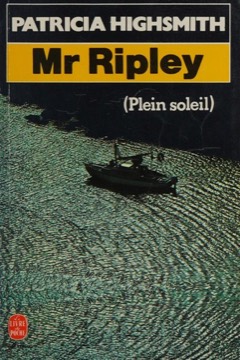
- [Librairie Générale Française]
- Pages
- 318
- Shelf
- Mystery
- Level
- Core
- ISBN-13
- 9782253019381
Record checked against
Sources disagree on the publication year (openlibrary 1979, wikidata 1955). The value shown is the one preferred by the most reliable source for original publication date; the disagreement is recorded rather than resolved.
Catalogue note
- Reads as
- ReflectiveChanges how you see rather than what you do.
- Level
- Core / BuildingAssumes general familiarity with the subject.
- Approach
- Theoretical
- Written for
- Readers who want to be kept up late, Readers with some grounding
- Ideas
Saved in this browser only — no account, nothing sent anywhere. My library
Read this if
- You want to be kept up late, and made uneasy about who to believe.
- You want a book that changes how you see things rather than what you do tomorrow.
- You know roughly how the subject works and want the fuller account.
The premise
Tom Ripley is broke, socially adept and running small frauds in New York when Herbert Greenleaf mistakes him for a friend of his son Dickie and pays him to travel to Italy and bring Dickie back.
Tom finds Dickie's life in Mongibello — money, sun, no obligations — and wants it more than he wants the fee.
He is sent to retrieve someone and decides instead to become him.
Devmark’s reading — not a quotation from the book
What makes it unusual
Highsmith writes entirely from Tom's perspective and does not judge him. The reader is placed inside the reasoning of someone without conscience and is made to hope he escapes.
There is no detective figure with moral authority. The tension is purely procedural — whether the impersonation holds — and the moral vacuum is the point rather than an oversight.
You are made to want him to get away with it, which is the novel's actual subject.
Devmark’s reading — not a quotation from the book
Themes
Class and envy drive everything. Tom's crimes are about access to a life he has watched from outside, and Highsmith is precise about the specific humiliations of being the guest who cannot pay.
The relationship between Tom and Dickie carries an unspoken sexual charge that the 1955 text renders obliquely and that later adaptations make explicit.
Its place
First of five Ripley novels, and the one that established Highsmith's reputation for crime fiction without moral resolution.
Highsmith's own reputation is complicated by well-documented antisemitism and racism in her diaries and later life, which is a fact readers are entitled to have.
Highsmith wrote four further Ripley novels across three decades, and unusually for crime fiction the character is allowed to age, prosper and remain entirely unpunished throughout.
The reader's position
Highsmith's method is to give Tom no interior condemnation and then have the reader supply none either. Suspense is generated by fear of his being caught rather than hope of it, and noticing that switch has happened is the book's most uncomfortable effect — it is engineered, and it works on nearly everyone.
You will find yourself hoping he gets away with it, and the book arranged that deliberately.
Devmark’s reading — not a quotation from the book
Competence and its limits
Tom is not a criminal mastermind: he improvises, panics, makes errors, and several times survives by luck or by other people's incuriosity. Highsmith is precise about the administrative reality of a deception — signatures, letters, hotel registers, timing — which is what makes the danger feel continuous.
Wanting to be someone
His desire is not for money as such but for a life: the clothes, the ease, the freedom from calculation that Dickie has without noticing it. The novel is a study of envy that has passed through admiration and come out as a wish to occupy rather than to possess.
What is left unsaid
Tom's attraction to Dickie is present throughout and never stated, which in 1955 was partly necessity and is also a structural choice. The refusal to name it keeps the relationship unresolved in a way that a franker treatment would have closed off, and it is part of why the book still reads as modern.
Italy
The specificity of place — Mongibello, Rome, Venice, the trains and boats between them — does the work of a police procedural in reverse. The reader tracks geography and paperwork the way an investigator would, which is how Highsmith sustains tension across a plot with very little violence in it.
The series and the screen
It is the first of five Ripley novels and the others follow him into a settled life without ever moralising. Screen versions have generally supplied the judgement the books withhold, which is the single most useful thing to know before coming to the novel from any adaptation.
What to take away
- 01Inside a man without conscienceNo judging narrator; the reader is placed in his reasoning.
- 02No detectiveTension is procedural, not moral.
- 03Class and envyThe crimes are about access to a life observed from outside.
- 04An oblique chargeThe Tom-Dickie relationship rendered indirectly in 1955.
- 05The author's recordHighsmith's documented prejudices are part of what travels with her work.