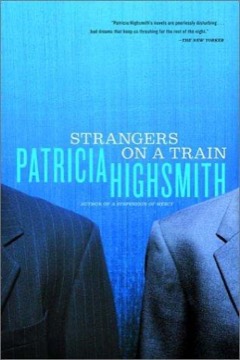
Strangers on a Train
Patricia Highsmith's 1950 debut, in which two men meet on a train and one proposes that they exchange murders.
- First published
- 1950
- Publisher
- Norton & Company Limited, W. W.
- Pages
- 256
- Shelf
- Thriller
- Level
- Core
- ISBN-13
- 9781405882323
Record checked against
Catalogue note
- Reads as
- ReflectiveChanges how you see rather than what you do.
- Level
- Core / BuildingAssumes general familiarity with the subject.
- Approach
- Theoretical
- Written for
- Readers who mean to stop at one more chapter, Readers with some grounding
- Ideas
Saved in this browser only — no account, nothing sent anywhere. My library
Read this if
- You want to be kept up late, and made uneasy about who to believe.
- You want a book that changes how you see things rather than what you do tomorrow.
- You know roughly how the subject works and want the fuller account.
The premise
Guy Haines, an architect travelling to negotiate a divorce, shares a compartment with Charles Bruno, a wealthy idler who drinks steadily and talks without stopping.
Bruno proposes a theory: two strangers, each with someone they want dead, could swap murders and neither would ever be connected to the crime. Guy dismisses it. Bruno does not.
One of them was joking. The novel is about discovering that the other was not.
Devmark’s reading — not a quotation from the book
Guilt without action
Guy commits nothing and is nevertheless implicated, and the novel's subject is the psychological consequence of having been offered something and not refused it forcefully enough.
Highsmith is interested in complicity as a mental state rather than as a legal one, and the distinction is where the book's discomfort originates.
Bruno
He is needy, alcoholic, fixated on his mother and on Guy, and entirely without a sense of other people as separate.
He is one of Highsmith's characteristic creations: not a criminal mastermind but a damaged man whose attention is a form of siege, and the pursuit is social rather than physical.
The relationship
The connection between the two is written with an unmistakable erotic charge that the period required to remain implicit.
Highsmith's handling of this is expert. Bruno's obsession reads as desire, possession and identification simultaneously, and Guy's inability to shake him off is partly an inability to name what is happening.
Psychological deterioration
The second half follows Guy's disintegration: drinking, paranoia, an inability to work, and a growing conviction that he deserves what is happening.
Highsmith is far more interested in this than in whether he is caught, and the novel's final movement is about confession as relief rather than as defeat.
Morality
The book declines to supply a moral framework, and its most disturbing suggestion is that the difference between Guy and Bruno is circumstantial rather than essential.
This became Highsmith's permanent position across her career, and it is stated here for the first time with complete clarity.
Prose
Plain, close and slightly airless, with a great deal of interior monologue and very little scene-setting.
Highsmith writes from inside a deteriorating mind more effectively than almost anyone, and the flatness of the prose is what makes the deterioration legible. She also withholds almost all physical description of her characters, which keeps the reader inside their reasoning rather than observing them from outside.
Structure
The murders occur early and the remainder is aftermath, which inverts the conventional shape and removes suspense about events in favour of suspense about minds.
The inversion is deliberate. Highsmith consistently found the consequences more interesting than the acts. The pursuit in the second half is entirely social — telephone calls, letters, unexpected visits — and the absence of physical threat makes it considerably more claustrophobic.
The Hitchcock film
The 1951 adaptation changes the plot substantially: Guy does not commit a murder, the ending is entirely different, and the moral situation is resolved.
The film is excellent and is a different work. The novel's refusal to let Guy remain innocent is precisely what Hitchcock removed.
A first novel
It was published when Highsmith was twenty-nine and already contains her mature preoccupations: guilt, identity exchange, male pairs, and the instability of moral categories.
The Talented Mr Ripley followed five years later and refined the same material into something considerably colder. Highsmith also wrote it while working in comics, and the economy of the setup owes something to a form that has to establish a situation very quickly.
Its influence
The exchanged-murder premise has been borrowed extensively and is now a recognised plot device, usually deployed with less interest in its psychological consequences.
Highsmith's wider influence on the psychological thriller is difficult to overstate, and this is where it begins. Her Ripley novels are the better-known work, and readers who respond to this should go to The Talented Mr Ripley next.
Who it is for
Readers who want suspense generated by character rather than by plot, and who are comfortable with a book that declines to condemn anyone.
It is short and uncomfortable. Readers who know the film will find the novel considerably darker and its protagonist considerably less sympathetic.
What to take away
- 01Complicity as a mental stateGuy does nothing and is implicated anyway, and the novel treats guilt as psychological rather than legal.
- 02Desire that cannot be namedBruno's obsession reads as attraction, possession and identification at once, and the period required all of it to stay implicit.
- 03Consequences over actsThe murders occur early and the rest is aftermath, which inverts the conventional shape deliberately.
- 04A circumstantial differenceThe book's most disturbing suggestion is that Guy and Bruno differ by situation rather than by nature.
- 05Confession as reliefThe final movement treats admission as something the protagonist wants rather than as defeat.
- 06What Hitchcock removedThe film keeps Guy innocent and resolves the moral situation, which is exactly what the novel refuses to do.