Big Little Lies
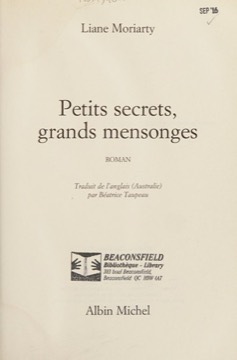
Liane Moriarty's novel about three mothers at an Australian primary school, told around a death at a school fundraiser that the reader does not yet understand. Comedy about playground politics wrapped around a serious book about domestic abuse.
- First published
- 2014
- Publisher
- Albin Michel
- Pages
- 475
- Shelf
- Mystery
- Level
- Entry
- ISBN-13
- 9782226317346
Record checked against
Two sources agreed on 2014; a third reported differently (openlibrary 2016, wikidata 2014, wikipedia 2014).
Catalogue note
- Reads as
- ReflectiveChanges how you see rather than what you do.
- Level
- Accessible / FoundationalNo prior reading assumed.
- Approach
- Theoretical
- Written for
- Readers who want to be kept up late, Newcomers to the subject
Saved in this browser only — no account, nothing sent anywhere. My library
Read this if
- You want to be kept up late, and made uneasy about who to believe.
- You read for the writing as much as for the argument.
- You want a book that changes how you see things rather than what you do tomorrow.
- You are starting from scratch here and want a way in that assumes no prior reading.
The premise
Madeline is loud, loyal and still furious about her first marriage. Celeste is beautiful, wealthy and married to a man everyone envies her. Jane is young, broke and new in town with a five-year-old son who is accused, on the first day of school, of hurting a classmate.
The novel opens at a school trivia night where somebody has died, and then goes back six months. Interspersed are fragments of police interviews with other parents — gossipy, contradictory, very funny — which withhold both the victim and the circumstances.
The interview fragments are the joke and the method: everyone has a theory, nobody has the facts.
Devmark’s reading — not a quotation from the book
How it is built
Moriarty writes social comedy extremely well, and uses it as cover. The book is genuinely entertaining about competitive parenting for long stretches, which is what makes the material underneath land when it arrives.
The withheld-death frame is a standard device, but it is doing real work here: it makes the reader treat every ordinary marital scene as potential evidence, which is close to how the abuse in the book actually operates.
The comedy is not a coating on the serious book. It is how the serious book gets past your guard.
Devmark’s reading — not a quotation from the book
Themes
The central subject is intimate partner violence, and the novel's most valuable move is showing how difficult it is to leave from the inside, including for a woman with money, education and options. Celeste's chapters are careful about shame, love and self-deception in a way the genre rarely manages.
Around it sits a lighter but real argument about how women police each other, and how quickly a playground can organise itself into factions.
The playground
The engine is a primary school and its parents: the committees, the pickup hierarchy, the fundraiser, the group messages. Moriarty uses the pettiest possible arena to establish who has power over whom, and the reader learns the social map so thoroughly that the serious material lands on ground already prepared.
The interview fragments
Between chapters, minor characters give gossipy statements to an investigation about an event the reader has not yet seen. The device supplies forward momentum, tells you something happened without telling you what, and quietly demonstrates the book's theme: everyone has an account, all of them are partial, and most are self-serving.
Everybody gives a statement. Everybody is certain. Almost nobody was looking.
Devmark’s reading — not a quotation from the book
What it is actually about
Beneath the comedy the subject is intimate partner violence, and the novel's most valuable insight is how the marriage looks from inside: the shame, the private logic, the way a woman with resources and intelligence explains the situation to herself. It refuses the assumption that this happens elsewhere, to other people.
Three women, deliberately chosen
The three leads are constructed to cover deliberately different ground: one loud, settled and financially comfortable; one beautiful, wealthy and outwardly the most enviable woman in the room; one young, single and precarious. Moriarty uses the contrast to demonstrate how differently the same category of harm is perceived, reported and believed depending entirely on who it is happening to and what they appear to have.
Comedy as method
The humour is not relief from the serious material; it is the delivery system for it. Readers are disarmed by a very funny book about school politics and are therefore inside the subject before they have braced for it, which is a deliberate and effective structure.
The children
The novel takes the children seriously as people rather than as plot devices, and the running question of what one child did to another is handled with the same care as the adult material. Moriarty is good on how partial a parent's knowledge of their own child actually is, and how confidently they act on it anyway.
Every parent in the book is certain about their child. Almost none of them is right.
Devmark’s reading — not a quotation from the book
The adaptation
The television version relocated the story to California, expanded some roles considerably and added material in its second season with no basis in the novel. It is well made and a reader coming from it should expect a different setting, a tighter plot and a comic register the screen version dials down.
What to take away
- 01Comedy as an entry pointThe social satire earns the trust that the darker material then uses.
- 02Why leaving is hardCeleste has every external resource and still cannot go, and the book explains why without excusing anyone.
- 03A chorus of witnessesThe interview snippets show how a community builds a story out of gossip and grievance.
- 04Suspicion as a lensKnowing someone will die makes ordinary domestic scenes read as evidence — which is the point.
- 05Mothers judging mothersThe playground factions are funny and also the mechanism that isolates the person who needs help.