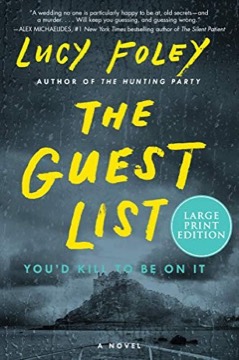
The Guest List
Lucy Foley's closed-circle thriller set at a wedding on a remote island off the Irish coast, where a storm cuts the party off and a body is found.
- First published
- 2020
- Publisher
- Intrínseca
- Pages
- 336
- Shelf
- Mystery
- Level
- Entry
- ISBN-13
- 9780062868930
Record checked against
Catalogue note
- Reads as
- ReflectiveChanges how you see rather than what you do.
- Level
- Accessible / FoundationalNo prior reading assumed.
- Approach
- Theoretical
- Written for
- Readers who want to be kept up late, Newcomers to the subject
Saved in this browser only — no account, nothing sent anywhere. My library
Read this if
- You want to be kept up late, and made uneasy about who to believe.
- You read for the writing as much as for the argument.
- You want a book that changes how you see things rather than what you do tomorrow.
- You are starting from scratch here and want a way in that assumes no prior reading.
The premise
A television presenter and a magazine founder marry on Inis an Amplóra, a small island with one restored folly, reachable only by boat. The guest list includes university friends with a shared history nobody will describe directly.
The weather closes in. The novel opens with a body and then goes back through the preceding day.
An island, a storm, a wedding party, and a shared history nobody will say out loud.
Devmark’s reading — not a quotation from the book
The structure
Foley rotates among several narrators — the bride, the bridesmaid, the plus-one, the wedding planner, the best man — with short chapters and interleaved flashbacks to school and university.
Crucially the victim is withheld as well as the killer, so the reader spends the book assessing who is most likely to be dead rather than only who is guilty.
You do not know who died, which doubles the number of questions in play.
Devmark’s reading — not a quotation from the book
What it is doing
It is a deliberate modern reworking of the Christie closed circle, and Foley has been explicit about the debt. The island functions exactly as the country house did.
The social material — old school hierarchies, money, the specific cruelty of a group that formed at fifteen — is more substantial than the genre usually attempts.
What kind of book it is
Fast, plotted for momentum, and built for a reader who wants a single weekend's read rather than a dense one.
Its multiple narrators are functional rather than distinct in voice, which is the most common criticism and a fair one.
Foley has written several further closed-circle thrillers in the same mode, and this is the one where the device is tightest, largely because the island imposes a genuinely small cast.
The island
A wedding held on a remote island off the Irish coast, with a treacherous bog, a ruined folly, no way off the island in bad weather and almost no phone signal, supplies a closed circle enforced entirely by geography. Foley's setting does precisely the work Christie's islands and snowbound trains did, and the novel is entirely open about the debt rather than pretending to originality.
Rotating narrators
Six voices take turns — the bride, the plus-one, the best man, the wedding planner, the bridesmaid and others — and every one of them is concealing something specific from the reader as well as from the other guests. The chapters are short enough that momentum never drops for more than a page or two. The technique distributes suspicion evenly across the whole party rather than directing it anywhere in particular.
The body comes last
Brief flash-forwards to a scream, a power cut and a body lying somewhere in the dark are interleaved throughout the build-up to the wedding day, so the reader knows with certainty that a killing occurs without knowing who dies or who is responsible. Withholding the identity of the victim as well as the murderer is the book's principal structural idea and the main source of its pull.
You are told there is a body long before you are told whose.
Devmark’s reading — not a quotation from the book
The ushers
The groomsmen and their shared boarding-school history supply the novel's actual subject: what a group of boys did to another boy years earlier, the code of silence that kept it quiet into adulthood, and how comfortably these men now carry it while running companies and getting married. The social observation in these sections is considerably sharper than the mystery plotting around it.
Weddings as pressure
Foley uses the machinery of an expensive wedding — the seating plan, the best man's speech, the dress, the two families meeting for the first time, the photographs that must be taken — to keep every character publicly performing while their private situations deteriorate underneath. The comedy of the logistics is doing real structural work in raising the tension rather than releasing it.
What it is and is not trying to do
This is a fast commercial thriller with a plot engineered for propulsion rather than plausibility: characterisation is thin outside two of the six narrators, several revelations arrive by coincidence, and the resolution depends on a sequence of people being in exactly the right place. It is extremely efficient at the thing it sets out to do, which is to be unputdownable for a weekend, and it does not attempt anything beyond that.
What to take away
- 01A closed circleAn island and a storm doing what the country house used to do.
- 02Victim withheldNeither the dead nor the killer is known, which doubles the questions.
- 03Rotating narratorsFive viewpoints with interleaved flashbacks.
- 04School hierarchiesThe social material is sharper than the genre usually bothers with.
- 05Momentum over voiceBuilt for pace; the narrators are not strongly differentiated.