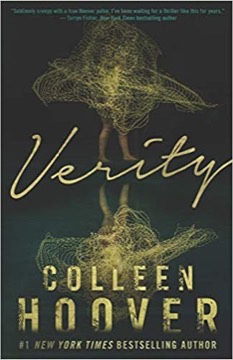
Verity
Colleen Hoover's thriller about a struggling writer hired to finish an injured novelist's series, who finds an unpublished manuscript in the house that reads as a confession.
- First published
- 2018
- Publisher
- Devir
- Pages
- 343
- Shelf
- Mystery
- Level
- Entry
- ISBN-13
- 9788408225621
Record checked against
Catalogue note
- Reads as
- ReflectiveChanges how you see rather than what you do.
- Level
- Accessible / FoundationalNo prior reading assumed.
- Approach
- Theoretical
- Written for
- Readers who want to be kept up late, Newcomers to the subject
Saved in this browser only — no account, nothing sent anywhere. My library
Read this if
- You want to be kept up late, and made uneasy about who to believe.
- You read for the writing as much as for the argument.
- You want a book that changes how you see things rather than what you do tomorrow.
- You are starting from scratch here and want a way in that assumes no prior reading.
The premise
Lowen Ashleigh is broke and grieving when she is offered the job of completing Verity Crawford's bestselling series. Verity is alive but incapacitated after an accident. Lowen moves into the family home to work through the notes.
Among them is an autobiography Verity never published. It is explicit, disturbing, and describes the family's history in terms nobody else has used.
The book inside the book is the engine, and its reliability is the question.
Devmark’s reading — not a quotation from the book
How it is built
The structure is a manuscript within a novel, alternating Lowen's narration with chapters of Verity's document. That lets Hoover run two competing accounts without a narrator having to lie.
The ending is deliberately unresolved in a way that has generated a large amount of argument among readers. Whether that is a strength or a dodge is the main thing people disagree about.
Two documents, two accounts, and no neutral party to adjudicate between them.
Devmark’s reading — not a quotation from the book
What to know before reading
This is Hoover's darkest book and contains graphic material including violence involving children. It is marketed as romantic suspense and is considerably harsher than that suggests.
Read it for the structural trick rather than for character: the pleasure is in an unreliable document rather than in anyone's interior life.
Why it sold
Verity arrived as book recommendation moved to short video, and it suits that distribution unusually well: a premise that states in one sentence, a short reading time, and an ending built to be argued about in public.
It is worth reading as a product of that environment as well as a novel. The construction rewards discussion in a way a quieter thriller would not, and the discussion is a large part of what the book is for.
A book inside a book
The structure alternates the narrator's present-day account with chapters of a manuscript she finds, supposedly an unfinished autobiography by the woman whose work she has been hired to complete. The manuscript is the book's engine and the source of everything that is meant to disturb.
The reliability problem
Nothing in the manuscript can be independently checked, and the narrator's own account is delivered by someone with an obvious motive. Hoover keeps both sources compromised, which is the construction the whole novel depends on — and the ending's additional material is designed to reopen rather than settle it.
Neither document can be verified. That is not a weakness in the plot; it is the plot.
Devmark’s reading — not a quotation from the book
The house
Almost all of the novel takes place inside one large isolated house containing an incapacitated woman, her husband, a surviving child and the narrator who has moved in to work. The confinement is straightforward gothic apparatus transplanted into a contemporary thriller, and its main function is to supply a constant, low, physical possibility of being discovered with the manuscript open.
Why it was a word-of-mouth success
It was originally self-published and spread almost entirely through online reading communities and short video recommendations rather than through reviews or bookshop placement, eventually becoming one of the best-known titles in a genre that was largely built outside traditional publishing altogether. Its commercial history is at least as notable as its content and explains a cultural footprint that its reviews alone would never predict.
Where the criticism lands
Critics have objected, with some force, to the treatment of disability in the book, to the use of serious harm to children primarily as shock material, and to characterisation that appears to exist mainly in order to service the plot's reversals. The prose is functional rather than crafted, and the novel consistently prioritises immediate effect over plausibility, which is either the point or the problem depending on the reader.
What to know first
It contains graphic sexual content, detailed depictions of serious harm to children, and extended passages of psychological cruelty, and it is written throughout to disturb rather than to examine anything in particular. Readers should treat the content warnings attached to it as entirely literal rather than as marketing: this is not a thriller that gestures at darkness from a safe distance, and it is not for everyone.
What to take away
- 01A manuscript inside a novelVerity's unpublished autobiography runs alongside Lowen's account.
- 02Unreliability without lyingTwo documents disagree; no narrator has to be caught out.
- 03A contested endingThe resolution is deliberately open and is the main thing readers argue about.
- 04Darker than its shelfMarketed as romantic suspense; considerably harsher than that implies.
- 05Structure over characterThe appeal is the mechanism, not interiority.