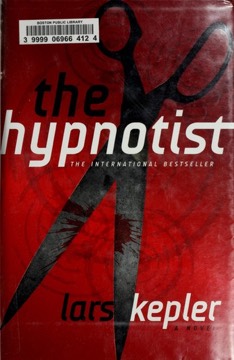
The Hypnotist
Lars Kepler's 2009 novel, the first in a Swedish series, in which a detective asks a hypnotist who has sworn never to practise again to question the only survivor of a family killing.
- First published
- 2009
- Publisher
- ACTES SUD
- Pages
- 571
- Shelf
- Thriller
- Level
- Entry
- ISBN-13
- 9780007461097
Record checked against
Catalogue note
- Reads as
- ReflectiveChanges how you see rather than what you do.
- Level
- Accessible / FoundationalNo prior reading assumed.
- Approach
- Theoretical
- Written for
- Readers who mean to stop at one more chapter, Newcomers to the subject
Saved in this browser only — no account, nothing sent anywhere. My library
Read this if
- You want to be kept up late, and made uneasy about who to believe.
- You read for the writing as much as for the argument.
- You want a book that changes how you see things rather than what you do tomorrow.
- You are starting from scratch here and want a way in that assumes no prior reading.
The premise
A family is killed in a Stockholm suburb. A fifteen-year-old boy survives with catastrophic injuries, and his older sister is missing and presumed targeted next.
Detective Joona Linna asks Erik Maria Bark, a psychiatrist who abandoned hypnosis after a scandal, to question the unconscious boy. Bark agrees.
The only witness is unconscious, and the one man who could reach him swore he never would again.
Devmark’s reading — not a quotation from the book
The opening
The first hundred pages — the discovery, the hospital, the hypnosis session — are the book's strongest material and among the most effective openings in Scandinavian crime fiction.
The session itself is genuinely tense and its consequences drive everything afterwards. The hospital sequence in particular is constructed with real care, and the decision to hypnotise an unconscious patient is given proper ethical weight before it happens.
The authors
Lars Kepler is the pen name of Alexandra Coelho Ahndoril and Alexander Ahndoril, a married Swedish writing team who had both published literary fiction separately.
The pseudonym was maintained for a period after publication, and the collaboration is invisible in the finished prose. They have also continued the series together for well over a decade, and their separate literary careers have largely given way to it.
Structure
The novel runs two plots: the family killings and an unrelated abduction connected to Bark's past hypnosis work, with the second eventually dominating.
The transition is abrupt and is the most common criticism. Readers invested in the first investigation frequently find the shift unsatisfying. The second plot also occupies considerably more of the book than the first, which means the novel's most compelling material is effectively its prologue.
Hypnosis
The treatment is dramatised well beyond clinical reality, with recovered memory and group hypnosis presented as considerably more powerful than evidence supports.
The book is not attempting accuracy. Readers with any background in the subject should expect to be unconvinced. The group-hypnosis scandal in Bark's past in particular relies on effects that have no clinical basis, and the novel presents them without qualification.
Joona Linna
The detective is Finnish, unfailingly correct, and given a habit of announcing that he is right before he is shown to be.
He is thinly characterised in this first book and is developed considerably across the long series that follows. His habit of announcing his own correctness is presented as endearing and is likely to read as irritating to a substantial number of readers.
Violence
The killings are graphic and the novel includes material involving children that is described directly.
The explicitness is consistent with a strand of Scandinavian crime fiction that emerged after Larsson, and readers should expect it. Several sequences also involve harm to children described directly rather than implied, which is worth knowing before beginning.
Pace
Very short chapters, frequent viewpoint shifts and a length that is substantial without feeling slow.
The construction is engineered for continuous reading and achieves it, which is the series' principal commercial quality. The chapters are also frequently two or three pages, which is a commercial decision that suits a novel of this length and keeps the momentum from ever settling.
Prose
Plain and functional in translation, present tense throughout, with description kept minimal.
The present tense is a deliberate choice and produces immediacy at the cost of any reflective register. The translation by Ann Long is serviceable, and readers who find Scandinavian crime translations generally flat will find nothing here to change that impression.
The series
Many Joona Linna novels follow and the series has been extremely successful across Europe, with the formula remaining consistent.
The books can largely be read independently, though the character's personal situation develops across them. The later books have moved further toward the serial-killer procedural, and readers who want that form will find the series delivers it reliably.
Its position
It arrived during the peak international appetite for Scandinavian crime and benefited substantially from it.
It is more commercial than Mankell and less distinctive than Nesbø, and it sits at the entertainment end of the category without pretending otherwise. Its commercial success was substantial across Europe, and the series has sold in very large numbers without attracting the critical attention its contemporaries received.
Who it is for
Readers who want a fast Scandinavian thriller with a strong opening and are untroubled by an implausible central mechanism.
It is the least literary book in this section's Nordic material. Readers who want the tradition at its most serious should read Sjöwall and Wahlöö instead.
What to take away
- 01An opening better than the bookThe discovery, the hospital and the hypnosis session are the strongest hundred pages and set an expectation the rest does not meet.
- 02A plot that swaps itselfThe family killings give way to an unrelated abduction, and the abruptness is the most common objection.
- 03Mechanism beyond evidenceHypnosis and recovered memory are dramatised well past clinical reality, and the book is not attempting accuracy.
- 04Engineered for continuous readingVery short chapters and frequent viewpoint shifts make the length disappear, which is the series' commercial quality.
- 05A pseudonym maintainedA married pair of literary novelists wrote it under one name, and the collaboration is invisible in the prose.
- 06The entertainment end of the categoryMore commercial than Mankell and less distinctive than Nesbø, without any pretence otherwise.