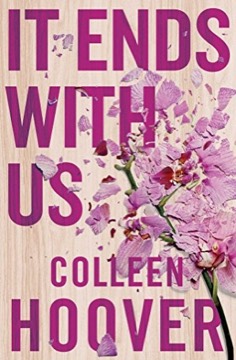
It Ends with Us
Colleen Hoover's novel about a woman who falls in love with a neurosurgeon and then recognises a pattern she grew up watching. A commercial romance that turns into a book about domestic abuse, and about the decision the title names.
- First published
- 2016
- Publisher
- Эксмо
- Pages
- 384
- Shelf
- Love
- Level
- Entry
- ISBN-13
- 9781797107455
Record checked against
Two sources agreed on 2016; a third reported differently (openlibrary 2012, wikidata 2016, wikipedia 2016).
Catalogue note
- Reads as
- ReflectiveChanges how you see rather than what you do.
- Level
- Accessible / FoundationalNo prior reading assumed.
- Approach
- Theoretical
- Written for
- Anyone thinking about how people attach, Newcomers to the subject
Saved in this browser only — no account, nothing sent anywhere. My library
Read this if
- You want to understand why people attach to each other the way they do.
- You read for the writing as much as for the argument.
- You want a book that changes how you see things rather than what you do tomorrow.
- You are starting from scratch here and want a way in that assumes no prior reading.
The premise
Lily Bloom moves to Boston, opens a flower shop and meets Ryle Kincaid, a neurosurgeon who is charming, driven and honest about not wanting a relationship. They begin one anyway. Interleaved are letters the teenage Lily wrote about Atlas, a homeless boy she sheltered, and about her father's treatment of her mother.
The novel begins as a romance and does not stay one. What it becomes is an account of how a woman who swore she would never tolerate what her mother tolerated finds herself making the same calculations.
The title is not about a relationship ending. It is about a pattern ending, and about who has to end it.
Devmark’s reading — not a quotation from the book
How it is built
Hoover's structure withholds by chronology: the teenage journals arrive slowly, so the reader understands Lily's frame of reference only as it becomes relevant. The prose is plain and fast, which is a commercial choice and also a functional one — the material is heavy and the sentences do not add weight to it.
The key craft decision is that Ryle is written to be genuinely likeable first. The book needs the reader to have invested in him, because that investment is the thing it is trying to explain.
You are made to like him on purpose, so that you understand why leaving is not simple.
Devmark’s reading — not a quotation from the book
Reception and caution
The book has been criticised, seriously, for being marketed and consumed as romance when its subject is abuse, and for a cover and social-media afterlife that flattened it. Those criticisms are fair and worth knowing before reading.
Hoover has said the novel draws on her mother's experience, and the author's note is part of the work. Readers for whom this material is close should know the book does depict violence directly.
The recognition
The novel's structure depends on a woman who watched her mother be beaten discovering, incrementally, that she is inside the same pattern. Hoover writes the incidents as they would be experienced rather than as they look from outside: each one with a plausible explanation, an apology, and a reason it was not what it appeared.
Every single incident arrives with an explanation attached. That is exactly how it works.
Devmark’s reading — not a quotation from the book
Why she stays
The book's most valuable work is on the question readers ask from outside. It shows the investment already made, the shame, the love that is real and coexists with the harm, and the specific difficulty of leaving someone everybody else admires — none of which is available from a list of warning signs.
Atlas
Atlas, the first love who reappears years later, functions structurally as evidence that a different kind of relationship is possible rather than as a rescue or an alternative prize. The novel is careful on this point: the decision, when it eventually comes, is explicitly not made because somebody else is available, and Hoover removes him from the scene at the moment it matters in order to make that unambiguous.
The letters
Lily's teenage diary entries, written as letters to a television presenter she watched after school, supply the backstory in the child's own voice and allow Hoover to show the pattern she grew up inside directly rather than summarising it from adulthood. It is a device that risks sentimentality at every turn and mostly avoids it, largely because the entries are funny before they are frightening.
Where it came from
Hoover has written that the novel is based on her mother's experience and that she found it the hardest thing she has written. That origin is the strongest argument for the book's seriousness and it does not resolve the criticism of how it was later sold.
The title
The phrase names the novel's actual argument: not that a particular relationship ends, but that a pattern transmitted down through a family is stopped deliberately by one person, at a specific and calculated cost to herself. Hoover places that decision in the context of a daughter who watched her own mother fail to make it, which is what gives the final chapters their weight.
It is not a statement about a couple. It is a statement about a line of inheritance.
Devmark’s reading — not a quotation from the book
The marketing problem
It was widely promoted as a romance, including by its publisher and by the social media that drove its enormous sales, and many readers arrived unprepared for a novel about domestic violence. The book's own content note came later. Approach it as what it is, not as what the cover suggested.
What to take away
- 01A pattern, not an incidentThe book's subject is inheritance: what the daughter of an abused woman has learned to accept.
- 02Likeable on purposeRyle is written to be loved, because the novel is explaining love that does not protect you.
- 03Two timelinesThe teenage journals supply the frame Lily is unknowingly using.
- 04The cost of the decisionEnding it is presented as expensive and lonely rather than triumphant.
- 05Read with the criticismIts packaging as romance is a real objection and travels with the book.