Jane Eyre
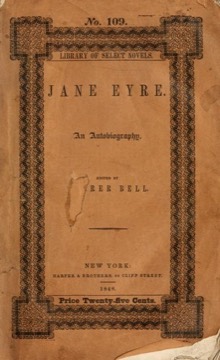
Charlotte Brontë's 1847 novel, narrated by a poor, plain governess who refuses at every stage to be made smaller. A gothic romance that is also one of the first English novels to insist a woman has an interior life of full weight.
- First published
- 1847
- Publisher
- Globe Fearon
- Pages
- 480
- Shelf
- Love
- Level
- Core
- ISBN-13
- 9780893757793
Record checked against
Catalogue note
- Reads as
- ReflectiveChanges how you see rather than what you do.
- Level
- Core / BuildingAssumes general familiarity with the subject.
- Approach
- Theoretical
- Written for
- Anyone thinking about how people attach, Readers with some grounding
Saved in this browser only — no account, nothing sent anywhere. My library
Read this if
- You want to be kept up late, and made uneasy about who to believe.
- You want to understand why people attach to each other the way they do.
- You want a book that changes how you see things rather than what you do tomorrow.
- You know roughly how the subject works and want the fuller account.
The premise
Jane is orphaned, raised by an aunt who despises her, and sent to a charity school where cold and hunger kill other children. She survives it, teaches there, and takes a post as governess at Thornfield Hall, where she is employed by Edward Rochester.
What develops between them is complicated by the house, which has something in it that nobody will explain, and by the fact that Jane has neither money nor family and therefore no protection at all.
Jane's refusal to be netted is the book's argument, not a flourish.
Devmark’s reading — not a quotation from the book
How it is built
The first-person narration was the radical part. Jane addresses the reader directly, judges her elders, and reports her own anger without apology, at a time when novels about women were expected to model submission.
Structurally it is five distinct places — Gateshead, Lowood, Thornfield, Moor House, Ferndean — each with its own temptation and its own test. The architecture is closer to a spiritual progress than to a courtship plot.
Themes
The insistence is on moral equality rather than social equality: Jane repeatedly asserts that she has a soul of the same size as anyone else's, which is the claim the book stakes everything on.
Money runs under it all. Jane's choices are constrained at every point by having none, and the novel is unusually frank that independence and income are the same question for a woman in 1847.
The romance is conditional on Jane's terms, and she leaves rather than accept it on his.
Devmark’s reading — not a quotation from the book
The argument around it
Jean Rhys's Wide Sargasso Sea (1966) rewrote this book from the perspective of the woman in the attic, and made visible the colonial money and the racial assumptions Brontë's novel uses without examining.
That critique is now inseparable from Jane Eyre. Reading it aware of what it does not see is not a modern imposition; it is the fuller version of the book.
The address to the reader
Jane speaks directly to whoever is reading, repeatedly and by name, and the device is not decorative. It establishes her as a person giving an account on her own authority at a time when the novel's central question is whether a poor, plain, dependent woman has standing to judge anything. The famous line announcing a marriage is the culmination of a claim made on every page.
She does not describe what happened to her. She tells you, on her own authority.
Devmark’s reading — not a quotation from the book
Lowood
The school section is drawn closely from the institution Brontë and her sisters attended, where two of them contracted the illness that killed them. The cold, the hunger, the hair-cutting and the public humiliation are reported rather than invented, and the chapter's anger is the source of everything Jane later refuses to accept.
The proposal she turns down
The second marriage offer, from a man who wants a fellow missionary rather than a wife, is the novel's real moral test. It would be virtuous, useful and socially unimpeachable, and Jane refuses it because it asks her to be used well rather than loved. Her rejection of a good man is harder-won than her rejection of a bad situation.
The inheritance
Her financial independence arrives before the reunion, and the sequence is deliberate: she returns as an equal rather than as a dependant. Brontë arranges the plot so the marriage cannot be read as rescue, which is a structural answer to the charge that the novel's ending undoes its argument.
The woman in the attic
The first wife is Creole, from a Jamaican plantation family, and her money built the fortune Rochester lives on. A landmark postcolonial reading, and the novel written in response to it, made her the centre of a long argument about what the book does and does not see — an argument worth carrying into it rather than discovering afterwards.
The gothic and the ordinary
Brontë runs supernatural machinery — a laugh in a corridor, a voice across distance, a fire — alongside minute realism about wages, meals and what a governess was paid. The mixture was what unsettled early readers, and it is why the book sits awkwardly and productively between two genres.
What to take away
- 01A narrator who judgesJane assesses her betters out loud, which in 1847 was the shocking part.
- 02Independence is financialEvery moral choice Jane makes is bounded by having no money of her own.
- 03Five houses, five testsThe structure is a progress, not a courtship.
- 04Equality of soulJane's central claim is that her interior life weighs the same as anyone's.
- 05What it cannot seeWide Sargasso Sea exposed the colonial foundation the novel treats as furniture.