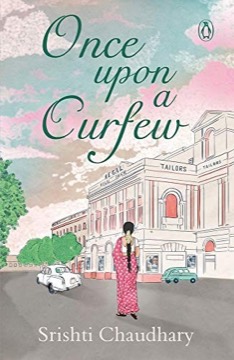
Once Upon a Curfew
Srishti Chaudhary's novel set in Delhi in 1974, about a young woman who opens a library for women in her grandmother's empty flat, just as Indira Gandhi's Emergency approaches.
- First published
- 2019
- Publisher
- Penguin Books India PVT, Limited
- Pages
- 304
- Shelf
- Love
- Level
- Entry
- ISBN-13
- 9780143445968
Record checked against
Only one source carried a publication date for this work, so the year is uncorroborated.
Catalogue note
- Reads as
- ReflectiveChanges how you see rather than what you do.
- Level
- Accessible / FoundationalNo prior reading assumed.
- Approach
- Theoretical
- Written for
- Anyone thinking about how people attach, Newcomers to the subject
Saved in this browser only — no account, nothing sent anywhere. My library
Read this if
- You want to understand why people attach to each other the way they do.
- You read for the writing as much as for the argument.
- You want to know how we got here.
- You want a book that changes how you see things rather than what you do tomorrow.
- You are starting from scratch here and want a way in that assumes no prior reading.
The premise
Indu is twenty, engaged to a man studying in London, and given the use of her grandmother's unoccupied flat. She decides to make it a lending library for women, which requires money, permission and a level of persistence nobody expects from her.
Rana, a law student who helps, is the complication. The Emergency of 1975 is the other.
A young woman in 1974 Delhi decides to open a library, and the country closes around her while she does it.
Devmark’s reading — not a quotation from the book
What it does well
The period is the reason to read it. Chaudhary is specific about middle-class Delhi in the mid-seventies: the marriage arrangements, the expectations around a woman's education, the radio, and then the suspension of civil liberties arriving into ordinary domestic life.
The library itself is the best material — what women borrow, what they say about it, and what a room of their own means in that context.
What kind of book it is
It is a light commercial novel rather than a literary one: the prose is plain, the romance is conventional, and the political material is present rather than examined in depth.
Read it for the setting and the premise, which are unusual in English-language romance, rather than for stylistic ambition.
The premise and period are the draw; the romance itself is conventional.
Devmark’s reading — not a quotation from the book
Its place here
The catalogue holds it as a representative of Indian commercial romance in English, a substantial category with very little presence in Western library lists.
Its engagement with the Emergency also gives it a connection to the catalogue's more serious treatments of the same period.
Books like this rarely appear in English-language catalogues outside India, and their absence gives a distorted impression of what the romance category actually contains globally, which is a reason to hold one.
The library as the plot
Indu's decision to convert an empty flat into a lending library for women is the novel's engine and its argument: a room women can enter alone, choose something in, and sit down without explaining themselves. Everything that happens to her afterwards follows from having created a space that did not previously exist.
The whole book turns on a room where a woman can sit down without being asked why.
Devmark’s reading — not a quotation from the book
Delhi, 1974
The period detail is the reason to read it: middle-class Delhi before the Emergency, the marriage negotiations, the chaperoning, the expectations placed on an educated daughter, and the specific social distance between what a young woman may study and what she may then do with it.
The fiancé in London
Indu's engagement to a man studying abroad structures her situation precisely: she is neither single nor married, is expected to wait, and is being formed into someone suitable for a life that has already been arranged. The absence is what gives her the room to act.
Politics at the edges
The Emergency approaches through the book rather than dominating it — arrests, newspapers, an atmosphere of caution — and reaches the characters late. That is a deliberate scale choice, showing a national event as something that arrives in a household gradually, but readers wanting a political novel will find it thin.
The romance
The central relationship is entirely conventional in shape and is clearly subordinate to the library plot, which is genuinely unusual for the category the book belongs to. The novel is demonstrably more interested in whether Indu gets to keep the thing she built, and on what terms, than it is in which of the available men she ends up marrying at the close.
Why this library holds it
It is light commercial fiction written in plain prose for an Indian readership and published there first, with a gentle pace and no interest in literary difficulty. It is held here as a representative of a very large publishing category — English-language commercial fiction written in and for India — which sells enormously on the subcontinent and is almost entirely invisible on Western shelves and in Western library catalogues.
What to take away
- 01A library as a plotThe founding of a women's lending library is the actual engine.
- 02Delhi, 1974Middle-class domestic detail immediately before the Emergency.
- 03Politics arriving domesticallyThe suspension of liberties reaching an ordinary household.
- 04Light, not literaryPlain prose and a conventional romance; the setting is the value.
- 05An underrepresented categoryIndian commercial romance in English, rarely catalogued elsewhere.