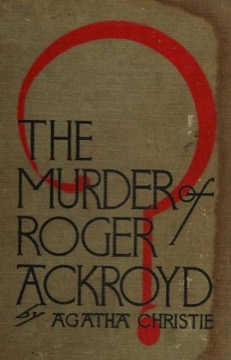
The Murder of Roger Ackroyd
Agatha Christie's 1926 Poirot novel, set in an English village and narrated by the local doctor. Its ending caused a public argument about whether detective fiction had rules and whether she had broken them.
- First published
- 1926
- Publisher
- Rba Publicaciones
- Pages
- 256
- Shelf
- Mystery
- Level
- Entry
- ISBN-13
- 9781986494366
Record checked against
Catalogue note
- Reads as
- ReflectiveChanges how you see rather than what you do.
- Level
- Accessible / FoundationalNo prior reading assumed.
- Approach
- Theoretical
- Written for
- Readers who want to be kept up late, Newcomers to the subject
- Ideas
Saved in this browser only — no account, nothing sent anywhere. My library
Read this if
- You want to be kept up late, and made uneasy about who to believe.
- You want a book that changes how you see things rather than what you do tomorrow.
- You are starting from scratch here and want a way in that assumes no prior reading.
The premise
Roger Ackroyd is stabbed in his study in the village of King's Abbot, the evening after a widow's suicide and a hint of blackmail. Hercule Poirot, supposedly retired and growing vegetable marrows next door, investigates.
Dr James Sheppard, the village doctor, narrates and acts as Poirot's assistant, in the role Hastings usually occupies.
A retired detective, a village, and a narrator who has taken the assistant's chair.
Devmark’s reading — not a quotation from the book
Why it is famous
The solution provoked a genuine controversy in 1926, with some critics arguing Christie had cheated. The consensus since is the opposite: every necessary fact is on the page, and the misdirection is achieved by omission and emphasis rather than by falsehood.
It is the standard example used to teach the difference between withholding and lying in a mystery, and it is why the book is studied rather than merely read.
The argument it caused is the reason it is taught: it withholds without ever lying.
Devmark’s reading — not a quotation from the book
The craft
Christie's technique is to let the reader's assumptions do the work. The narration is scrupulously accurate throughout; what it does is decline to mention things at the moments when mentioning them would be natural.
Re-reading is a different book, and it is designed for that. Almost every chapter contains a sentence that is doing two jobs.
Where to place it
Widely voted the best crime novel ever written by the Crime Writers' Association, and the one that established Christie's reputation beyond the genre.
It should not be the first Christie read if you already know the solution — and the solution is among the most spoiled in literature, so approach unspoiled if at all possible.
Fair play
The novel's notoriety rests on a device many readers felt was a cheat, and the defence is textual: every fact needed is on the page, the misdirection is achieved by omission of the kind any narrator makes, and the sentences in question are literally true throughout. Christie plays fair by a narrow definition and knows exactly how narrow it is.
Nothing in it is false. A great deal of it is arranged.
Devmark’s reading — not a quotation from the book
The village
King's Abbot is drawn with real economy in a handful of pages — the gossip network, the doctor's sister who knows everything before anyone tells her, the fine social gradations between the big house, the professional class and the servants. Christie establishes that information travels instantly and unreliably in a small place, which supplies both the comedy of the opening chapters and the precise conditions the crime requires in order to work.
Caroline
The narrator's sister, who extracts and redistributes everything worth knowing in the village without appearing to leave her own sitting room, was described by Christie as the character she most enjoyed writing in the book. She is a clear ancestor of Miss Marple, and the idea that a provincial spinster with no official standing might be the superior intelligence in the room effectively begins here.
Poirot in retirement
He has moved to the village to grow vegetable marrows and does so badly, which is the joke the book opens on. Placing him as a neighbour rather than an official investigator changes the social dynamics of every interview and is part of why the novel feels closer than the others.
The argument it started
Members of the Detection Club argued at length over whether the device broke the genre's implicit rules, and some contemporary reviewers called it an outright swindle. The dispute contributed directly to the formal codes of fair play that writers drew up in the following years. The book is therefore partly responsible for the very conventions it is now usually described as having violated.
Reading it now
Its solution is so widely known that many readers arrive already spoiled, and it survives this better than expected: the pleasure shifts to watching the construction, and the second read is where the craft becomes visible. If you do not know it, avoid every introduction and most blurbs.
What to take away
- 01A narrator in the assistant's chairSheppard takes the Hastings role, which is the setup.
- 02Withholding, not lyingEvery fact is present; emphasis does the misdirection.
- 03The 1926 controversyCritics argued it cheated; the consensus reversed.
- 04Built for re-readingMost chapters contain a sentence doing two jobs.
- 05Approach unspoiledOne of the most widely spoiled endings in fiction.