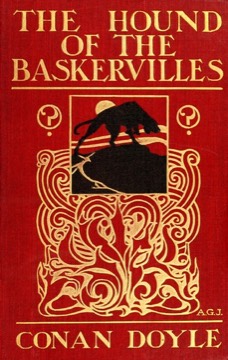
The Hound of the Baskervilles
Arthur Conan Doyle's 1902 Sherlock Holmes novel, set on Dartmoor, in which a family legend about a spectral hound meets a very material inheritance. The most read of the Holmes stories.
- First published
- 1902
- Publisher
- Editions Zulma
- Pages
- 207
- Shelf
- Mystery
- Level
- Entry
- ISBN-13
- 9781849904094
Record checked against
Two sources agreed on 1902; a third reported differently (openlibrary 1900, wikidata 1902, wikipedia 1902).
Catalogue note
- Reads as
- ReflectiveChanges how you see rather than what you do.
- Level
- Accessible / FoundationalNo prior reading assumed.
- Approach
- Theoretical
- Written for
- Readers who want to be kept up late, Newcomers to the subject
- Ideas
Saved in this browser only — no account, nothing sent anywhere. My library
Read this if
- You want to be kept up late, and made uneasy about who to believe.
- You want a book that changes how you see things rather than what you do tomorrow.
- You are starting from scratch here and want a way in that assumes no prior reading.
The premise
Sir Charles Baskerville is found dead on the moor, his face contorted, with the footprints of a gigantic hound nearby. A family document records a curse dating to the seventeenth century.
Holmes sends Watson to Devon to protect the heir, and absents himself — so that for the central section the reader has only Watson, which is the structural choice that makes the book work.
Holmes leaves for the middle of the novel, and the dread is what fills the gap.
Devmark’s reading — not a quotation from the book
Why it endures
It is a Holmes story that runs almost entirely on atmosphere. The moor, the fog, the escaped convict and the sound carrying across the mire do more work than deduction does for two-thirds of the book.
Doyle keeps the supernatural explanation genuinely live. Holmes's rationalism is the counterweight, not the given, and the novel takes the legend seriously enough for the rationalism to mean something.
The supernatural explanation is kept genuinely available, which is what gives the rational one weight.
Devmark’s reading — not a quotation from the book
The context
Doyle had killed Holmes off in 1893 and this was the first new story since, set before Reichenbach to avoid resurrecting him. Public demand eventually brought Holmes back properly.
The Dartmoor setting was drawn from a trip with a journalist friend who supplied local legends, and the geography is close enough to real to be walked.
Where to start
This is the usual entry point to Holmes, and reasonably so: it is self-contained, novel-length, and needs no prior stories.
It is also the least characteristic, precisely because Holmes is offstage for so much of it. The short stories are where the method is on display.
Watson carries the middle
Holmes leaves the narrative for a substantial central stretch and Watson is alone at the Hall, sending reports. It is the best use Doyle ever made of him: a competent, observant man doing real work without the certainty his friend supplies, and the section where the reader is genuinely without a guide.
The best stretch of the book is the one Holmes is not in.
Devmark’s reading — not a quotation from the book
A supernatural story, dismantled
The structure is a rationalist argument in narrative form: a legend is established with every atmospheric advantage, evidence accumulates that seems to confirm it, and it is then taken apart mechanically. Doyle, who later became a committed spiritualist, wrote the most effective anti-supernatural detective story in English.
The moor
Dartmoor does more work than any character in the book: the fog, the distances, the prehistoric stone huts scattered across it, the escaped convict somewhere out there, and the mire that will swallow anything that steps wrong. The landscape supplies a constant low-level threat, which is what allows the plot to proceed slowly and with long stretches of nothing happening without ever losing its tension.
The naturalist
The most effective antagonist in the canon is an unremarkable local man with a butterfly net and a professional interest in the terrain. The plan depends on patience, local knowledge and an accurate reading of what a frightened man will do, which is a considerably better constructed scheme than the criminal masterminds elsewhere in Holmes.
Who supplied the idea
Doyle developed the story after hearing West Country legends from a journalist friend who travelled with him, and acknowledged the debt in print at the time. How much of the plot originated with the collaborator has been argued over since, without resolution, and it is a live question rather than a scandal.
Where it sits in the canon
Holmes had been killed off years earlier and this was not a resurrection: the case is explicitly set before the death, so Doyle could write it without reversing himself or conceding anything to the readers who had been demanding a return. The genuine resurrection came afterwards, in a later story, largely in response to the appetite this book had just demonstrated was still there.
What to take away
- 01Holmes offstageHis absence for the middle section is the structural device.
- 02Atmosphere over deductionThe moor does more work than the method for two-thirds.
- 03A live supernatural optionKept genuinely available, which gives rationalism its stakes.
- 04Written after his deathSet before Reichenbach so Doyle need not resurrect him.
- 05Atypical entry pointSelf-contained and popular, but not where the method shows.