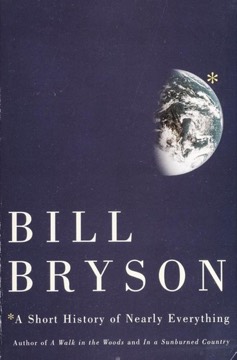
A Short History of Nearly Everything
Bill Bryson's tour of the sciences, written by a travel writer who realised he did not understand the planet he had been writing about. Covers cosmology to palaeontology by way of the people who worked it out.
- First published
- 2003
- Publisher
- Goldmann Verlag
- Pages
- 592
- Shelf
- Science
- Level
- Entry
- ISBN-13
- 9788492966790
Record checked against
Catalogue note
- Reads as
- ConceptualExplains how something works before what to do about it.
- Level
- Accessible / FoundationalNo prior reading assumed.
- Approach
- Theoretical
- Written for
- Curious general readers, Newcomers to the subject
Saved in this browser only — no account, nothing sent anywhere. My library
Read this if
- You want to know how we know things, and how that goes wrong.
- You want to know how we got here.
- You want to understand how it works before deciding what to do about it.
- You are starting from scratch here and want a way in that assumes no prior reading.
The approach
Bryson's method is biographical. Rather than explaining a field, he explains who established it, usually including how unlikely, obsessive or unpleasant they were.
That choice is the book's engine. The reader gets the measurement of the Earth's circumference, the discovery of deep time and the identification of the atom as stories about people making do with inadequate instruments.
It is a history of scientists as much as of science, which is what makes it readable.
Devmark’s reading — not a quotation from the book
What it covers
Cosmology and the age of the universe; geology and plate tectonics; chemistry and the periodic table; the size and emptiness of atoms; the history of life and the several near-extinctions of it; and the improbability of the conditions that allow the reader to exist.
The recurring theme is how recently most of this was settled, and how much remains genuinely open.
Its limits
Published in 2003, so the cosmology and genetics chapters are dated in places — the book predates a great deal of exoplanet and genomic work.
Bryson is a non-scientist reporting, and some specialists have noted simplifications. It is an excellent door into the subject and not a reference; the enthusiasm is the point.
It is a door rather than a reference, and it was written to be exactly that.
Devmark’s reading — not a quotation from the book
The recurring theme
The thread running through every chapter is how much of what we know was established by people who were wrong about most of the rest, working with instruments that should not have been sufficient.
Bryson keeps returning to the near-misses: the measurements that happened to cancel their own errors, the discoveries made by people investigating something else, and the correct conclusions ignored for decades because their author was unfashionable or unpleasant.
Weighing the planet
The early chapters are built around the physical difficulty of measurements now quoted casually. Establishing the mass of the Earth required an eighteenth-century experiment with suspended lead spheres in a sealed shed, detecting a deflection barely visible to the eye. Bryson's method is to make the reader feel the implausibility of the measurement before reporting the number.
Lead, dating and one man's campaign
His most consequential story is the geochemist who set out to date the Earth by measuring lead isotopes, discovered that industrial lead contamination had made clean measurement almost impossible, and spent much of his career fighting the industry that had put it there. It is the book's clearest demonstration that scientific work and public argument are not separable activities.
He set out to date the planet and ended up proving it had been poisoned.
Devmark’s reading — not a quotation from the book
The bone wars
The nineteenth-century palaeontologists who loathed each other, raced to name species, dynamited each other's dig sites and destroyed specimens rather than let a rival have them supply Bryson with his running theme: the science survived the scientists. A great deal of foundational work was done by people who were vain, obsessive, wrong about much of it, or all three.
How long continental drift was refused
Plate tectonics is the case study in delayed acceptance. The proposal that continents move was available for decades and rejected largely because its proposer could not supply a mechanism, and it became consensus only when seafloor evidence arrived. Bryson uses it to complicate the idea that evidence simply wins.
How nearly we are not here
A sustained thread runs through the later chapters on contingency: mass extinctions, impact events, supervolcanic systems, and the specific improbability of an unbroken chain of ancestors. It is the book's one piece of genuine argument rather than reportage, and it is where the tone shifts from delight to something closer to vertigo.
What has moved since 2003
The cosmology and genetics chapters are the most dated: the book predates two decades of exoplanet discovery, the maturing of the human genome's interpretation, the direct detection of gravitational waves and most of modern palaeogenetics, along with the sequencing advances that reshaped what could be recovered from ancient remains. The history of science, which is the bulk of the book, is unaffected by any of it, because a story about how a measurement was first made does not expire when the measurement is refined.
What to take from it
It is a book about how knowledge was obtained rather than a summary of what is known, and that is why it survives being out of date. The recurring lesson — that most of this was established very recently, often by accident, usually by odd people, and is still incomplete — is the part worth keeping.
What to take away
- 01Biography as methodFields explained through the people who established them.
- 02How recent it all isMost of what is described was settled within living memory.
- 03ImprobabilityThe conditions allowing a reader to exist, run through repeatedly.
- 04Dated in parts2003, so cosmology and genomics have moved.
- 05Enthusiasm is the pointWritten by an outsider who wanted to understand.