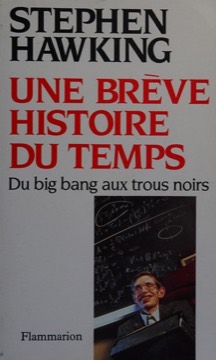
A Brief History of Time
Stephen Hawking's attempt to explain the large-scale structure of the universe — space, time, black holes and the origin of everything — to readers with no mathematics, written with the stated constraint of including as few equations as possible.
- First published
- 1988
- Publisher
- Random House Publishing
- Pages
- 241
- Shelf
- Science
- Level
- Core
- ISBN-13
- 9786051067582
Record checked against
Two sources agreed on 1988; a third reported differently (openlibrary 1988, wikidata 1988, wikipedia 2005).
Catalogue note
- Reads as
- ConceptualExplains how something works before what to do about it.
- Level
- Core / BuildingAssumes general familiarity with the subject.
- Approach
- Theoretical
- Written for
- Curious general readers, Readers with some grounding
- Ideas
Saved in this browser only — no account, nothing sent anywhere. My library
Read this if
- You want to know how the universe is put together.
- You want to understand how it works before deciding what to do about it.
- You know roughly how the subject works and want the fuller account.
What the book is doing
Hawking set out to explain cosmology to people who would never read a physics paper, and the book's structure follows a single question: where did the universe come from, and does that question even have an answer inside physics?
He famously worked under the constraint that each equation would halve his readership, and the book contains essentially one. That decision shapes everything — the arguments are carried by analogy, which is both why it worked and where it strains.
Almost no equations, by design. The arguments arrive as pictures, which is the book's strength and its limit.
Devmark’s reading — not a quotation from the book
Our picture of the universe
The opening traces how the model changed: from a static, eternal cosmos to an expanding one, via Hubble's observation that distant galaxies are receding.
Hawking's point is that an expanding universe is not merely a different picture but a different kind of question. Run the expansion backwards and everything converges, which turns the origin of the universe from a matter for philosophy into a matter for physics.
Space and time
The relativity chapters do the foundational work. Special relativity establishes that the speed of light is the same for all observers and that simultaneity is therefore not absolute. General relativity reinterprets gravity as the curvature of spacetime by mass and energy.
The consequence Hawking emphasises is that time is not a universal backdrop. It is part of the thing being described, which is what makes "before the universe" a much stranger phrase than it sounds.
Black holes
This is Hawking's own field and the book's strongest material. A region where curvature is steep enough that nothing escapes, bounded by an event horizon — a one-way surface rather than a physical object.
His treatment of what an event horizon means for an infalling observer versus a distant one is the clearest thing in the book, and it makes the non-absoluteness of time concrete in a way the earlier chapters only assert.
Black holes are not entirely black
The result that made Hawking's name is the argument that black holes should radiate. Quantum effects near the horizon cause a black hole to emit radiation and slowly lose mass — a conclusion that surprised him and was initially resisted.
Its importance is that it is a genuine bridge between general relativity and quantum mechanics, which is where the search for a deeper theory has been focused since. He also explains the resulting information problem, which remains open.
The arrow of time
Hawking asks why time has a direction when most physical laws do not distinguish forward from backward, and distinguishes thermodynamic, psychological and cosmological arrows.
His argument connecting them is elegant and has been questioned. What is robust is the framing: the direction of time is not a given but something a physical theory has to account for, and that reframing is worth more than any particular resolution.
Most physical laws work equally well run backwards. That time does not is a fact needing explanation.
Devmark’s reading — not a quotation from the book
The no-boundary proposal
The book's most speculative chapter presents work with Jim Hartle: if imaginary time is used, the universe may have no boundary and no initial singularity — finite but without an edge, the way a sphere's surface is.
Hawking is reasonably clear this is a proposal rather than an established result, though the framing occasionally outruns the caveat. It should be read as a live idea, not as settled cosmology.
Where readers get stuck
The commonest report is that the first half is followed and the second half is not, and this is a real property of the book rather than a failure of the reader.
The difficulty is structural: once quantum mechanics and imaginary time arrive, the analogies stop carrying the argument and the missing mathematics starts to matter. The book is often described as more bought than finished, and the chapter where it happens is fairly consistent.
What has changed since
Published in 1988, and cosmology has moved. The accelerating expansion of the universe was discovered in 1998; dark energy is now central and is barely present here. Gravitational waves have been detected, a black hole has been imaged, and the cosmic microwave background has been mapped in detail.
The relativity and black-hole material remains sound. The frontier material should be read as a snapshot of where the field stood, and Hawking's own later books revise several positions.
Why it still matters
It changed what a popular science book could be by refusing to condescend. Hawking treats the reader as capable of holding a genuinely difficult idea if it is explained carefully, and that stance influenced everything written in the genre since.
Read it for the conceptual shift — that space and time are participants rather than a stage — and then read something newer for the current state of play.
What to take away
- 01Time is part of the descriptionNot a universal backdrop, which is what makes 'before the universe' a much stranger phrase than it sounds.
- 02An event horizon is a surface, not an objectA one-way boundary in spacetime, and what it means depends entirely on where you are watching from.
- 03Black holes radiateHawking's own result, and the most important existing bridge between relativity and quantum mechanics.
- 04The arrow of time needs explainingPhysical laws mostly run equally well backwards; that our experience does not is a fact requiring an account.
- 05Read it as a 1988 snapshotRelativity and black holes hold up; dark energy and accelerating expansion arrived a decade after publication.