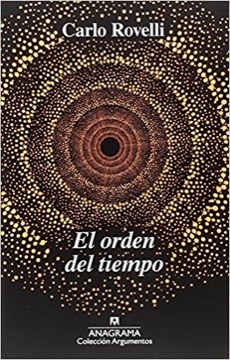
The Order of Time
Carlo Rovelli's argument that time as we experience it — flowing, universal, directional — does not exist at the fundamental level, and that what remains is a network of events rather than a sequence.
- First published
- 2017
- Publisher
- Penguin Books (English edition)
- Pages
- 234
- Shelf
- Science
- Level
- Core
- ISBN-13
- 9788845931925
Record checked against
Catalogue note
- Reads as
- ConceptualExplains how something works before what to do about it.
- Level
- Core / BuildingAssumes general familiarity with the subject.
- Approach
- Theoretical
- Written for
- Curious general readers, Readers with some grounding
Saved in this browser only — no account, nothing sent anywhere. My library
Read this if
- You want to know how the universe is put together.
- You want to examine an assumption you have never examined.
- You want to understand how it works before deciding what to do about it.
- You know roughly how the subject works and want the fuller account.
The structure
The book proceeds in three movements: the dismantling of time as we ordinarily understand it, the description of what physics leaves in its place, and an account of why we nonetheless experience time as we do.
The third part is the most original and the least expected. Having removed time from the physics, Rovelli spends the final third explaining why the experience is real anyway.
Having removed time from the physics, he spends the last third explaining why our experience of it is real.
Devmark’s reading — not a quotation from the book
The loss of unity
His first dismantling: relativity establishes that time passes at different rates depending on gravitational potential and velocity, and this is measured routinely rather than being a theoretical curiosity.
Clocks at different altitudes genuinely disagree, and the effect must be corrected for in satellite navigation. There is no universal now, and two events cannot in general be said to be simultaneous.
The loss of direction
His second: the fundamental equations of physics do not distinguish past from future. The single exception involves entropy, and entropy's increase is the only physical basis for the difference.
His argument, following Boltzmann, is that entropy is not an intrinsic property but depends on how we describe a system — on which differences we blur together. The past differs from the future because of the particular coarse-grained view we occupy.
The loss of the present
His third: given relativity, there is no meaningful global present. What is happening now on a distant galaxy is not a well-defined question, because different observers will give different answers and none is privileged.
The present is local. It extends as far as the region within which simultaneity is approximately well defined, and no further.
The loss of independence
His fourth: in quantum gravity, time does not appear as a background parameter at all. The fundamental description involves relations between variables, none of which is privileged as the time variable.
The Wheeler-DeWitt equation, which contains no time variable, is his technical anchor. The claim that fundamental physics may be entirely timeless is genuinely held by serious physicists and is not settled.
What remains: events, not things
His positive account. The world is not made of things persisting through time but of events — happenings, processes, relations — and what we call an object is a process that is slow relative to us.
A stone is a long event. A kiss is a short one. The difference is degree rather than kind, and this is the metaphysical claim the book is actually making.
A stone is a long event and a kiss is a short one. The difference is degree, not kind.
Devmark’s reading — not a quotation from the book
Why we experience time anyway
His third section, and the most interesting. Our experience of time's flow comes from our position: we are macroscopic systems that interact with the world through a blurred description, which produces entropy, which produces an arrow.
His argument that memory and anticipation — the specific structure of a brain that records traces and projects forward — constitute the experience of duration connects the physics to the phenomenology in a way most such books do not attempt.
The emotional register
He ends with mortality, with Proust, with the Epic of Gilgamesh, and with the claim that understanding time's nature does not diminish the significance of a finite life.
This is either the book's best feature or its least disciplined. Rovelli moves between physics and lyric without marking the transition, and a reader wanting to know where the science stops has to judge for themselves.
How settled any of this is
The relativistic material is established physics. The thermodynamic account of time's arrow is mainstream though the details are debated. The claim that time is absent from fundamental physics is a live position in quantum gravity and is not a consensus.
Rovelli is a proponent of one approach among several, and the book does not give much space to physicists who disagree.
Reading it
It is short and the writing is the main attraction. Readers who found *Seven Brief Lessons* too compressed will find this a genuine development of one of its themes.
Readers wanting the physics rather than the meditation will find the proportions frustrating, since a substantial share of the book is literary rather than explanatory.
What to take away
- 01There is no universal nowClocks at different altitudes genuinely disagree, and satellite navigation corrects for it routinely.
- 02The arrow comes from our blurEntropy depends on which differences a description ignores, which is where past and future separate.
- 03The present is localWhat is happening now in a distant galaxy is not a well-defined question.
- 04Events, not thingsWhat we call an object is a process that happens to be slow relative to us.
- 05The timeless claim is contestedIt is a live position in quantum gravity and not a consensus, and the book favours one approach.