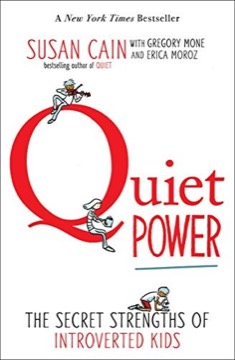
Quiet Power
Susan Cain's adaptation of Quiet for teenagers: what introversion is, what it is not, and how to operate in schools and social worlds that are built around the opposite temperament.
- First published
- 2016
- Publisher
- Puffin Books
- Pages
- 288
- Shelf
- Habits
- Level
- Entry
- ISBN-13
- 9780241977897
Record checked against
Catalogue note
- Reads as
- PracticalWritten to be applied, not only understood.
- Level
- Accessible / FoundationalNo prior reading assumed.
- Approach
- Practical
- Written for
- Anyone changing how they work, Newcomers to the subject
Saved in this browser only — no account, nothing sent anywhere. My library
Read this if
- You want evidence about why people behave as they do, not folklore.
- You want to think about how gender shapes a life, including your own.
- You want something to apply, not only something to think about.
- You are starting from scratch here and want a way in that assumes no prior reading.
What it covers
Cain restates the core research — introversion as a difference in optimal stimulation rather than as shyness or social deficit — and then applies it to the specific settings adolescents live in: classrooms, group projects, parties, sports teams, families.
The examples are drawn from interviews with young people, and the register is practical rather than consoling.
Introversion is about where your energy comes from, not about whether you like people.
Devmark’s reading — not a quotation from the book
What is useful in it
The strongest material is on the group project and the class-participation grade — two structures that systematically disadvantage a quiet student — and on the difference between choosing solitude and being excluded.
It also handles leadership carefully, arguing from evidence that quiet leaders do particularly well with proactive teams, which is a more precise claim than the usual reassurance.
Who it is for
Written for readers roughly eleven to eighteen, and useful to the adults around them. Someone who has already read Quiet will find the underlying research familiar: the adaptation is in the application rather than in the argument, and the examples have been rebuilt for a reader whose whole social world is compulsory.
That last point is what makes the younger version worth having separately. An adult who finds open-plan offices draining can usually arrange some relief. A fifteen-year-old cannot leave the cafeteria, opt out of the group project or decline the party without a social cost, and Cain writes for that constraint rather than around it.
Written for a younger reader
This is Cain's adaptation of her introversion argument for children and teenagers, and the shift changes the content substantially. The settings are school, friendship, group projects and parties rather than boardrooms, and the advice has to work for someone with very little control over their own environment.
The classroom problem
The most useful material concerns education specifically: participation grades, group work, open-plan classrooms and the assumption that a child who does not speak is not engaged. Cain is direct that a great deal of modern teaching is designed around one temperament and marks the other down for being itself.
A quiet child in a class graded on participation is being marked down for a temperament.
Devmark’s reading — not a quotation from the book
Quiet leadership
She argues that leadership is routinely and lazily conflated with volume, and gives examples of young people leading through thorough preparation, one-to-one persuasion before a meeting, and sustained focus on a single project rather than by commanding a room. The point is to widen what a young person is able to recognise as leadership when they see it in themselves, rather than concluding they do not have it.
Friendship and parties
A practical section covers social events: arriving early when the group is small, having a specific person to find, treating a party as something with a planned end rather than an endurance test, and the legitimacy of leaving. The advice is small, concrete and unusually free of the instruction to try harder.
For parents and teachers
Sections addressed to adults ask them to distinguish shyness, which is fear, from introversion, which is a preference about stimulation, and to stop treating the second as a problem requiring correction. The distinction is the single most useful thing in the book for an adult reading it.
Where the framing strains
Introversion and extroversion are presented as a clear binary rather than a distribution, and the book's examples are drawn largely from confident, articulate, well-supported children. Cain's underlying research base is real but is stretched a long way to reach specific advice about a particular child's Tuesday.
What to do with it
It works best read by a young person and an adult separately and then discussed, which is close to how it is structured. The transferable core is small: quiet is not a deficiency, preparation is a legitimate strategy, and recovery time after social effort is a requirement rather than an indulgence.
What to take away
- 01Stimulation, not shynessIntroversion is a threshold for stimulation, and shyness is fear of judgement.
- 02School is built for extrovertsParticipation grades and group work disadvantage a specific temperament.
- 03Chosen solitudeThe book distinguishes wanting to be alone from being left out.
- 04Quiet leadershipIntroverted leaders do measurably well with teams that bring their own initiative.
- 05An adaptationSame research as Quiet, applied to adolescence.