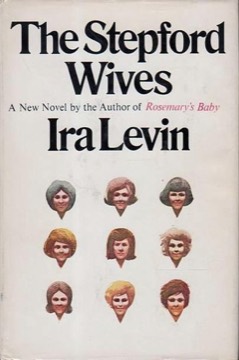
The Stepford Wives
Ira Levin's 1972 novel about a woman who moves to a Connecticut suburb and notices that its wives are uniformly docile, houseproud and content.
- First published
- 1972
- Publisher
- Blackstone Audio, Incorporated
- Pages
- 159
- Shelf
- Thriller
- Level
- Entry
- ISBN-13
- 9781842622070
Record checked against
Catalogue note
- Reads as
- ReflectiveChanges how you see rather than what you do.
- Level
- Accessible / FoundationalNo prior reading assumed.
- Approach
- Theoretical
- Written for
- Readers who mean to stop at one more chapter, Newcomers to the subject
Saved in this browser only — no account, nothing sent anywhere. My library
Read this if
- You want to be kept up late, and made uneasy about who to believe.
- You want to think about how gender shapes a life, including your own.
- You want a book that changes how you see things rather than what you do tomorrow.
- You are starting from scratch here and want a way in that assumes no prior reading.
The premise
Joanna Eberhart, a photographer with feminist commitments, moves from Manhattan to Stepford with her husband and children. She finds the local women uninterested in anything except housework and their husbands.
The men belong to an association that meets in a large house and does not admit women. Joanna and a new friend begin to investigate.
Every woman in the town is delighted with her housework, and the men have a club.
Devmark’s reading — not a quotation from the book
Satire
The novel is a satire on the backlash against second-wave feminism, published at the moment that backlash was forming, and its target is explicit.
Levin's method is literalisation: the wish that a wife be compliant is granted exactly, and the horror is that the men want it and are prepared to arrange it.
Brevity
It runs to well under two hundred pages, with short chapters and almost no description.
The economy is total and is essential to the effect. A longer version would have had to explain its mechanism, and the novel's power depends on never doing that. Levin's other novels are similarly short, and the discipline is consistent enough across his career to read as a deliberate method rather than as an accident of any one book.
What is never shown
The process by which the wives are changed is never depicted and barely described, and the novel ends without confirming exactly what has happened.
The withholding is deliberate. Explanation would convert the book into science fiction, and its force depends on remaining a suspicion. Levin also declines to specify how many women have been changed or over how long, which leaves the scale of it entirely to the reader.
Joanna
She is intelligent, sceptical and increasingly isolated, and the novel tracks the specific experience of being disbelieved about something she can see.
Her deterioration is social rather than psychological: she is correct throughout, and the pressure comes from everyone behaving as though she is not.
Bobbie
Joanna's friend, loud and untidy and the only other woman who notices, supplies both the comedy and the book's most effective single moment.
Her function in the structure is to demonstrate the process on someone the reader has come to like, which is considerably worse than demonstrating it on a stranger.
The men
The husbands are ordinary, pleasant and unremarkable, and their conspiracy requires no fanaticism — only a shared preference they had never previously been able to act on.
The banality is the point. Levin's argument is that this desire was already present and widely held, and that the town merely supplied a method.
The phrase
Stepford wife entered the language as a term for a docile, conformist woman, and is now frequently used by people who have not read the book.
The novel's meaning has drifted in the process: the popular usage blames the women, while the book's target is entirely the men.
The ending
It concludes with a short scene that confirms the outcome without explaining it, and stops.
The abruptness is characteristic of Levin and is correct here. Any further material would dilute a final image that works precisely because it is brief. The final chapter also shifts perspective, which distances the reader at exactly the moment they most want to stay close, and the discomfort is deliberate.
The adaptations
A 1975 film is faithful and effective; a 2004 remake plays the premise as comedy and reverses much of its meaning.
The remake is a useful illustration of how completely a satire can be inverted by treating its target as a joke. The 1975 version also ends on an image in a supermarket that has become as well known as anything in the book itself.
How it has aged
The specific feminist context is of its moment, and some of the novel's assumptions about suburban life are dated.
The central proposition — that a widely held private preference might be acted upon if a mechanism existed — has not dated at all. The novel's specific anxiety about consciousness-raising groups and the women's movement also locates it precisely, which is useful rather than limiting.
Who it is for
Readers who want satire that functions as horror, and who value compression.
It can be read in two hours and is among the most efficient books in this section. Readers who know only the phrase will find the actual novel considerably angrier than they expect.
What to take away
- 01Literalising a wishThe desire for a compliant wife is granted exactly, and the horror is that the men want it and can arrange it.
- 02Explanation permanently withheldThe mechanism is never shown, because describing it would convert a suspicion into science fiction.
- 03Correct and disbelievedJoanna's deterioration is social rather than psychological: she is right throughout and everyone behaves as though she is not.
- 04Banality as the argumentThe husbands are pleasant and unremarkable, and their conspiracy needs no fanaticism — only a preference and a method.
- 05A phrase that inverted the meaningPopular usage of Stepford wife blames the women, while the novel's target is entirely the men.
- 06Compression as forceUnder two hundred pages with no description, and a longer version would have had to explain what must stay unexplained.