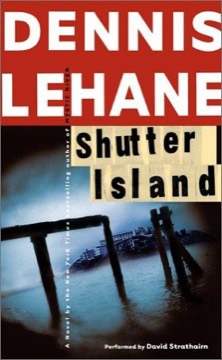
Shutter Island
Dennis Lehane's 2003 novel in which two US marshals travel to a hospital for the criminally insane to investigate a patient's disappearance, as a hurricane closes in.
- First published
- 2003
- Publisher
- Transworld Pub
- Pages
- 385
- Shelf
- Thriller
- Level
- Entry
- ISBN-13
- 9789044309911
Record checked against
Catalogue note
- Reads as
- ReflectiveChanges how you see rather than what you do.
- Level
- Accessible / FoundationalNo prior reading assumed.
- Approach
- Theoretical
- Written for
- Readers who mean to stop at one more chapter, Newcomers to the subject
- Ideas
Saved in this browser only — no account, nothing sent anywhere. My library
Read this if
- You want to be kept up late, and made uneasy about who to believe.
- You want a book that changes how you see things rather than what you do tomorrow.
- You are starting from scratch here and want a way in that assumes no prior reading.
The premise
In 1954 two federal marshals are ferried to Shutter Island in Boston Harbour, where Ashecliffe Hospital holds patients who have committed violent crimes and been found insane.
A woman has vanished from a locked room. A storm is coming, the staff are unhelpful, and the senior marshal has private reasons for wanting to be on the island.
A locked room, on an island, with a hurricane due.
Devmark’s reading — not a quotation from the book
Genre machinery
Lehane assembles the parts deliberately: the gothic asylum, the isolated setting, the cut communications, the sinister doctor, the unreliable narration and the ticking weather.
The book is openly a construction out of pulp materials, and it uses the reader's familiarity with those materials as part of its method.
Teddy Daniels
The marshal is a widower, a veteran of the liberation of Dachau, a migraine sufferer, and increasingly certain that the hospital is conducting experiments on patients.
His perceptions are the reader's only access, and the novel is careful to make his reasoning look sound while quietly accumulating details that do not fit.
Cold War context
The paranoia is period-specific: HUAC, lobotomy, early psychopharmacology and rumours of government experimentation on human subjects are all live anxieties in 1954.
Lehane uses them to make Teddy's suspicions historically plausible rather than merely paranoid, which is what keeps the middle of the book balanced.
Trauma as the real subject
Beneath the conspiracy plot the novel is about grief, guilt and the stories people build to make an unbearable fact survivable.
The Dachau material is not decoration. It establishes early that this is a character who has already seen more than can be integrated, and that his mind has strategies for it.
Structure and pace
Short chapters, a four-day timeline and a storm that steadily removes options: the ferry stops, the phones fail, the roads flood. The escalation is mechanical and the book is considerably faster than Lehane's other standalone work.
The middle section, in which the pair are effectively trapped and reduced to interviewing staff who have clearly been briefed, is where the dread is best sustained.
The twist, handled carefully
The novel has a well-known reversal, and it is fair — the evidence is present throughout, and a second reading finds it distributed with real skill.
What distinguishes it from a mere trick is that the reversal changes the emotional meaning of everything preceding it rather than merely the facts.
Rereadability
It is one of the few thrillers genuinely improved by knowing the ending, because the dialogue is written to work in two registers at once.
Scenes that read as evasion on a first pass read as patience on a second, which is an unusual amount of craft to spend on a book most people read for the surprise.
Written so that every conversation means one thing forwards and another backwards.
Devmark’s reading — not a quotation from the book
The prose
Plainer and more functional than Mystic River, with the lyricism reserved for the island's weather and for Teddy's memories of his wife.
The restraint is strategic. A more decorated style would have drawn attention to the places where the narration is being economical with the truth.
The ending's last line
The novel closes on a line of dialogue that reopens the question the resolution appeared to settle, and does not answer it.
It is the book's best decision. The ambiguity is genuine rather than coy: both readings are fully supported by the preceding four hundred pages, and choosing between them requires deciding what you think a person owes themselves. It converts a clever thriller into something considerably sadder.
The Scorsese film
The 2010 adaptation is faithful in plot and considerably more baroque in style, with an ending that preserves the final ambiguity.
The novel is quieter and gives more room to Teddy's interior life, which makes the resolution land as grief rather than as revelation. Scorsese externalises the same material as hallucination and weather, a legitimate choice that trades the book's claustrophobia for spectacle.
Who it is for
Readers who enjoy being played with by a book that plays fair. It requires nothing and moves very quickly.
Readers who dislike reversals on principle should avoid it, since the whole structure is organised around one and no part of the book is indifferent to it. There is no secondary pleasure to fall back on if the central device does not work for you.
What to take away
- 01Pulp materials, used knowinglyThe gothic asylum, the storm and the cut telephone lines are assembled deliberately, and the reader's familiarity is part of the method.
- 02Period paranoia as ballastLobotomy, HUAC and human experimentation were live 1954 anxieties, which keeps the suspicions plausible.
- 03Trauma under the conspiracyThe Dachau material establishes a mind that has already developed strategies for the unbearable.
- 04A reversal that is played fairThe evidence is distributed throughout, and the twist changes emotional meaning rather than just facts.
- 05Dialogue in two registersConversations are written to read one way forwards and another backwards, which makes rereading the point.
- 06A final ambiguityThe closing line reopens what the resolution appeared to settle, turning a clever thriller into a sad one.