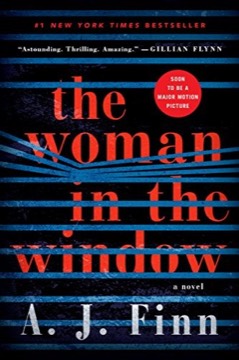
The Woman in the Window
A. J. Finn's 2018 novel about an agoraphobic child psychologist who watches her neighbours and believes she has witnessed a murder.
- First published
- 2018
- Publisher
- CreateSpace Independent Publishing Platform
- Pages
- 240
- Shelf
- Thriller
- Level
- Entry
- ISBN-13
- 9781718849419
Record checked against
Catalogue note
- Reads as
- ReflectiveChanges how you see rather than what you do.
- Level
- Accessible / FoundationalNo prior reading assumed.
- Approach
- Theoretical
- Written for
- Readers who mean to stop at one more chapter, Newcomers to the subject
- Ideas
Saved in this browser only — no account, nothing sent anywhere. My library
Read this if
- You want to be kept up late, and made uneasy about who to believe.
- You want a book that changes how you see things rather than what you do tomorrow.
- You are starting from scratch here and want a way in that assumes no prior reading.
The premise
Anna Fox has not left her Harlem townhouse in ten months. She drinks heavily, takes medication that should not be combined with it, watches old films, and observes the houses opposite through a camera lens.
She believes she sees a woman stabbed in the house across the park. The police find the woman alive, and she is not the person Anna met.
She saw something through a window while drunk on medication she should not be mixing.
Devmark’s reading — not a quotation from the book
Deliberate pastiche
The novel is openly constructed from Rear Window and from the mid-century suspense films Anna watches, and it names its sources constantly.
The self-awareness is the book's method: it is a genre exercise that acknowledges being one, and its pleasures are those of a well-executed familiar shape.
The unreliable narrator
Anna's alcohol consumption, her medication and her mental state are all established early and thoroughly, so the reader cannot assume anything she reports.
The construction is careful. Every element of her unreliability is externally corroborated, which means the doubt is earned rather than asserted. Finn also has other characters correct her account directly, so the reader is never in the position of having to take her impairment on trust.
Agoraphobia
The condition is described with attention to its mechanics: the panic on approaching the door, the delivery arrangements, the online support forum.
Finn's treatment is more detailed than the plot requires, and the house's geography becomes the novel's entire world in a way that serves the claustrophobia.
Film references
Anna watches classic thrillers continuously and the novel quotes, discusses and structurally borrows from them.
The device works as characterisation and as a fair-play signal: the reader is being told which conventions are in play, which makes the eventual departures from them more effective. The films she watches are also chosen to comment on her situation, and a reader who knows them will notice the selection is doing work.
Pace
Very short chapters, frequent scene breaks, and a great deal of white space, designed to be read quickly.
The construction is commercial in the best sense. The book is extremely easy to keep reading and does not require sustained attention. Chapters are frequently a single page and the book is dated by day, which supplies a calendar structure that costs the reader no effort to follow.
The reveals
There are two significant ones, and the first — concerning Anna's own circumstances — is considerably better than the second.
The disclosure about her family is genuinely affecting and is prepared with real care. The identification of the antagonist is more routine. Finn also plants the evidence for the first disclosure in the opening chapters, and a second reading finds it distributed with real care.
Prose
Present tense, first person, with short sentences and a self-consciously literary vocabulary in places.
It is a debut and the writing occasionally reaches, particularly in the descriptions of weather and of the house, which sit oddly against the briskness elsewhere. The film descriptions in particular are the best writing in the book, and are noticeably more assured than the passages describing the present-day action.
The controversy
A 2019 New Yorker article documented that the author had made extensive false claims about his personal history, including a cancer diagnosis and a sibling's death.
The article is part of the book's public record. It does not bear on the novel's construction and readers are entitled to know about it.
Originality
The book's similarity to an earlier novel, Sarah A. Denzil's Saving April, has been noted by several readers, and the general familiarity of the premise is acknowledged by the book itself.
How much this matters is a judgement call in a category where the premises are largely shared.
The film
A 2021 adaptation was poorly received and compresses the psychological material substantially.
The novel's interiority is what makes it work, and a film that externalises it is left with a fairly standard mystery. The adaptation also assembled an unusually strong cast and was still poorly received, which suggests the problem was structural rather than in the execution.
Who it is for
Readers who want an efficient, self-aware, extremely readable thriller and do not require originality.
It is one of the better-executed examples of the category and is frank about what it is. Readers looking for something new should choose elsewhere on this shelf. It is also extremely fast, and readers who want a single evening's entertainment with a competent construction will find it entirely adequate.
What to take away
- 01A pastiche that names its sourcesThe novel is built openly from Rear Window and mid-century suspense, and the acknowledgement is part of the method.
- 02Unreliability externally corroboratedAnna's drinking and medication are confirmed by other characters, so the doubt is established rather than merely claimed.
- 03The house as the whole worldAgoraphobia reduces the setting to one building, and the detailed geography does the claustrophobia's work.
- 04Conventions declared in advanceTelling the reader which genre rules are in play makes the eventual departures from them land harder.
- 05One reveal much better than the otherThe disclosure about the narrator's family is prepared and affecting; the identification of the antagonist is routine.
- 06A public record worth statingThe author was documented to have made extensive false personal claims, which does not bear on the book and is part of its history.