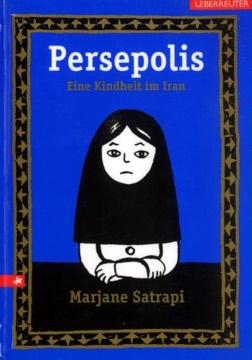
Persepolis
Marjane Satrapi's graphic memoir of growing up in Tehran during the Islamic Revolution and the Iran-Iraq war, drawn in stark black and white. A child's-eye account of a country changing around her.
- First published
- 2000
- Publisher
- Aḥuzat bayit
- Pages
- 352
- Shelf
- History
- Level
- Entry
- ISBN-13
- 9788328102873
Record checked against
Only one source carried a publication date for this work, so the year is uncorroborated.
Catalogue note
- Reads as
- ReflectiveChanges how you see rather than what you do.
- Level
- Accessible / FoundationalNo prior reading assumed.
- Approach
- Theoretical
- Written for
- Readers of history, Newcomers to the subject
Saved in this browser only — no account, nothing sent anywhere. My library
Read this if
- You want a life told honestly, at full length.
- You want to know how we got here.
- You want to understand how power is taken, kept and lost.
- You want a book that changes how you see things rather than what you do tomorrow.
- You are starting from scratch here and want a way in that assumes no prior reading.
What it covers
Satrapi is ten when the Shah falls. Her family are secular leftists who opposed him and then find the revolution turning on people like them. The veil becomes compulsory at her school; relatives are imprisoned and executed; Iraq invades.
At fourteen her parents send her alone to Vienna for safety. The later volumes cover that exile and her return.
The revolution arrives at school first, as a new rule about what girls wear.
Devmark’s reading — not a quotation from the book
How it works as comics
The drawing is flat, high-contrast and deliberately simple, close to woodcut. That simplification lets Satrapi place a bombing and a domestic argument in the same visual register without either overwhelming the other.
The child's perspective is carried by the pictures as much as the text: God appears as a cartoon figure, political arguments are overheard from doorways, and scale is consistently a child's.
The severity of the black and white is what lets the book hold both a party and an execution.
Devmark’s reading — not a quotation from the book
The family
The adults around Marji are the book's quiet achievement. Her parents demonstrate against the Shah and then against the regime that replaced him, argue in front of her, and are frightened in ways they try and fail to conceal. Her grandmother supplies the book's moral centre and its best lines.
Satrapi refuses to make any of them heroic. They compromise, they send their daughter away, they survive, and the memoir treats all of that as what a political catastrophe actually does to a household.
Why it matters
It gave a large Western readership a version of Iran that was neither theocratic caricature nor exile nostalgia: an ordinary, argumentative, educated family living through a political catastrophe.
It is also a landmark for comics as a form for serious autobiography, and is widely taught for exactly that reason.
The veil in the schoolyard
The book opens with ten-year-old girls being required to wear the veil at school and using it to skip rope and play, which establishes the whole method: enormous political change registered through what it does to an ordinary child's day. Satrapi almost never explains a policy; she shows the moment it arrives in a classroom.
The uncle
Her communist uncle, imprisoned under the Shah and executed under the Islamic Republic, is the figure through whom the revolution's betrayal of its own participants is delivered. His last visit before execution, requested with her, is the point at which the book stops being a child's account of confusing adults.
The war at home
The middle section covers the Iran-Iraq war from inside a bombed city: sirens, shortages, the boys sent to the front with plastic keys promising paradise, the black-market parties held in defiance. Satrapi's target is not only the regime but the gap between the official version of the war and what families were doing to survive it.
The official war and the war as lived in one flat are not the same war, and she draws both.
Devmark’s reading — not a quotation from the book
Vienna
Sent abroad at fourteen for her safety, she experiences displacement rather than rescue: hostility, drift, homelessness, and the particular loneliness of being treated as a representative of a country that people only know through news footage. It is the section that complicates any reading of the book as a simple escape narrative.
Going back
The return to Iran is the hardest material: depression, a marriage entered and left, the surveillance of ordinary behaviour, and the recognition that she now fits neither place. Satrapi refuses the arrival story in both directions, which is why the ending is a departure rather than a resolution.
Why it is drawn this way
The black-and-white artwork is flat, high-contrast and deliberately simple, with faces reduced to a few marks. The austerity does specific work: it lets her place an execution and a joke on the same page without tonal collision, and the visual restraint carries material that photographic realism would make unbearable.
What to take from it
Read it for the child's-eye method, which does considerably more work than its apparent simplicity suggests: an adult writer recovering what a specific ten-year-old actually understood, without correcting her from above. The second volume is the harder and less celebrated half, and the two are best read together — the story is not finished when she leaves Iran, and Satrapi refuses to let either departure count as an arrival.
What to take away
- 01A child's scalePolitics arrives through school rules, overheard arguments and missing relatives.
- 02Woodcut simplicityThe flat black-and-white style lets ordinary and catastrophic scenes share a page.
- 03Neither caricature nor nostalgiaAn educated secular family living through a revolution that turned on them.
- 04Exile as the second halfVienna is not relief; it is a different kind of dislocation.
- 05Comics as serious memoirOne of the works that settled that argument.