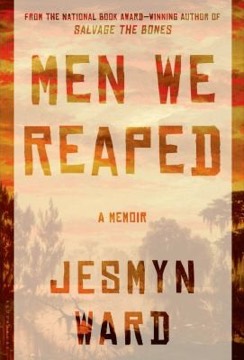
Men We Reaped
Jesmyn Ward's memoir about five young Black men from her Mississippi community — including her brother — who died within four years, and about the conditions that killed them.
- First published
- 2013
- Publisher
- Bloomsbury USA
- Pages
- 272
- Shelf
- History
- Level
- Core
- ISBN-13
- 9781410462503
Record checked against
Catalogue note
- Reads as
- ReflectiveChanges how you see rather than what you do.
- Level
- Core / BuildingAssumes general familiarity with the subject.
- Approach
- Theoretical
- Written for
- Readers of history, Readers with some grounding
- Ideas
Saved in this browser only — no account, nothing sent anywhere. My library
Read this if
- You want a life told honestly, at full length.
- You want a book that changes how you see things rather than what you do tomorrow.
- You know roughly how the subject works and want the fuller account.
What it is
Between 2000 and 2004 Ward lost five men she knew: to drugs, to a car accident caused by a drunk driver who served little time, to suicide, to violence. One was her younger brother Joshua.
The book tells their deaths in reverse chronological order while telling her own family's life forwards, so the two lines converge on Joshua.
Two clocks running in opposite directions, meeting at her brother.
Devmark’s reading — not a quotation from the book
How it is built
The reverse structure is the memoir's central decision. Beginning with the most recent death and ending with the one closest to her means the reader arrives at Joshua already understanding the pattern, which is what Ward wants established first.
She refuses the individual-failure explanation at every point, and instead documents what the community had available: which jobs, which schools, which roads, what policing.
Themes
Ward's argument is that these were not five separate tragedies but one situation with five outcomes, produced by rural Black poverty in DeLisle, Mississippi.
It is also about survivor's obligation — she is the one who left for college, and the book is explicit about what that distance both cost and protected.
The book's claim is that five deaths in four years is a pattern, not a coincidence.
Devmark’s reading — not a quotation from the book
How it reads
Ward is a novelist, and the prose carries that: the DeLisle landscape, the pines and the water and the particular quality of Gulf Coast heat, are rendered with the attention she gives to fiction.
That care is doing argumentative work. The book insists on the place being beautiful and specific rather than a byword for deprivation, which makes the claim about conditions harder to dismiss as a generalisation about the South.
Five deaths
The book is organised around five young Black men from Ward's community in rural Mississippi who died within four years: her brother, and four friends and relatives, by accident, suicide, overdose and gunshot. The insistence that these are one phenomenon rather than five coincidences is the argument the whole memoir exists to make.
Five deaths in four years, in one small place. The book's claim is that this is not a coincidence.
Devmark’s reading — not a quotation from the book
Two directions at once
One narrative runs forward from her grandparents to her own childhood; the other runs backward through the five deaths, from the most recent to her brother's, which came first. The two meet at the end, so the book closes on the loss that set everything in motion.
The economics
Ward is specific and unsentimental about money throughout: which jobs were actually available, the distances driven to reach them, the fathers working in other states, the drug economy functioning as the employer of last resort, and the private school place paid for by the white family her mother cleaned for. The deaths are placed firmly inside a material situation rather than attributed to individual choices.
Being the one who left
She writes carefully about the scholarship, the university in another state, and what it is to return as someone who is unmistakably of the place and also visibly marked as no longer entirely in it. The double guilt of having survived and of having left runs underneath the whole book, and Ward declines to resolve it, redeem it or convert it into a lesson for anybody.
Her brother
Her brother Joshua's death, caused by a drunk driver who ultimately served a short sentence for leaving the scene of an accident rather than for killing him, is the book's centre and its last chapter. The disproportion between what actually happened and what the legal record eventually said about it is stated plainly, once, without commentary, and then left on the page to sit there.
The title
It comes from a line of Harriet Tubman's about the harvest of the dead, and it frames the book's claim: that these young men were gathered by something systematic rather than lost individually. Ward's fiction covers the same territory, and readers who know it will recognise the place immediately.
What to take away
- 01Five deaths, four yearsOne community, one period, five young men.
- 02Reverse chronologyThe deaths run backwards toward her brother while her life runs forwards.
- 03Conditions, not choicesWard documents what was available rather than what was decided.
- 04The one who leftHer own escape to college is examined rather than assumed.
- 05Named, specificallyThe men are individuals in the book, not a statistic about a place.