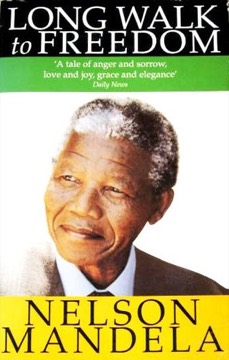
Long Walk to Freedom
Nelson Mandela's autobiography — from a rural childhood in the Transkei through the founding of the ANC's armed wing, the Rivonia trial, twenty-seven years of imprisonment, and the negotiations that ended apartheid.
- First published
- 1994
- Publisher
- Back Bay Books
- Pages
- 643
- Shelf
- History
- Level
- Core
- ISBN-13
- 9786054986972
Record checked against
Catalogue note
- Reads as
- ReflectiveChanges how you see rather than what you do.
- Level
- Core / BuildingAssumes general familiarity with the subject.
- Approach
- Theoretical
- Written for
- Readers of history, Readers with some grounding
Saved in this browser only — no account, nothing sent anywhere. My library
Read this if
- You want a life told honestly, at full length.
- You want to understand how power is taken, kept and lost.
- You want to know how we got here.
- You want a book that changes how you see things rather than what you do tomorrow.
- You know roughly how the subject works and want the fuller account.
How it was written
Mandela began the manuscript secretly in prison on Robben Island, writing at night and having pages copied and smuggled out while the original was buried in the garden. Part of it was discovered and confiscated.
It was completed and substantially shaped after his release, with assistance from an editor. Knowing both facts matters: the prison sections were written by a man who did not know whether he would be released, and the later sections by one who had become president.
Part of it was written at night in a cell and buried in a garden, by a man who did not know he would be released.
Devmark’s reading — not a quotation from the book
The rural childhood
His opening chapters on the Transkei, his father's deposition as a chief, his upbringing in the household of the Thembu regent, and the traditional education in custom, history and leadership he received there.
His account of watching the regent's council — where anyone could speak, the chief listened and summarised rather than directed, and consensus was sought — is explicitly identified as the source of his own leadership style.
Johannesburg and politicisation
His move to the city, work as a law clerk, legal study, and his gradual entry into the ANC through the Youth League.
His account of his own early politics is unusually candid — he describes himself as initially an African nationalist suspicious of communists and of Indian allies, and traces how that changed through experience rather than presenting himself as having always held his mature position.
The turn to armed struggle
His account of the decision to found Umkhonto we Sizwe after the Sharpeville massacre and the banning of the ANC, and his reasoning that non-violence had been met with escalating state violence and had been exhausted as a strategy.
He does not present this as easy or obviously correct, and he sets out the internal argument within the movement in detail rather than as a foregone conclusion.
The Rivonia trial
His account of the trial in which he and others faced the death penalty, and of the decision to make a statement from the dock rather than testify and be cross-examined.
His closing words — that he was prepared to die for the ideal of a democratic and free society — were spoken knowing the sentence might be capital. It is the most famous passage in South African political history and he describes the deliberation behind it plainly.
Robben Island
The long central section: the quarry labour, the classification system, the censorship of letters, the deaths of his mother and eldest son announced without permission to attend the funerals.
His account of how the prisoners organised — the political education, the negotiations over conditions, the refusal to be treated as criminals — shows a political movement continuing to operate inside a prison, which is the section's most striking material.
The discipline of restraint
Running throughout: his insistence on courtesy toward warders, his study of Afrikaans and Afrikaner history, and his refusal of bitterness as a strategic choice rather than a temperamental one.
His observation that a man who takes away another's freedom is himself not free is not sentiment. It is a conclusion he reached about what the settlement would require, and he had decades to test it.
The absence of bitterness was a strategic conclusion about what a settlement would require, not a temperament.
Devmark’s reading — not a quotation from the book
The negotiations
His account of beginning talks with the government while still imprisoned and without the movement's authorisation, knowing that he risked being seen as having sold out.
His reasoning — that someone had to start, that a leader who waits for consensus before a necessary first move never makes it, and that he was uniquely positioned because he could not be accused of seeking personal advantage — is the clearest strategic passage in the book.
Where it is limited
It is a political autobiography and it is selective. His personal life, particularly his marriages and his relationship with his children, receives comparatively little space, and Winnie Mandela's role and the controversies around her are handled briefly.
It is also written with the settlement in view, which shapes the account of earlier disagreements within the movement toward reconciliation.
What it is for
It is a primary source on one of the twentieth century's major political transitions, written by its central participant.
Read as leadership material it offers something rarer than most such books: a detailed account of maintaining a strategy across decades in conditions designed to break it, and of deciding when to compromise without conceding the objective.
What to take away
- 01The regent's council was the modelEveryone speaks, the leader listens and summarises last, and consensus is sought rather than imposed.
- 02He describes changing his mindHis early suspicion of allies and how experience altered it, rather than a always-correct self-portrait.
- 03Restraint was strategyThe refusal of bitterness was a conclusion about what a settlement would require, tested over decades.
- 04Someone has to startHe opened talks without authorisation because a leader waiting for consensus never makes the first move.
- 05A movement can operate inside a prisonThe political education, the negotiation over conditions, the refusal of criminal status.