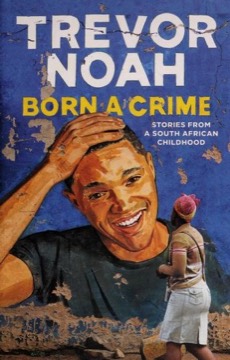
Born a Crime
Stories from a South African Childhood
Trevor Noah's memoir of growing up mixed-race in South Africa under and after apartheid — where his existence was itself evidence of a crime — told as comedy that keeps turning into something harder.
- First published
- 2016
- Publisher
- Spiegel & Grau
- Pages
- 304
- Shelf
- History
- Level
- Entry
- ISBN-13
- 9781984897534
Record checked against
Catalogue note
- Reads as
- ReflectiveChanges how you see rather than what you do.
- Level
- Accessible / FoundationalNo prior reading assumed.
- Approach
- Theoretical
- Written for
- Readers of history, Newcomers to the subject
Saved in this browser only — no account, nothing sent anywhere. My library
Read this if
- You want a life told honestly, at full length.
- You want to know how we got here.
- You read for the writing as much as for the argument.
- You want a book that changes how you see things rather than what you do tomorrow.
- You are starting from scratch here and want a way in that assumes no prior reading.
The title's literal meaning
Under the Immorality Act, sexual relations between a white person and a Black person were a criminal offence. Noah's mother was Xhosa and his father Swiss, which made his existence documentary proof of a crime.
The consequence was practical: he could not be seen in public with either parent. His mother walked at a distance, his father on the other side of the street, and he spent his early childhood largely indoors.
He could not be seen with either parent in public. His mother walked ahead and his father across the road.
Devmark’s reading — not a quotation from the book
Patricia
His mother is the book's actual subject. Fiercely religious, stubborn, unwilling to accept the limits set for her, she taught him English deliberately, took him places Black South Africans were not expected to go, and refused to raise him as though the restrictions were permanent.
His description of her as raising him for a country that did not yet exist is the memoir's organising idea, and everything he becomes is traceable to it.
Language as passing
His account of learning several languages and using them as a form of mobility: speaking a group's language changed how he was categorised even though his appearance did not.
His argument that language does more work than appearance in determining belonging is the memoir's sharpest sociological observation, and he supports it with specific incidents rather than asserting it.
Being nowhere
His experience of not fitting any available category: not Black enough, not white, classified as coloured by a system whose category did not match how he was raised.
His account of choosing which group to sit with at school, and the realisation that this was a choice most people never make, is the clearest material on what racial classification does to a person who falls between the definitions.
The comedy
Much of the book is very funny, and the humour is structural rather than decorative. He sets up a story as farce — the CD business, the dog, the disastrous prom — and then lets the circumstances underneath become visible.
The technique means the reader laughs and is then shown what was actually happening, which is more effective than a straightforwardly grim account would be.
Poverty, described precisely
His chapters on the economics of the township: the specific cost of things, the hustles, the way informal economies work, and the mechanics of being poor rather than the atmosphere of it.
His observation that people in poverty are not short of ideas but short of capital and of any margin for a failed attempt is made concrete through his own small businesses.
The stepfather
The book's hardest material: his mother's marriage to an abusive man, the police's refusal to act on her reports, and his eventual shooting of her.
She survived, with a bullet passing through her head and exiting without disabling injury. Noah tells it plainly, including her response afterward, which is characteristically hers and is the book's final note.
She survived a bullet through the head, and her response afterward is the last thing the book gives you.
Devmark’s reading — not a quotation from the book
Apartheid explained through experience
Between chapters he includes short passages of historical explanation: how the Bantu education system worked, why the tribal divisions were cultivated, how the pass laws operated.
They are brief and well judged, and they let a reader with no background understand the structure without turning the memoir into a history lesson.
What it is not
It is not a comprehensive account of the transition, not a political analysis, and not particularly concerned with his subsequent career, which is barely present.
The book ends before he becomes known. That is a deliberate choice and it keeps the focus on the childhood rather than using it as the origin story of a famous person.
Why it works
Because the specificity is relentless: particular streets, particular prices, particular arguments with his mother, rather than general statements about what apartheid was like.
And because the central relationship is genuinely the point. It is a book about a mother, in which the political system is the circumstance rather than the subject.
What to take away
- 01Raised for a country that did not exist yetHis mother refused to prepare him for the restrictions as though they were permanent.
- 02Language outranks appearanceSpeaking a group's language changed his categorisation when his face did not.
- 03Poverty is a shortage of marginNot of ideas: the absence of any capacity to absorb a failed attempt is what traps people.
- 04Comedy as a delivery mechanismHe sets the story up as farce and then lets the circumstances underneath become visible.
- 05It ends before the fameA deliberate choice that keeps the childhood as the subject rather than as an origin story.