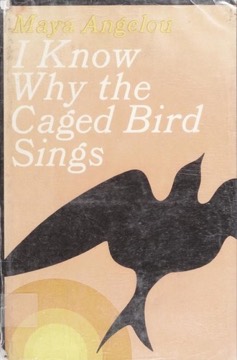
I Know Why the Caged Bird Sings
Maya Angelou's 1969 account of her childhood in segregated Arkansas and wartime San Francisco, from age three to seventeen. The first of seven volumes, and the one that changed what an American autobiography could contain.
- First published
- 1969
- Publisher
- Van Hoc
- Pages
- 281
- Shelf
- History
- Level
- Core
- ISBN-13
- 9780748122349
Record checked against
Catalogue note
- Reads as
- ReflectiveChanges how you see rather than what you do.
- Level
- Core / BuildingAssumes general familiarity with the subject.
- Approach
- Theoretical
- Written for
- Readers of history, Readers with some grounding
Saved in this browser only — no account, nothing sent anywhere. My library
Read this if
- You want a life told honestly, at full length.
- You want to think harder about what is actually right.
- You want a book that changes how you see things rather than what you do tomorrow.
- You know roughly how the subject works and want the fuller account.
What it covers
Angelou and her brother Bailey are sent, alone and labelled, to their grandmother in Stamps, Arkansas. Momma runs the general store and a household governed by scripture and by the arithmetic of surviving white neighbours.
The book covers a rape at eight by her mother's boyfriend, the years of silence that followed, the teachers and books that ended the silence, and a teenage pregnancy at the close. It was among the first mainstream autobiographies by a Black woman to state such material plainly.
The caged bird sings, in Dunbar's poem and in Angelou's title, because it has nothing else.
Devmark’s reading — not a quotation from the book
How it is written
Angelou narrates as an adult recovering a child's perspective, which lets her register humiliations the child absorbed without naming. The prose is formal, rhythmic and closer to poetry than to conventional memoir.
Literature is the book's own subject: Shakespeare, Dunbar, Poe and the teacher Mrs Flowers are the machinery by which Angelou recovers speech, so the book is partly an account of how reading made its own existence possible.
Why it matters
It has been among the most frequently challenged books in American schools for decades, almost always for the rape chapter, and Angelou consistently argued that removing it removed the point.
Its influence on Black American memoir is difficult to overstate: it established that a life could be told with this much interiority, humour and refusal of respectability at once.
The store
Her grandmother's general store in rural Arkansas is the book's centre of gravity: a Black-owned business in a segregated town, where the economics of cotton picking, credit and deference are visible every day from behind the counter. Angelou uses it to show a child learning the rules of a system by watching transactions.
The silence
After being raped at eight by her mother's partner, and after his death shortly following her testimony, Angelou stopped speaking for years, having concluded that her words had killed him. The account of that logic — a child's reasoning, entirely coherent on its own terms — is among the most quietly devastating passages in American memoir.
Mrs Flowers
She is drawn back into speech by a neighbour who lends her books, reads aloud to her, and requires her to recite — treating her as a person with a mind rather than a problem to be managed. The episode is the book's clearest statement of what literature was for in her life, which is not decorative.
She was not coaxed back into speech by kindness. She was required to read aloud.
Devmark’s reading — not a quotation from the book
The graduation
The chapter in which a white official addresses her graduating class about their futures in athletics and manual work, and the audience's response to it, is frequently anthologised. It is the book's most controlled piece of writing: humiliation administered publicly and then answered, without the narrator raising her voice.
Why it is challenged
It has been among the most frequently removed books from American school libraries, on grounds including the depiction of rape, sexuality and its treatment of race. Angelou's position was consistent — the events are what happened to a child, and removing the account protects adults rather than children.
The adult narrator
The technical achievement is the double vision: an adult writer recovering a child's understanding without correcting it from above. The reader is given the child's interpretation and enough material to see past it, which is why the book can handle its subject matter without either clinical distance or sensationalism.
What to take from it
It is the first of seven autobiographical volumes and stands alone. Read it for the demonstration that a childhood shaped by segregation, displacement and assault can be rendered without either bitterness or uplift — and for the proposition, made throughout, that literacy was the specific thing that returned her to herself.
What to take away
- 01Silence, and the end of itYears of mutism after the assault, broken by a teacher and by books.
- 02A child's view, an adult's wordsAngelou renders what the child absorbed and the adult can name.
- 03Segregation as arithmeticMomma's store runs on precise calculations about white neighbours.
- 04Literature as rescueThe book is partly an account of how reading made the book possible.
- 05Repeatedly challengedBanned most often for the chapter Angelou said was the reason to read it.