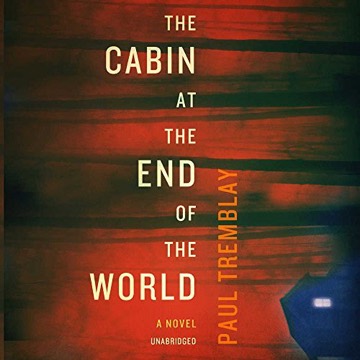
The Cabin at the End of the World
Paul Tremblay's 2018 novel in which four strangers arrive at a holiday cabin and tell the family inside that they must choose one of themselves to die, or the world ends.
- First published
- 2018
- Publisher
- HarperCollins Publishers
- Pages
- 137
- Shelf
- Thriller
- Level
- Core
- ISBN-13
- 9780062912237
Record checked against
Catalogue note
- Reads as
- ReflectiveChanges how you see rather than what you do.
- Level
- Core / BuildingAssumes general familiarity with the subject.
- Approach
- Theoretical
- Written for
- Readers who mean to stop at one more chapter, Readers with some grounding
Saved in this browser only — no account, nothing sent anywhere. My library
Read this if
- You want to be kept up late, and made uneasy about who to believe.
- You want to think harder about what is actually right.
- You want a life told honestly, at full length.
- You want a book that changes how you see things rather than what you do tomorrow.
- You know roughly how the subject works and want the fuller account.
The premise
Eric and Andrew are on holiday at a remote New Hampshire cabin with their seven-year-old daughter Wen. Four people arrive carrying improvised weapons and ask to be let in.
They are not there to rob or harm anyone. They explain that the family must willingly sacrifice one of their own, and that if they refuse, the world will end.
Four strangers with a demand, and a family that cannot tell whether they are right.
Devmark’s reading — not a quotation from the book
The impossible choice
The novel's structure is a single sustained dilemma with no available information. The family cannot verify the claim, cannot escape, and cannot choose without committing something unbearable.
Tremblay keeps the pressure entirely on this. There is no subplot and almost no relief. Tremblay also removes every conventional escape route early, so the reader spends the novel unable to imagine a way out alongside the characters.
Ambiguity maintained
Events on the television appear to corroborate the intruders' claims, and can equally be explained as ordinary disasters reported during a crisis.
The novel refuses to resolve this, and every apparent confirmation is available as coincidence, which is sustained to the final page. The intruders themselves cannot prove anything either, which means their certainty is a matter of belief rather than of knowledge, and they know it.
The intruders
They are frightened, apologetic, and entirely convinced, and they are not presented as cultists or as stupid.
Leonard in particular is gentle and articulate, and the horror comes from sincerity rather than from malice. They do not want to be doing this and believe they have no choice.
The family
Eric and Andrew's relationship, including the homophobic assault Andrew survived years earlier, is developed enough to make the stakes concrete.
Wen is written as a specific seven-year-old rather than as a child in general, and the opening chapter from her perspective is the book's best writing.
Violence
The novel's violence is sudden, clumsy and physically detailed, and it is inflicted by people who are not practised at it.
The awkwardness is what makes it disturbing. Nothing is efficient, and the descriptions insist on how difficult and slow harming a person actually is.
Unity of place and time
It observes something close to the classical unities: one location, a continuous timeframe, a fixed cast.
The constraint produces a claustrophobia that a wider canvas would dissipate, and the novel is structured much more like a play than like a thriller. The novel has in fact been adapted for the stage, and the suitability is not accidental given how completely it observes those constraints.
Faith and evidence
The book is genuinely interested in what it would take to believe something unfalsifiable, and in whether refusing to believe is itself a kind of faith.
Neither family member is religious, and their resistance is epistemological rather than doctrinal, which makes the argument sharper. The novel is also interested in what it costs to hold out, and whether a refusal maintained past a certain point becomes something other than reason.
Prose
Present tense, close third person rotating between characters, with long uninterrupted paragraphs during the most intense passages.
The technique produces an airless quality, and the rotation means the reader is never allowed to settle into one perspective's interpretation. The rotation also includes the intruders, so the reader spends time inside the perspective of people doing something the book has established as monstrous.
The ending
The resolution is ambiguous by design and has been widely discussed, and it declines to tell the reader whether the intruders were right.
Readers who require an answer will find it unsatisfying. The book's position is that the answer was never obtainable, which is the whole point of the situation.
The adaptation
A 2023 film changed the ending substantially, resolving the ambiguity the novel preserves.
Tremblay has spoken about the change without condemning it. The novel is the version that holds the question open, and that is its principal achievement. The film also softens several of the novel's harshest events, which makes it a considerably more bearable experience and a substantially less interesting one.
Who it is for
Readers who want a tightly constrained moral situation and can accept deliberate irresolution.
It is short, extremely tense and genuinely upsetting. Readers who found the film's answer unsatisfying should know that the book's refusal to give one is considerably more effective. It is also among the shortest books in this section, and the brevity is essential: a longer version could not have sustained pressure at this intensity.
What to take away
- 01A dilemma with no available informationThe family cannot verify the claim, escape it, or choose without committing something unbearable.
- 02Every confirmation also a coincidenceTelevised disasters corroborate the intruders and are equally explicable as ordinary events reported during a crisis.
- 03Sincerity rather than maliceThe intruders are frightened, apologetic and entirely convinced, which is considerably worse than if they were cruel.
- 04Violence that is slow and clumsyNothing is efficient, and the descriptions insist on how difficult harming a person actually is.
- 05Refusal as its own faithThe family's resistance is epistemological rather than doctrinal, which sharpens the question the book is asking.
- 06Irresolution as the achievementThe novel declines to say whether the intruders were right, on the grounds that the answer was never obtainable.