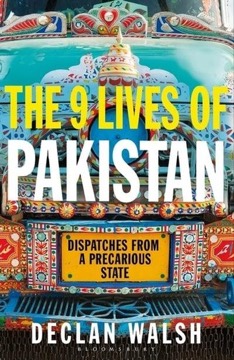
The Nine Lives of Pakistan
Declan Walsh's portrait of Pakistan through nine people, written after he was expelled from the country in 2013 following nine years as a correspondent there.
- First published
- 2020
- Publisher
- BLOOMSBURY BOOKS
- Pages
- not established
- Shelf
- History
- Level
- Core
- ISBN-13
- 9781408868478
Record checked against
Only one source carried a publication date for this work, so the year is uncorroborated. No page count is recorded, so no reading estimate is shown for the book itself.
Catalogue note
- Reads as
- ReflectiveChanges how you see rather than what you do.
- Level
- Core / BuildingAssumes general familiarity with the subject.
- Approach
- Theoretical
- Written for
- Readers of history, Readers with some grounding
Saved in this browser only — no account, nothing sent anywhere. My library
Read this if
- You want to know how we got here.
- You want to understand how power is taken, kept and lost.
- You want a book that changes how you see things rather than what you do tomorrow.
- You know roughly how the subject works and want the fuller account.
The structure
Nine chapters, nine lives: a human rights lawyer, a Pashtun tribal chief, a social worker, a politician, an intelligence officer, a Baloch separatist, a police chief in Karachi, and others. Each life opens onto a different contradiction in the country.
Walsh's own expulsion, and his eventual discovery of who ordered it, frames the book.
Nine people, each standing at a different fault line, with the reporter's own expulsion as the frame.
Devmark’s reading — not a quotation from the book
Why the form works
Pakistan is usually written about through the army, the bomb or militancy. Walsh's biographical approach produces a country of individuals making choices under constraint rather than a set of geopolitical facts.
Several of his subjects were killed during or after the reporting, which is reported plainly and is the strongest statement the book makes about the conditions it describes.
What it argues
Walsh's implicit case is that Pakistan is held together by contradiction rather than despite it, and that the recurring predictions of collapse misunderstand a state that functions precisely through its unresolved tensions.
He is careful not to explain the country, and says so. The nine lives are offered as evidence, not as a thesis.
He declines to explain Pakistan, and treats that refusal as the honest position.
Devmark’s reading — not a quotation from the book
How it reads
Foreign correspondence at its most readable — reported over nearly a decade, with the access that implies, and written without the compression that usually flattens the region.
A good starting point for a reader with no background, and substantial enough for one who has.
Walsh writes without the apparatus of expertise — no theory, no framework announced in an introduction — and the effect is that the reader arrives at the conclusions rather than being handed them.
Nine portraits
Walsh builds the country through individuals: a Karachi police officer, a Baloch nationalist, a Pashtun politician, a human rights lawyer, a socialite, a cleric and others. Several were killed during or after his reporting, which gives the structure its weight — the lives are not illustrations but the subject.
Reported from inside
Walsh spent nearly a decade as a correspondent in Pakistan before being expelled in 2013 with a note citing undesirable activities. The book is built from that period's notebooks and from returning afterwards, and his access to people on multiple sides of the country's divides is its main asset.
He was expelled with a one-line note. The book is what he had already gathered.
Devmark’s reading — not a quotation from the book
The army
A continuous thread throughout concerns the military's position as the country's most powerful institution: its intelligence directorate, its extensive commercial and property interests, its long and ambiguous relationship with militant groups, and the hard limits it places on what any elected government can do. Walsh is direct about all of it without reducing Pakistan to the army, which is the trap most foreign accounts fall into.
Balochistan
The chapter on the disappeared in Balochistan is the book's hardest material and the least covered anywhere else, and it is also the closest Walsh comes to explaining why he was expelled from the country. It documents a long-running conflict involving enforced disappearances and killings that receives almost no international attention relative to its scale or its duration, and the reporting behind it was plainly dangerous to obtain.
The contradictions
His framing is a country perpetually predicted to collapse and perpetually not collapsing, held together by something the predictions do not capture. The nine lives of the title are both the individual portraits and that resilience, and he resists resolving the tension into a thesis.
What it is not
It is not a history of Pakistan and does not attempt a continuous narrative running from independence to the present. Anyone without some background will need to supply the chronology themselves from elsewhere. What the book offers instead is texture, access to people on every side of the country's divisions, and the particular authority of a correspondent who knew most of his subjects personally over many years.
What to take away
- 01Nine lives, nine fault linesBiography used as a way into a state.
- 02Subjects who were killedSeveral died during or after the reporting, reported plainly.
- 03Contradiction as structureThe argument that tension is how the country works, not why it fails.
- 04The expulsionWalsh's own removal frames the book and closes it.
- 05Refuses to explainNo unifying thesis offered, deliberately.