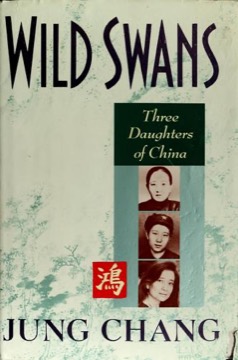
Wild Swans
Three Daughters of China
Jung Chang's account of three generations of women in her family across twentieth-century China: her grandmother, a warlord's concubine with bound feet; her mother, a Communist official; and herself, a Red Guard turned exile.
- First published
- 1991
- Publisher
- Circe
- Pages
- 560
- Shelf
- History
- Level
- Core
- ISBN-13
- 9788535908626
Record checked against
Two sources agreed on 1991; a third reported differently (openlibrary 1989, wikidata 1991, wikipedia 1991).
Catalogue note
- Reads as
- ReflectiveChanges how you see rather than what you do.
- Level
- Core / BuildingAssumes general familiarity with the subject.
- Approach
- Theoretical
- Written for
- Readers of history, Readers with some grounding
Saved in this browser only — no account, nothing sent anywhere. My library
Read this if
- You want a life told honestly, at full length.
- You want to know how we got here.
- You want a book that changes how you see things rather than what you do tomorrow.
- You know roughly how the subject works and want the fuller account.
What it covers
The grandmother is given as a concubine to a warlord general in 1924, her feet bound as a child. The mother joins the Communist underground as a teenager and rises through the Party. Chang is born in 1952, becomes a Red Guard at fourteen, and leaves for Britain in 1978.
Through them: the fall of the empire, the Japanese occupation, the civil war, land reform, the Great Leap Forward famine, and the Cultural Revolution.
Bound feet to Red Guard to Britain, in three lifetimes of one family.
Devmark’s reading — not a quotation from the book
What makes it distinctive
Her parents were committed Party officials, so the book is not written from outside. The Cultural Revolution material is the account of a family destroyed by a movement they had helped build, which is more uncomfortable than an outsider's version.
Her father's insistence on principle, and what it cost him, is the moral centre of the book.
Its reception
It sold enormously in the West and is banned in mainland China. It has also been criticised by some historians for compressing and for the certainty of its judgements, particularly in Chang's later work on Mao.
As family memoir grounded in direct experience it is strong. As history it is one account among several, and the later Mao biography drew considerably more scholarly objection than this book did.
Strong as memoir; contested as history, and the distinction matters when reading it.
Devmark’s reading — not a quotation from the book
How it reads
Long and consistently readable, with the structure doing most of the work: each generation's assumptions look inevitable from inside and absurd from the next.
The famine and Cultural Revolution chapters are difficult and specific.
Chang wrote it in English, her third language, after leaving China, and the slight formality of the prose is part of its effect: the distance in the writing matches the distance from which she is looking back.
Three generations, one method
The structure — grandmother, mother, daughter — lets Chang show the same country three times under different systems, with each woman's constraints visibly produced by her era rather than by her character. It is the reason the book works as history and not only as family memoir.
The concubine
Her grandmother's life begins with bound feet and a transaction: given at fifteen as a concubine to a warlord general, then effectively imprisoned for years in a household she could not leave. The opening section is the book's most foreign to a contemporary reader and establishes how recently that world ended.
Believers, then targets
Her parents were committed Communist officials who joined out of conviction and were then denounced, humiliated and imprisoned during the Cultural Revolution. That trajectory is the book's most valuable feature: it is written from inside the faith rather than by an opponent, so the disillusionment is earned rather than assumed.
They were not enemies of the revolution. They were its officials, and then they were its targets.
Devmark’s reading — not a quotation from the book
The famine and the campaigns
Chang covers the Great Leap Forward and the famine that followed, the backyard furnaces, the denunciation meetings and the Red Guards, largely through what they did to one family and one work unit. The method makes the scale legible in a way aggregate figures do not.
Where it is contested
The book has been criticised by some historians for the certainty of its narrative voice and for reading later knowledge back into events, and Chang's subsequent biography of Mao attracted far heavier scholarly criticism. Readers should hold the family testimony and the broader historical interpretation somewhat separately.
Where it cannot be read
It has sold enormously outside China and is banned in mainland China, which is itself part of the book's significance: for many readers it was the first detailed account of this period by someone who lived it, and for the people it describes it remains unavailable.
What to take from it
It is long and consistently readable, with the generational structure doing most of the work. Read it as testimony with a strong interpretive frame — the lived detail is its authority, and the confident historical judgements surrounding it are where other historians have pushed back.
What to take away
- 01Three generationsConcubine, Party official, Red Guard — one family, one century.
- 02Written from insideHer parents were committed officials, not victims from outside.
- 03Her father's principleThe moral centre, and what insisting on it cost.
- 04Banned at homeStill unavailable in mainland China.
- 05Memoir, not historyStrong as testimony; contested where it generalises.