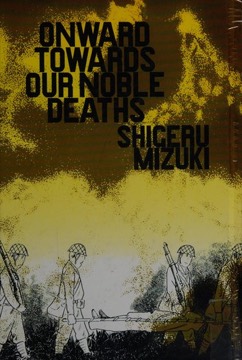
Onward Towards Our Noble Deaths
Shigeru Mizuki's 1973 account of a Japanese infantry unit ordered to die in New Guinea, drawn from his own wartime service. Anti-war comics from someone who was there.
- First published
- 1973
- Publisher
- Drawn & Quarterly Publications
- Pages
- 368
- Shelf
- Anime
- Level
- Core
- ISBN-13
- 9781451715101
Record checked against
Catalogue note
- Reads as
- ReflectiveChanges how you see rather than what you do.
- Level
- Core / BuildingAssumes general familiarity with the subject.
- Approach
- Theoretical
- Written for
- Readers of comics, and anyone curious how the form works, Readers with some grounding
Saved in this browser only — no account, nothing sent anywhere. My library
Read this if
- You read for the writing as much as for the argument.
- You want to understand how power is taken, kept and lost.
- You want a life told honestly, at full length.
- You want a book that changes how you see things rather than what you do tomorrow.
- You know roughly how the subject works and want the fuller account.
What it is
A Japanese unit is stationed on New Britain in 1943, starving, diseased and strategically irrelevant. Their commanders order a suicide attack for the honour of the regiment, and then order the survivors to die properly when some of them live.
Mizuki calls it ninety per cent fact, and he lost his left arm in the same campaign.
Ordered to die for honour, and then ordered again when some of them survived it.
Devmark’s reading — not a quotation from the book
Mizuki's war
He was conscripted, served in New Guinea, contracted malaria, survived an Allied attack that killed his unit, and lost his arm to a bomb.
He drew for the rest of his life with his right hand. The authority of this book comes directly from that experience and the anger in it is undisguised.
The argument
The target is not the enemy but the Japanese command structure: officers who valued the appearance of honour over their men's lives, and a system in which surrender was unavailable.
The book is explicit that the soldiers were killed by their own army's logic, and that the deaths achieved nothing whatsoever.
The soldiers
The men are drawn as ordinary, frightened, hungry and frequently petty, with no heroism available to them.
Mizuki refuses to ennoble them. They steal food, bully each other and want to live, and the refusal to make them admirable is what makes their deaths land.
The drawing
The style is jarring and deliberate: cartoonish, rubbery figures placed against backgrounds of extraordinary photographic detail.
The jungle, the equipment and the terrain are rendered with obsessive precision while the people are drawn simply, and the mismatch is the book's defining formal choice. Mizuki traced the landscapes from photographs and from memory, and the jungle is drawn with a density that makes the cartoon soldiers look temporary inside it.
Comedy
There is a substantial amount of humour, mostly about food, rank and bodily functions, and it sits directly against the atrocity.
Mizuki's comic register is how he makes the material survivable, and the jokes stop entirely in the final section. It is also how the soldiers themselves are shown coping, so the jokes are characterisation as well as relief, and their disappearance marks the point at which coping stops.
The ending
The final sequence is among the bleakest in the medium, and Mizuki has said he could not bring himself to depict certain things accurately.
The acknowledgement is in the book itself, which is an unusual admission and one that increases rather than diminishes its authority.
Historical value
It is a first-hand account by a participant, published in 1973 when Japanese public discussion of the war was still constrained.
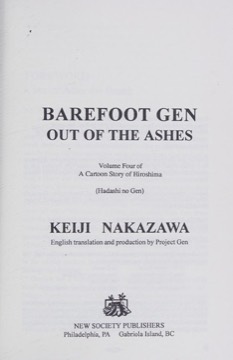
Its position in the literature is comparable to Barefoot Gen's: a survivor using comics to say something the culture preferred not to hear. Mizuki also returned to the subject repeatedly across his career, and this is the most concentrated of those accounts and the angriest.
Length
A single volume of around three hundred and seventy pages, which is self-contained and can be read in a sitting.
The concentration matters. A longer version would have dissipated the effect, and the book ends exactly where its argument concludes. Mizuki published it in a magazine that permitted long-form work, which was not generally available, and the book exists in that form largely by chance.
Mizuki's other work
He is best known for GeGeGe no Kitarō, a long-running comic folklore series, and for Showa, a multi-volume history of twentieth-century Japan.
The range is unusual: the same author produced children's monster comics and this, and the connection between them is his interest in what Japan chooses to remember.
The edition
Drawn and Quarterly published it in English in 2011 with translation notes and a biographical afterword.
The apparatus is useful, particularly on the military ranks and the campaign, which a reader without background will otherwise find hard to place. Translator Jocelyne Allen's notes also explain several specifically military terms that have no English equivalent, which materially helps a reader follow the chain of command.
Who it is for
Readers interested in war literature, in comics as testimony, or in Japanese accounts of the war from below.
It is short, difficult and important. Readers should expect the comic drawing to make the content harder rather than easier, which is precisely what it is for.
What to take away
- 01Killed by their own commandThe target is the Japanese officer class and a system in which surrender was unavailable, not the enemy.
- 02Soldiers not ennobledThe men steal, bully and want to live, and refusing to make them admirable is what makes their deaths register.
- 03Cartoon figures, photographic jungleSimple people against obsessively detailed terrain is the book's defining formal choice.
- 04Comedy as the delivery mechanismHumour about food and rank makes the material survivable, and it stops entirely in the final section.
- 05An author admitting his limitMizuki states in the book that he could not depict certain things accurately, which increases its authority.
- 06Testimony from someone who was thereMizuki was conscripted, survived the campaign that killed his unit, and lost an arm in it.