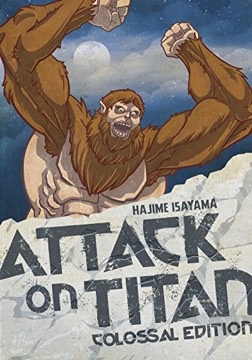
Attack on Titan
Hajime Isayama's series, begun in 2009, about humanity enclosed behind walls against enormous humanoid creatures. A siege story that becomes a study of nationalism.
- First published
- 2009
- Publisher
- Kodansha America, Incorporated
- Pages
- 944
- Shelf
- Anime
- Level
- Core
- ISBN-13
- 9781632361813
Record checked against
Catalogue note
- Reads as
- ReflectiveChanges how you see rather than what you do.
- Level
- Core / BuildingAssumes general familiarity with the subject.
- Approach
- Theoretical
- Written for
- Readers of comics, and anyone curious how the form works, Readers with some grounding
Saved in this browser only — no account, nothing sent anywhere. My library
Read this if
- You read for the writing as much as for the argument.
- You want to understand how power is taken, kept and lost.
- You want a book that changes how you see things rather than what you do tomorrow.
- You know roughly how the subject works and want the fuller account.
What it is
Humanity lives inside three concentric walls, protected for a century from Titans — enormous, naked, expressionless humanoids that eat people without apparent need for food.
When the outermost wall is breached, Eren Yeager watches his mother killed and enlists. The series follows his military training, the defence of the walls, and the progressive discovery of what the walls are actually for.
A century of safety, ended in an afternoon, by something nobody has ever explained.
Devmark’s reading — not a quotation from the book
The premise's reversal
The series spends roughly its first third as a survival horror story and then begins systematically dismantling its own setup: the origin of the Titans, the history inside the walls, and the wider world outside them.
Almost every fact established early turns out to be a partial truth maintained deliberately, and the reveals are prepared rather than sprung.
From siege to politics
By its later volumes the series has become a story about competing national histories, inherited grievance, and the way each side's account of an atrocity licenses the next one.
This transformation is the work's central achievement and its most contentious quality. Readers who came for monsters find themselves in a book about ethnic persecution and military occupation.
Eren
He begins as a conventional revenge-driven protagonist and ends somewhere genuinely unusual, and the series does not flinch from where his commitments take him.
The later volumes ask the reader to keep following a character whose actions become indefensible, and Isayama refuses to supply a comfortable position from which to judge him.
The military structure
The Survey Corps, the Garrison and the Military Police are drawn with real attention to how institutions behave under pressure: internal politics, resource allocation, recruitment and the casual expenditure of lives.
The mortality rate is the series' most effective device. Named characters die constantly and without narrative protection.
Freedom and its cost
The word recurs throughout, and the series is finally sceptical about it: every character pursuing freedom does so at someone else's expense, and the book keeps making the exchange explicit.
It is a more disciplined thematic argument than the genre usually attempts, and it holds across a hundred and thirty chapters.
The art
Isayama's drawing is rough, particularly early, with awkward anatomy and inconsistent faces, and it improves substantially without ever becoming polished.
The roughness suits the material. The Titans in particular are unsettling precisely because they are drawn slightly wrong, with proportions and expressions that do not resolve into anything readable.
The manoeuvring gear
The vertical manoeuvring equipment — grapples and gas that let soldiers move through three-dimensional space — is the series' best action invention, and it produces combat unlike anything else in the medium.
It also has a cost structure: fuel, blades and anchor points all run out, which keeps the fights tactical rather than simply spectacular.
The ending
The conclusion is among the most divisive in the medium's history, resolving the political argument in a way large parts of the readership rejected.
The objections are substantive rather than merely disappointed, concerning character consistency and the moral position the final chapters take. Readers should expect to have an opinion.
Political readings
The series has been read as nationalist and as anti-nationalist, and both readings can be supported from the text, which is itself worth noting.
Isayama was also criticised over social media posts about Japanese wartime history early in the run. The work is genuinely ambiguous and the ambiguity is not obviously accidental.
The adaptation
The animated series is extremely faithful and, in its later seasons, is often considered to surpass the source visually, particularly in the action sequences.
It is a reasonable alternative entry point. The manga remains tighter in its final act, where the anime's pacing stretches the material considerably.
Who it is for
Readers who want an action series with genuine political ambition and can accept extreme violence and a large cast that does not survive.
It is thirty-four volumes, complete, and among the most widely discussed works of the period. Readers who dislike ambiguity about a protagonist's morality should be warned that the second half depends on it entirely.
What to take away
- 01A premise dismantled deliberatelyNearly every early fact proves a maintained partial truth, and the reveals are prepared rather than sprung.
- 02Monsters replaced by historyThe series becomes a study of competing national accounts, inherited grievance and how each atrocity licenses the next.
- 03No safe vantage pointEren's actions become indefensible and the book refuses to supply a comfortable position from which to judge him.
- 04Mortality without protectionNamed characters die constantly, which is the single most effective device for sustaining tension across thirty-four volumes.
- 05Freedom priced explicitlyEvery character pursuing freedom does so at someone else's expense, and the series keeps making the exchange visible.
- 06Roughness that serves the subjectThe Titans unsettle because they are drawn slightly wrong, with proportions that never resolve into anything readable.