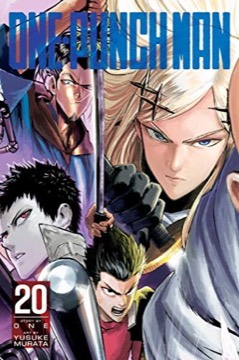
One-Punch Man
ONE and Yusuke Murata's series, begun as a webcomic in 2009, about a hero who defeats every opponent with a single blow and finds it boring. A satire of the action genre.
- First published
- 2012
- Publisher
- Editorial Ivrea
- Pages
- 204
- Shelf
- Anime
- Level
- Entry
- ISBN-13
- 9788418061387
Record checked against
Catalogue note
- Reads as
- ReflectiveChanges how you see rather than what you do.
- Level
- Accessible / FoundationalNo prior reading assumed.
- Approach
- Theoretical
- Written for
- Readers of comics, and anyone curious how the form works, Newcomers to the subject
Saved in this browser only — no account, nothing sent anywhere. My library
Read this if
- You read for the writing as much as for the argument.
- You want a book that changes how you see things rather than what you do tomorrow.
- You are starting from scratch here and want a way in that assumes no prior reading.
What it is
Saitama trained until he lost his hair and became strong enough to end any fight immediately. The result is not satisfaction but a profound boredom: no opponent can give him a contest, and nobody recognises what he has done.
He registers with a hero association, is ranked poorly because he fails the written examination, and spends the series as an unrecognised presence in other people's battles.
He wins every fight in one hit, and the only consequence is that nothing is interesting any more.
Devmark’s reading — not a quotation from the book
The joke, and its depth
The premise inverts the genre's fundamental mechanism: if escalating power is what action narratives are built on, a protagonist who has finished escalating cannot have a story.
The series solves this by making everyone else the story, and Saitama's irrelevance to his own narrative is the running structural joke.
Anticlimax as technique
Fights are built up at length with elaborate opponents, stakes and preparation, and then resolved in a panel.
The deflation is reliable and remains funny because the build-up is always sincere. The series commits fully to the tension it is about to discard. Murata also draws the build-up at maximum effort every time, which means the joke costs more to set up than almost any other gag in the medium.
Murata's drawing
The redrawn version is among the most technically spectacular action art in the medium, with enormous detail, extraordinary sense of scale, and choreography that rewards close reading.
The contrast between the drawing's seriousness and the plot's dismissal of it is much of the joke, and Murata is plainly in on it.
The original webcomic
ONE's own version, drawn crudely and still updating separately, is a distinct work with different pacing and considerably more emphasis on the comedy.
Many readers prefer it, and the two have diverged substantially. The webcomic is the purer expression of the idea and the redraw is the more impressive object.
Genos and the supporting cast
The cyborg who appoints himself Saitama's disciple, and the hero association's ranked roster, supply the emotional investment the protagonist cannot.
Several supporting heroes — particularly those who are weak and continue anyway — carry the series' actual argument about what heroism costs. Mumen Rider, a hero with no powers at all who continues to intervene anyway, is the clearest statement of that argument and the series' most admired character.
Recognition
Saitama's real problem is not boredom but obscurity: he saves people constantly and is credited with nothing, and the series takes this seriously.
The gap between what he does and what he is seen to do is the source of most of the genuinely affecting material, and it is handled without self-pity.
Bureaucracy
The hero association ranks, evaluates, publicises and monetises its members, and the series is consistently satirical about an institution that measures the wrong things.
Saitama's low rank despite his ability is the joke's engine, and the satire of performance metrics is sharper than the premise requires.
Pace of publication
Murata redraws at an irregular rate and frequently revises chapters after release, sometimes substantially.
The series is ongoing and the publication history is unusually messy, with several arcs existing in multiple versions. Readers approaching it now should be aware that chapter numbering has shifted more than once, and that several arcs exist in a revised form that supersedes the original release.
Compared to Mob Psycho
Both concern overwhelming power treated as uninteresting, and this is the more satirical while Mob Psycho is the more emotionally substantial.
Readers who want the idea at its funniest should read this; readers who want it developed into something about growing up should read the other.
The adaptation
The first animated season is widely regarded as exceptional, with fight animation of unusual quality; the second, made by a different studio, was less well received.
The first season is a reasonable entry point and captures the tone accurately. The first season also compresses the early volumes efficiently, so it covers a substantial portion of the material available at the time.
Who it is for
Readers who want a genuine satire of the action genre executed with complete technical commitment.
It is ongoing and messy, and the idea is fully legible from the first few volumes. Readers who want the joke without the commitment can read those and stop without loss.
What to take away
- 01A protagonist who has finished escalatingIf action narratives run on increasing power, a hero who has maxed out cannot have a story, and the series makes that the structure.
- 02Sincere build-up, discardedFights are constructed at full length and resolved in a panel, and the deflation stays funny because the tension is always genuine.
- 03Spectacular art against a dismissive plotMurata's drawing takes the fights entirely seriously, which is much of the joke and is plainly deliberate.
- 04Obscurity rather than boredomSaitama's real problem is that he is credited with nothing, and the series treats that seriously and without self-pity.
- 05Institutions measuring the wrong thingThe hero association's rankings and publicity make the satire of performance metrics sharper than the premise needed.
- 06Two versions, genuinely differentONE's crude webcomic and Murata's redraw have diverged substantially, and many readers prefer the original.