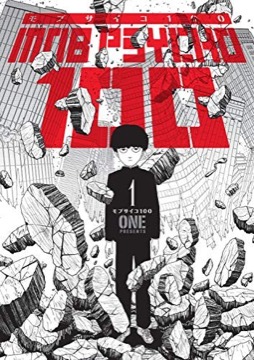
Mob Psycho 100
ONE's series, begun in 2012, about a middle-school boy with enormous psychic power who wants to be liked for something else. A comedy about the irrelevance of talent.
- First published
- 2012
- Publisher
- Ivrea
- Pages
- 200
- Shelf
- Anime
- Level
- Entry
- ISBN-13
- 9781506713694
Record checked against
Catalogue note
- Reads as
- ReflectiveChanges how you see rather than what you do.
- Level
- Accessible / FoundationalNo prior reading assumed.
- Approach
- Theoretical
- Written for
- Readers of comics, and anyone curious how the form works, Newcomers to the subject
Saved in this browser only — no account, nothing sent anywhere. My library
Read this if
- You read for the writing as much as for the argument.
- You want a book that changes how you see things rather than what you do tomorrow.
- You are starting from scratch here and want a way in that assumes no prior reading.
What it is
Shigeo Kageyama, called Mob, is an unremarkable middle-school student with psychic abilities of extraordinary scale. He works part-time for a fraudulent exorcist who has no powers at all and who charges for it.
Mob has concluded that his powers are not an achievement and wants instead to become someone people like, which he pursues through the body-improvement club.
The most powerful psychic alive, whose actual goal is to get slightly fitter and talk to a girl.
Devmark’s reading — not a quotation from the book
Power as irrelevant
The series' argument is that Mob's abilities are simply a fact about him, no more a virtue than height, and that the things worth having must be worked for.
It is delivered without sanctimony. Mob is not humble about his powers; he is genuinely indifferent to them, which is a considerably more interesting position.
Reigen
The fraudulent exorcist is a con man who charges for services he cannot perform, uses a child as free labour, and is also the only adult who treats Mob as a person rather than as a phenomenon.
He is the series' best creation. His advice is frequently good despite being improvised, and the eventual examination of what he has and has not done for Mob is the work's emotional peak.
Emotional pressure
Mob suppresses feeling constantly, and the title refers to a counter tracking his accumulating emotional state toward an explosion.
The device is a good one: his power is tied directly to feelings he refuses to have, so the plot mechanism and the character study are the same thing.
ONE's drawing
The art is famously crude — simple faces, minimal detail, a deliberate amateurishness — and it is used with genuine skill.
The simplicity makes the occasional fully rendered page land enormously, and ONE's page rhythm and comic timing are excellent regardless of the linework. The webcomic original is cruder still, and the published version represents ONE cleaning up his own work rather than a second artist redrawing it.
Comedy
It is consistently funny, largely through deadpan and through characters taking absurd situations seriously, and the humour never disappears even in the most dramatic arcs.
The comedy and the sincerity coexist without either undercutting the other, which is unusual and is central to why the series works.
The antagonists
Several are other psychics who have concluded that their abilities make them superior, and the series answers this argument repeatedly and substantively.
Mob's counter is not that he is stronger. It is that the premise is wrong, and the series is careful to have him demonstrate rather than assert it.
Structure
Sixteen volumes, complete, with distinct arcs and a genuine conclusion that resolves both the psychic plot and Mob's personal one.
The series knows what it is about and finishes when it has said it, which is rare in this section and worth noting. The final arc in particular resolves the emotional material rather than the psychic material, which is the correct choice and not the obvious one.
Growing up
The underlying subject is adolescence: wanting to be liked, being bad at talking to people, and the gradual discovery that the things you were given are not the things that matter.
It is handled with real tenderness, and Mob's small social victories are given more narrative weight than any of his psychic ones.
One Punch Man
ONE also created One-Punch Man, which shares the premise of overwhelming power treated as uninteresting and is considerably more satirical.
Readers who like one usually like the other, and this is generally considered the warmer and more emotionally substantial of the two. The two were serialised in overlapping periods, and ONE has written both continuously, which is a considerable output for one author.
The adaptation
The animated series is visually extraordinary, with a level of experimental animation unusual for television, and is widely regarded as one of the best adaptations in the medium.
It is a reasonable entry point and is in several respects more impressive than the source, which is not something that can often be said.
Who it is for
Readers who want comedy with genuine emotional substance, and who are not put off by deliberately unpolished art.
It is complete, relatively short, and among the most good-natured things in this section. It requires no familiarity with the medium at all. It is also one of the few series in this section that can be finished in a weekend, which matters for readers testing whether the medium suits them.
What to take away
- 01Talent treated as a fact, not a virtueMob's power is no more an achievement than his height, and he is indifferent to it rather than humble about it.
- 02Plot mechanism and character study identicalHis power is tied to the feelings he refuses to have, so the escalation counter is also the psychological arc.
- 03A con man who is also the only adult presentReigen exploits Mob and is the only person treating him as a person, and the series examines both honestly.
- 04Crudity used deliberatelyThe simple art makes occasional full rendering land enormously, and the timing is excellent regardless of linework.
- 05An argument demonstrated, not assertedPsychic antagonists claim superiority, and Mob's answer is to show the premise is wrong rather than to out-fight them.
- 06Small victories weighted heavilySocial progress is given more narrative weight than any psychic confrontation in the series.