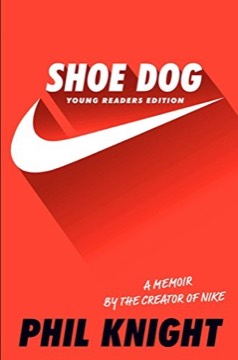
Shoe Dog
A Memoir by the Creator of Nike
Phil Knight's memoir of the founding and near-constant financial peril of the company that became Nike — written decades later, and unusually willing to describe the parts of company-building that founder accounts normally omit.
- First published
- 2016
- Publisher
- Simon & Schuster (UK)Scribner (US)
- Pages
- 386
- Shelf
- Business
- Level
- Entry
- ISBN-13
- 9788466363914
Record checked against
Two sources agreed on 2016; a third reported differently (openlibrary 2014, wikidata 2016, wikipedia 2016).
Catalogue note
- Reads as
- ReflectiveChanges how you see rather than what you do.
- Level
- Accessible / FoundationalNo prior reading assumed.
- Approach
- Theoretical
- Written for
- Founders and operators, Newcomers to the subject
Saved in this browser only — no account, nothing sent anywhere. My library
Read this if
- You are starting or growing a company and want the unglamorous parts.
- You want a life told honestly, at full length.
- You read for the writing as much as for the argument.
- You want a book that changes how you see things rather than what you do tomorrow.
- You are starting from scratch here and want a way in that assumes no prior reading.
What kind of memoir this is
It covers roughly 1962 to 1980, from Knight's idea of importing Japanese running shoes to the company going public, and then stops. The decades of global dominance that made Nike famous are handled in a brief closing chapter.
That choice is what makes the book good. It is an account of the period when the outcome was genuinely uncertain, written by someone who no longer needs it to have been inevitable.
It stops at the IPO. The famous decades are a closing chapter, because they are not the interesting part.
Devmark’s reading — not a quotation from the book
The Crazy Idea, and the structure of the business
Knight's original plan was to import Onitsuka Tiger running shoes from Japan and sell them in the United States, a business he began by describing himself to a Japanese manufacturer as the representative of a company that did not exist.
The resulting arrangement — a distributor with no product of its own, dependent on a supplier who could terminate at will — is the structural tension of the entire first half, and Knight is clear that he understood the vulnerability and could not escape it for years.
Growth as a financial emergency
The book's most valuable and least glamorous thread is that Blue Ribbon was nearly insolvent almost continuously, precisely because it grew fast.
Every doubling of sales required financing inventory before revenue arrived, which meant a constant fight for credit. Knight describes bank relationships, a bank calling in loans, and an episode with federal customs authorities that could have ended the company. This is the part of company-building that most founder memoirs skip entirely.
The people
Knight devotes substantial space to the early employees, several of them eccentric, difficult or, in his telling, barely employable elsewhere — and to Bill Bowerman, his former coach and co-founder, drawn with real ambivalence.
He is notably generous about others and hard on himself, which is unusual in the genre and is a large part of why the book reads as credible.
What he is honest about
Knight writes about being a poor communicator, an absent father, and about the cost of the company to his family — including an account of personal loss that arrives without warning and is handled without any attempt to make it meaningful.
He also declines to present his decisions as strategy. Several of the moves that mattered most are described as improvised responses to a crisis, which is a rare and useful corrective to the retrospective coherence of most business narrative.
What he is not honest about
This should be stated. The book gives very little space to the labour controversies that surrounded Nike's overseas manufacturing from the 1990s, which fall outside its timeframe but are the most significant criticism the company has faced.
There are also episodes — the handling of the Onitsuka relationship in particular — where Knight's account is self-serving and a reader should notice that only one side is being presented.
The timeframe ends conveniently before the criticism that defined the company's public reputation.
Devmark’s reading — not a quotation from the book
As a business book
It is not one, and does not try to be. There is no framework, no extractable method, and Knight explicitly declines to offer advice.
What it does supply is texture: what cash-flow pressure actually feels like, how supplier dependence constrains every decision, and how long a company can exist without anyone outside it noticing. Those are difficult to convey any other way.
The writing
Knight worked on it for years and the craft shows. The prose is considerably better than the genre's norm, the pacing is controlled, and the recurring device of the running metaphor is used with restraint.
It was also substantially shaped in the editing, and readers should understand it as a constructed narrative rather than a record — the selection of what to include is doing a great deal of work.
Where it sits
It is probably the best-written founder memoir in general circulation, and the most useful specifically because it refuses the shape the genre usually takes.
Read alongside something like Horowitz for the management dimension Knight does not address, and alongside external reporting on Nike for the period the book chooses not to cover.
What to take from it
Mostly an emotional calibration rather than a lesson: that a company which later looks inevitable was, for its first fifteen years, one bad quarter from ending, and that its founder did not know how it would turn out.
The practical residue is the financing observation — that growth consumes cash and that a profitable, growing business can fail for want of working capital, which remains one of the most under-appreciated facts in entrepreneurship.
What to take away
- 01Growth consumes cashA profitable, fast-growing business can fail for want of working capital, and nearly did here repeatedly.
- 02Supplier dependence constrains everythingA distributor with no product of its own negotiates from a position it cannot improve.
- 03Most decisions were improvisedKnight declines to retrofit strategy onto responses that were made in a crisis.
- 04It ends before the criticismThe timeframe excludes the labour controversies that shaped the company's public reputation.
- 05Read it for texture, not methodThere is no framework here. What it conveys is what uncertainty at that scale actually felt like.