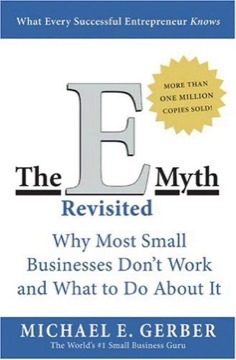
The E-Myth Revisited
why most small businesses don't work and what to do about it
Michael Gerber's argument that most small businesses are started by skilled technicians who mistakenly assume that being good at the work qualifies them to run a business doing that work — and that the resulting job is worse than the one they left.
- First published
- 1995
- Publisher
- HarperCollins
- Pages
- 268
- Shelf
- Business
- Level
- Entry
- ISBN-13
- 9780060574901
Record checked against
Only one source carried a publication date for this work, so the year is uncorroborated.
Catalogue note
- Reads as
- ConceptualExplains how something works before what to do about it.
- Level
- Accessible / FoundationalNo prior reading assumed.
- Approach
- Theoretical
- Written for
- Founders and operators, Newcomers to the subject
Saved in this browser only — no account, nothing sent anywhere. My library
Read this if
- You are starting or growing a company and want the unglamorous parts.
- You keep fixing symptoms and want to see the structure producing them.
- You want to understand how it works before deciding what to do about it.
- You are starting from scratch here and want a way in that assumes no prior reading.
The entrepreneurial myth
The myth of the title is that small businesses are started by entrepreneurs. Gerber's contention is that most are started by technicians — a baker, a plumber, a designer — who had what he calls an entrepreneurial seizure and assumed that doing the work well was the hard part.
The consequence is that they have not built a business; they have bought themselves a job with worse hours, more risk and a boss who is harder to please.
Understanding the technical work of a business and understanding a business that does that work are different skills.
Devmark’s reading — not a quotation from the book
Technician, Manager, Entrepreneur
Gerber's model of the three personalities inside every owner. The Entrepreneur lives in the future and sees opportunity. The Manager lives in the past and wants order and predictability. The Technician lives in the present and wants to do the work.
His claim is that the typical small-business owner is roughly 70 per cent Technician, and that the imbalance explains why the business cannot grow past the owner's own capacity.
Infancy, adolescence and maturity
His developmental model. In infancy the business *is* the owner. Adolescence begins when the owner hires help, and the characteristic crisis is management by abdication — handing work over without a system and then discovering it is not being done the way it was.
Most businesses, in his account, respond by shrinking back to infancy or pushing into chaos. Maturity is the state of a business that was designed from the start to operate without the founder.
Work on it, not in it
The book's most quoted instruction and its central discipline. The owner's job is to build the business as a product, not to perform the business's work.
Gerber is clear this does not mean the owner stops doing the work immediately, only that time must be deliberately protected for building systems, and that no amount of working harder inside the business substitutes for it.
The franchise prototype
His organising device: build the business as though it were the prototype for ten thousand more, whether or not you intend to franchise it.
The test this imposes is specific — the business must be able to run without you, must give consistent results, must be operated by people with the lowest possible level of skill, and must be documented in an operations manual. It is a demanding standard and it is the book's real content.
Build it as if it were the prototype for ten thousand. Then the question 'could someone else run this?' has an answer.
Devmark’s reading — not a quotation from the book
Systems over people
Gerber's position is that the ordinary response to inconsistent results — hire better people — is the expensive one, and that a well-designed system produces consistent results from ordinary people.
This is the argument readers most often resist, and it is worth noting it applies most cleanly to work that is genuinely repeatable. Gerber does not much distinguish businesses whose value comes from judgement.
The business development process
His operational loop: innovation, quantification, orchestration. Innovation is the search for a better way to do something; quantification is measuring whether it worked; orchestration is eliminating the discretion once it has.
The quantification step is the one most owners skip, and Gerber's insistence that an untested change is not an improvement is the most transferable piece of method in the book.
Your primary aim
Before the business plan, Gerber asks for a personal one: what do you want your life to look like, and what would the business have to do to serve it?
This reframes the whole exercise. The business is a means, and a business that consumes the life it was meant to support has failed even if it is profitable — which is the book's real emotional argument.
Where it is limited
It is repetitive, the fictional Sarah-and-her-pie-shop framing wears thin, and the tone is evangelical. The core argument is delivered early and then restated at length.
Substantively, the systems-over-people prescription fits repeatable service businesses far better than it fits professional practices, creative work, or anything where the value is the judgement being exercised. Gerber treats his model as universal when it is not.
Why it still sells
Because the diagnosis lands. The specific misery it describes — a person who was good at something, started a business doing it, and now cannot take a week off — is extremely common and rarely named that precisely.
Its durable instruction is the franchise-prototype test. Asking "could a competent stranger run this from the documentation?" exposes more about a small business in an hour than any financial review.
What to take away
- 01Skill at the work is not the qualificationDoing the work and running a business that does the work are different jobs with different failure modes.
- 02You may have bought a jobWorse hours, more risk, and a boss harder to satisfy than the one you left.
- 03Build the prototypeDesign it as though ten thousand copies will follow, and the question of whether it can run without you gets answered.
- 04Quantify before you orchestrateAn untested change is not an improvement; measuring is the step owners skip.
- 05Start from the life, not the businessA profitable business that consumes the life it was meant to serve has still failed.