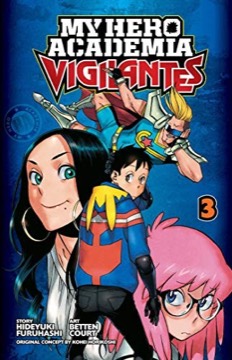
My Hero Academia
Kohei Horikoshi's series, begun in 2014, set in a world where most people have superpowers, following a boy born without one who wants to be a hero anyway.
- First published
- 2014
- Publisher
- VIZ Media LLC
- Pages
- 216
- Shelf
- Anime
- Level
- Entry
- ISBN-13
- 9781974710669
Record checked against
Catalogue note
- Reads as
- ReflectiveChanges how you see rather than what you do.
- Level
- Accessible / FoundationalNo prior reading assumed.
- Approach
- Theoretical
- Written for
- Readers of comics, and anyone curious how the form works, Newcomers to the subject
Saved in this browser only — no account, nothing sent anywhere. My library
Read this if
- You read for the writing as much as for the argument.
- You want to think harder about what is actually right.
- You want a book that changes how you see things rather than what you do tomorrow.
- You are starting from scratch here and want a way in that assumes no prior reading.
What it is
In a society where roughly eighty per cent of people have a Quirk, Izuku Midoriya has none, and is therefore excluded from the profession he has studied obsessively since childhood.
The most celebrated hero alive chooses him as a successor and transfers a transmissible Quirk to him, and the series follows his training at a hero academy.
He has studied the profession his whole life and is constitutionally barred from it.
Devmark’s reading — not a quotation from the book
Heroism as a profession
The series' best idea is that heroes are licensed, ranked, salaried and commercially sponsored, with agencies, internships and public approval ratings.
Treating the superhero as a job with an industry around it generates most of the world-building, and it lets the series ask what happens to people whose Quirks are not commercially useful.
Quirks and society
Powers are hereditary, unevenly distributed and socially stratifying, and several antagonists are produced directly by discrimination against people with unpleasant or frightening abilities.
The series is genuinely interested in this and develops it substantially, particularly through the villain organisation, whose members are consistently given comprehensible origins.
Midoriya
He is analytical rather than naturally gifted, keeps detailed notebooks on other people's abilities, and wins primarily through preparation and an almost self-destructive willingness to be injured.
The injuries are treated as real and cumulative, which distinguishes him from most protagonists in the format. His notebooks are a nice piece of characterisation: he was studying a profession that had already excluded him, and kept doing it anyway.
Bakugo
His childhood friend and rival is aggressive, contemptuous and initially close to a bully, and the series spends its full length on his slow and genuinely difficult reform.
It is the most carefully handled relationship in the work, and the refusal to resolve it quickly is a large part of why it works.
The school structure
Much of the series is organised around examinations, sports festivals, internships and licensing tests, which supplies a natural rhythm and clear stakes.
The academic frame also allows a large supporting cast to be developed efficiently, since classmates can be given individual arcs without leaving the setting.
Western comics influence
Horikoshi's design sense draws openly on American superhero comics, and All Might in particular is a deliberate synthesis of Superman-style iconography with Japanese serial structure.
The hybrid is the series' commercial insight: a familiar Western genre delivered with the pacing and ensemble focus of weekly shōnen.
The art
Clean, energetic and strongly designed, with a distinctive approach to costume and an unusual willingness to draw genuine physical damage.
The action is generally legible, though the later large-scale battles become crowded and harder to follow. Horikoshi's costume design in particular is exceptional, and the class's individual suits are each legible as a solution to that character's specific ability.
Later arcs
The final war arcs are substantially darker, with heavy casualties and a society that turns against the profession it had depended on.
Opinion on the ending is mixed, with a common criticism that several long-developed antagonists are resolved more quickly than their setup warranted. The scale also becomes a problem, since a cast this large cannot all be served in a conflict of that size.
The villains
The League of Villains are among the series' strongest material, particularly Shigaraki, whose origin is among the bleakest things in mainstream shōnen.
The series argues consistently that the hero system produces the people who attack it, and it does not retreat from that when it becomes uncomfortable.
Its position
It was the dominant new property in its magazine for most of the 2010s and carried a large international audience, with a long-running animated adaptation and several films.
It is complete, which makes it an easier recommendation than several of its contemporaries. Its ending arrived after roughly a decade of serialisation, which is a long run to sustain at a weekly schedule.
Who it is for
Readers who like superhero fiction and want it with an ensemble structure and a genuine interest in the institutions around it.
It is long but consistently paced, and its school setting makes it approachable for readers who find the more apocalyptic series in this section unappealing.
What to take away
- 01Heroism as a licensed industryAgencies, rankings, sponsorship and approval ratings generate most of the world-building and most of the good questions.
- 02Powers that stratifyQuirks are hereditary and unevenly distributed, and several antagonists are produced directly by discrimination.
- 03Preparation over talentMidoriya wins by study, notebooks and a willingness to be injured, and the injuries accumulate rather than resetting.
- 04A rival reformed slowlyBakugo's change takes the full length of the series, and the refusal to resolve it quickly is why it works.
- 05The system creates its attackersThe series argues consistently that the hero industry produces the villains who assault it, and does not retreat from that.
- 06A deliberate hybridAmerican superhero iconography delivered with the ensemble focus and pacing of weekly shōnen.