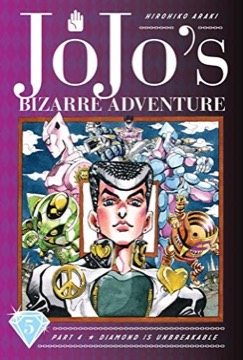
JoJo's Bizarre Adventure
Hirohiko Araki's series, begun in 1987, following successive generations of one family across changing genres and eras. Famous for its fashion sense and its combat logic.
- First published
- 1987
- Publisher
- VIZ Media LLC
- Pages
- 394
- Shelf
- Anime
- Level
- Core
- ISBN-13
- 9781974708093
Record checked against
Catalogue note
- Reads as
- ReflectiveChanges how you see rather than what you do.
- Level
- Core / BuildingAssumes general familiarity with the subject.
- Approach
- Theoretical
- Written for
- Readers of comics, and anyone curious how the form works, Readers with some grounding
Saved in this browser only — no account, nothing sent anywhere. My library
Read this if
- You read for the writing as much as for the argument.
- You care why some things are obvious to use and others are not.
- You want a book that changes how you see things rather than what you do tomorrow.
- You know roughly how the subject works and want the fuller account.
What it is
The series is divided into parts, each following a different member of the Joestar family in a different period and location: Victorian England, 1930s America, a journey across Asia, a Japanese suburb, an Italian crime family, a Florida prison.
Each part has its own protagonist, antagonist and genre, connected by bloodline and by a recurring supernatural conflict.
Nine parts, nine protagonists, nine genres, one family.
Devmark’s reading — not a quotation from the book
Stands
From the third part onward, characters manifest a personified ability called a Stand — a projected figure with a specific, often bizarre power and strict limits.
The invention is the series' major contribution. Stand powers are rarely about raw force; they are conditional, weird and frequently useless outside one narrow application, which forces every fight to be solved rather than won.
Combat as puzzle
A typical confrontation involves working out what an opponent's ability actually does, under what conditions, and how its limitation can be turned against it.
Araki plays fair. The rules are stated before they are exploited, and the solutions are frequently ingenious in a way that has more in common with a locked-room mystery than with an action serial.
The fashion
Araki draws clothing with obsessive attention, drawing directly on runway fashion, and characters change outfits constantly for no plot reason.
The visual sensibility — extreme poses, unusual colour, an interest in the body as sculpture — is distinctive enough that the series has influenced fashion illustration in return.
Poses and physicality
The figures adopt contorted, weight-defying postures borrowed from classical sculpture and fashion photography, and these have become one of the most recognisable visual signatures in the medium.
They are not naturalistic and are not meant to be. The series treats the body as a design element rather than as an anatomical fact.
Tonal register
It is simultaneously extremely serious and extremely silly, with grotesque violence, melodramatic declarations, elaborate wordplay and jokes that run for entire volumes.
The combination is unstable by design and is the main thing that decides whether a reader gets on with it. There is no ironic distance; the series means all of it.
Music references
Characters, Stands and locations are named after Western musicians, songs and albums with almost no attempt at disguise, which has caused persistent licensing difficulties for adaptations.
The habit is characteristic of Araki's magpie approach, which also takes freely from horror cinema, Renaissance painting and pulp adventure.
Part variation
The parts differ enormously in quality and in kind. The first is a straightforward Victorian horror pastiche; the fourth is a suburban murder mystery; the fifth is a crime story; the seventh is a Western set in an alternate continuity.
Readers commonly start at part three or part four rather than at the beginning, and the series supports that better than most long works.
Women in the series
The earlier parts treat female characters poorly, and the sixth part responds directly by making a woman the protagonist and giving the supporting cast genuine weight.
The improvement is real and uneven. Araki has discussed changing his approach deliberately, and the later parts are noticeably better on this.
The art's evolution
The drawing changes radically across the run, from heavy musculature in the early parts to slender, elongated figures later, and the linework becomes progressively cleaner.
Few long-running series change this visibly. Readers who dislike the early style should know it does not persist. The colour work changes just as much, and Araki's palettes in the later parts are among the most distinctive in the medium.
Adaptations and reach
A well-regarded animated series has adapted the parts in sequence since 2012 and is responsible for much of the series' international audience, though music-licensing issues force name changes throughout.
The manga remains the fuller version, particularly for the puzzle fights, where the animation's pacing sometimes obscures the reasoning.
Who it is for
Readers who want invention over consistency, and who can accept a work that is simultaneously ridiculous and completely sincere.
It is long but genuinely modular. A reader can begin at part four, enjoy a complete suburban mystery in eighteen volumes, and decide from there whether the rest is worth the commitment.
What to take away
- 01Conditional powers force ingenuityStand abilities are narrow, weird and strictly limited, so every fight must be solved rather than out-muscled.
- 02Fights played fairRules are stated before they are exploited, which puts the confrontations closer to locked-room mysteries than to action.
- 03The body as designContorted poses borrowed from sculpture and fashion photography treat anatomy as a stylistic element rather than a constraint.
- 04Serious and silly at onceGrotesque violence sits beside sustained jokes with no ironic distance, and that instability decides most readers' response.
- 05Modularity as structureEach part has its own protagonist, era and genre, so readers can begin almost anywhere.
- 06Visible evolutionThe drawing changes radically across decades, from heavy musculature to elongated figures, more than almost any comparable series.