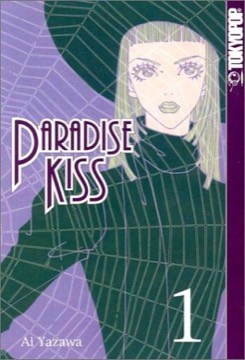
Paradise Kiss
Ai Yazawa's series, begun in 1999, in which a studious high-school student is recruited as a model by a group of fashion-school students. A short, sharp book about ambition.
- First published
- 1999
- Publisher
- not established
- Pages
- not established
- Shelf
- Anime
- Level
- Entry
- ISBN-13
- not established
Record checked against
No page count is recorded, so no reading estimate is shown for the book itself.
Catalogue note
- Reads as
- ReflectiveChanges how you see rather than what you do.
- Level
- Accessible / FoundationalNo prior reading assumed.
- Approach
- Theoretical
- Written for
- Readers of comics, and anyone curious how the form works, Newcomers to the subject
Saved in this browser only — no account, nothing sent anywhere. My library
Read this if
- You read for the writing as much as for the argument.
- You care why some things are obvious to use and others are not.
- You want a book that changes how you see things rather than what you do tomorrow.
- You are starting from scratch here and want a way in that assumes no prior reading.
What it is
Yukari Hayasaka is a diligent, unhappy student on an academic track she has never chosen. She is approached by students from a fashion vocational school who need a model for their graduation show.
Over five volumes she becomes involved with their studio, with its designer George, and with the question of what she actually wants.
A model student who has never once been asked what she would like to do.
Devmark’s reading — not a quotation from the book
Length and discipline
Five volumes, which is unusually short, and the series is correspondingly tight: no filler, no digressions, and a clear arc for each of the central characters.
Yazawa's control here is considerably firmer than in her longer work, and the brevity is a substantial part of why it is admired.
George
The designer is charismatic, controlling, honest about his own limitations and largely uninterested in being good to anyone.
He is written as genuinely attractive and genuinely bad for Yukari at the same time, and the series never resolves that into a lesson about recognising red flags.
Vocation
The book's actual subject is work: what it means to choose a craft, to be mediocre at something you love, and to discover an ambition late.
Each of the studio's members has a different relationship to their own talent, and the series is unsentimental about the fact that wanting something is not the same as being able to do it.
Yukari's arc
She moves from a life organised entirely by her mother's expectations to one she has chosen, and the series is careful that this is frightening rather than liberating.
Her eventual decision is not the romantic one, and the ending's refusal of that has been much discussed.
Fashion
The clothes are drawn with real expertise and the design process is shown step by step — pattern, fitting, fabric, the show itself.
Yazawa's own fashion training is more visible here than anywhere else in her work, and the garments function as plot rather than as ornament.
The art
Sharp, graphic and heavily patterned, with an extremely strong sense of layout and a willingness to use full pages for a single image.
It is her most visually assured work, and several sequences are closer to poster design than to comics. The series was serialised in a fashion magazine, and the page design reflects that audience: it is meant to be looked at as much as read.
Sex and adulthood
The series treats its characters as adults making adult decisions, including about sex, and does not punish anyone for it.
The register is notably more mature than the high-school setting would suggest, and the series is honest that Yukari is out of her depth without treating that as a moral failure.
The ending
It concludes with a substantial time skip that shows the consequences of everyone's choices years later, including several that did not work out.
The epilogue is what elevates the book. It insists on the long view and refuses to let the intensity of the central period stand as the whole story.
Relation to Nana
Several characters appear in both series, and Paradise Kiss was serialised in a fashion magazine rather than a manga magazine, which shaped its audience and its register.
Readers who admire Nana but are deterred by its length and its suspension are usually directed here, and the recommendation is sound.
Adaptations
A twelve-episode animated series and a live-action film both exist and both follow the plot closely while softening George considerably.
The manga's version of him is harder and the ending is colder, which is substantially the point. Both adaptations also compress the epilogue, which is where the manga does its most important work and is the reason to read the original.
Who it is for
Readers who want a short, complete, adult book about ambition and unsuitable relationships, drawn beautifully.
It is one of the easiest recommendations in this section: five volumes, finished, entirely self-contained, and the best available demonstration of what josei manga can do. Readers arriving from Nana will find it tighter and considerably less punishing, and readers new to Yazawa should probably begin here.
What to take away
- 01Brevity as disciplineFive volumes with no filler and a clear arc for every central character, tighter than anything else Yazawa wrote.
- 02Attractive and bad, simultaneouslyGeorge is written as genuinely compelling and genuinely harmful, and the series declines to turn this into a lesson.
- 03Vocation as the real subjectWhat it means to choose a craft, to be mediocre at something you love, and to find an ambition late.
- 04Choice framed as frighteningYukari's move away from her mother's plan is written as terrifying rather than as liberation.
- 05The long view insisted onA time-skip epilogue shows the consequences years later and refuses to let the intense central period stand as the whole story.
- 06Garments as plotPattern, fitting and fabric are shown step by step, and the clothes carry narrative weight rather than decorating it.