Golden Kamuy
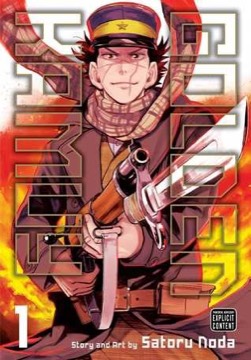
Satoru Noda's series, begun in 2014, about a Russo-Japanese War veteran and an Ainu girl searching for hidden gold in Hokkaido. Historical adventure with substantial ethnographic research.
- First published
- 2014
- Publisher
- not established
- Pages
- not established
- Shelf
- Anime
- Level
- Core
- ISBN-13
- 9781421594880
Record checked against
No page count is recorded, so no reading estimate is shown for the book itself.
Catalogue note
- Reads as
- ReflectiveChanges how you see rather than what you do.
- Level
- Core / BuildingAssumes general familiarity with the subject.
- Approach
- Theoretical
- Written for
- Readers of comics, and anyone curious how the form works, Readers with some grounding
Saved in this browser only — no account, nothing sent anywhere. My library
Read this if
- You read for the writing as much as for the argument.
- You want to know how we got here.
- You want a book that changes how you see things rather than what you do tomorrow.
- You know roughly how the subject works and want the fuller account.
What it is
Saichi Sugimoto, a decorated and traumatised veteran, learns of a cache of gold stolen from the Ainu and hidden by a man who tattooed a map across the skins of twenty-four prison escapees.
He partners with Asirpa, a young Ainu hunter whose father was among the murdered, and they compete for the tattooed skins against an army division and a surviving shogunate loyalist.
A treasure map tattooed across twenty-four convicts, and three parties collecting them.
Devmark’s reading — not a quotation from the book
Ainu culture
The series' most substantial achievement is its depiction of Ainu life: language, hunting practice, food preparation, spiritual belief, clothing and the effects of Japanese colonisation.
Noda consulted an Ainu language scholar throughout, and the material is integrated into the adventure rather than presented as background. For many Japanese readers it was a first substantial encounter with the culture.
Food
Cooking and eating occupy an enormous proportion of the page count, particularly Ainu preparations of game, and the series treats each meal as an event.
The food scenes are a genuine pleasure and are also how the ethnography is delivered: a reader learns the culture by watching what is made and how it is shared.
Tone
It moves between brutal violence, historical drama and sustained absurd comedy, frequently within a chapter, and several recurring gags run for volumes.
The tonal range is extreme and is the series' defining quality. Readers who cannot accept a torture sequence followed immediately by a joke about a mushroom will struggle.
The antagonists
Lieutenant Tsurumi and Toshizo Hijikata are both given coherent political projects, substantial charisma and genuine followings, and neither is simply an obstacle.
The competing parties all want the gold for reasons connected to the period's actual politics, which gives the treasure hunt a historical seriousness it would not otherwise have.
Violence
It is graphic and frequent, including torture, mutilation and detailed hunting sequences, and the series does not treat killing as clean.
Sugimoto's wartime trauma is a constant, and his capacity for violence is presented as damage rather than as competence. The hunting sequences in particular are drawn with the same unflinching attention as the combat, and the series makes no distinction between the two in how it looks at a body.
Asirpa
She is twelve or thereabouts, entirely competent in her own environment, and the series lets her be the authority in every situation involving the land.
Her relationship with Sugimoto is the emotional centre, and the series is careful that she is never simply a guide to her own culture for his benefit.
The art
Noda's drawing is detailed and functional, exceptionally good at animals, weapons, period clothing and snow, and less concerned with visual beauty than with accuracy.
The hunting and butchery sequences are drawn with a precision that makes the ethnographic material convincing. Noda's snow in particular is worth noting, since a substantial portion of the series takes place in it and the drawing never lets it become a blank background.
Structure
Thirty-one volumes, with a plot that accumulates characters continuously and several long digressions that appear irrelevant and are not.
The series is unusually good at making a minor character introduced for a joke turn out to matter considerably later. Noda has said he planned the ending early, and the density of foreshadowing across the middle volumes supports that account.
The ending
It concludes the treasure plot and the political material, and the final arc is large, fast and somewhat compressed relative to the leisurely middle.
Opinion on the ending is mixed, with the most common complaint being that several characters are resolved more quickly than their development warranted.
Its reception
It won the Tezuka Osamu Cultural Prize and has been credited with a significant increase in public interest in Ainu culture in Japan.
Ainu commentators have generally responded positively while noting that a single popular work carries more attention than it should have to. The series also prompted a museum exhibition and collaborations with Ainu cultural institutions, which is an unusual afterlife for an adventure comic.
Who it is for
Readers who want historical adventure with genuine research, and who can accept extreme tonal swings and graphic content.
It is complete, long, and among the most distinctive things in this section. Readers who want consistency of tone will find it actively uninterested in providing any.
What to take away
- 01Ethnography inside an adventureAinu language, hunting and belief are integrated into the plot rather than presented as background material.
- 02Food as the teaching methodThe culture is conveyed by watching meals prepared and shared, which is why the cooking occupies so much space.
- 03Antagonists with political projectsBoth rival parties want the gold for reasons rooted in the period's actual politics, not merely for wealth.
- 04Violence as damageSugimoto's capacity for killing is presented as wartime injury rather than as competence to be admired.
- 05Authority where it belongsAsirpa is the expert in every situation involving the land, and is never merely a guide to her own culture.
- 06Jokes that turn out to matterMinor characters introduced for comic purposes repeatedly prove significant many volumes later.